How Gas Prices Affect Ceramic Tile Prices
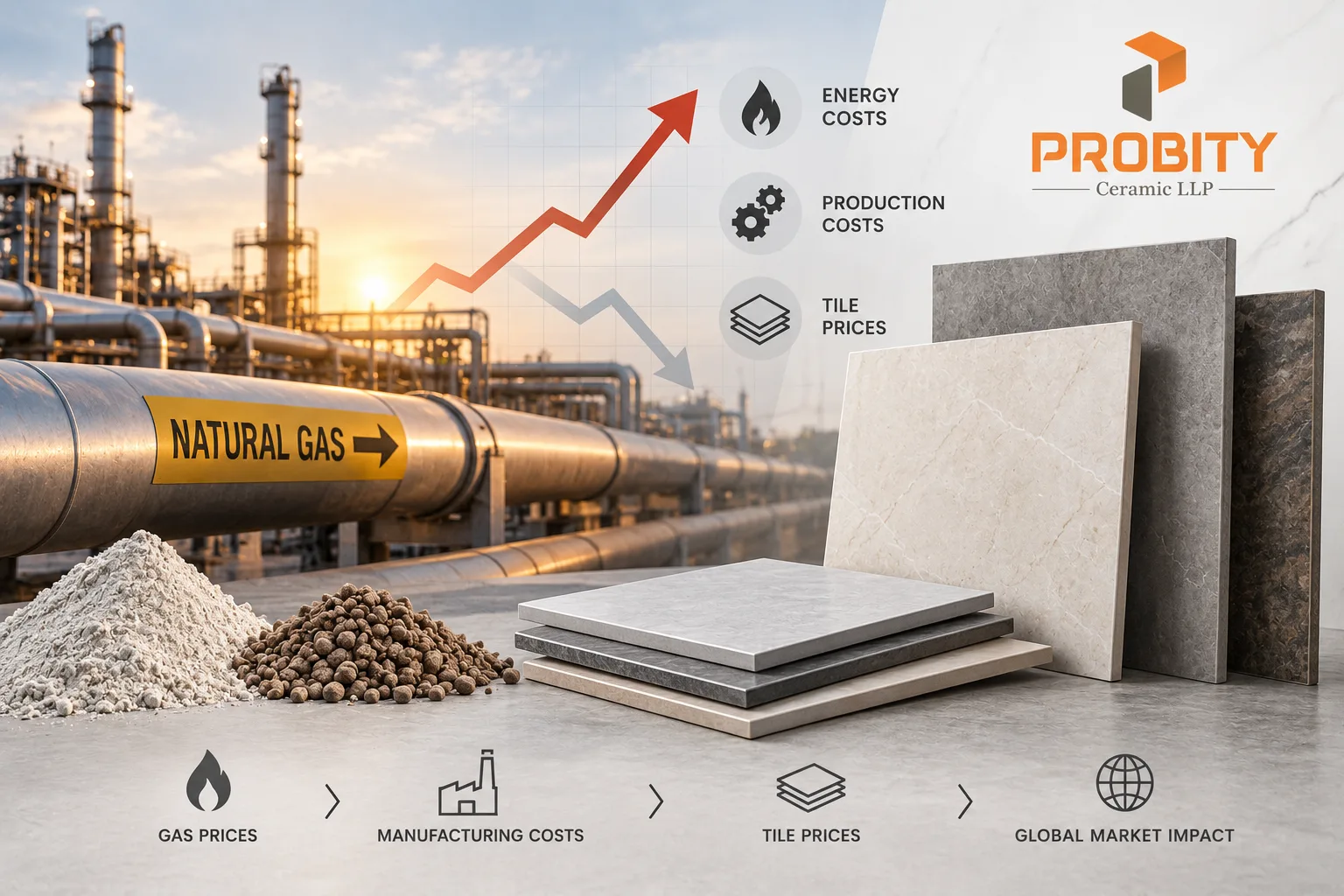
Ask most tile buyers what drives pricing and they'll mention raw material costs, labour, or freight. Few immediately think of natural gas yet energy, and gas specifically, is one of the largest and most volatile cost components in ceramic tile manufacturing. A sustained spike in gas prices can move tile FOB pricing more than almost any other single input, and it often does so with little warning.
For importers and distributors managing quotes, contracts, and customer pricing, understanding this relationship isn't optional background knowledge — it's a practical tool for anticipating price movement, asking better questions of suppliers, and protecting margin. This guide explains exactly how gas prices flow through to tile pricing, and what buyers can do about it.
1. Why Natural Gas Matters So Much in Ceramic Tile Manufacturing
Ceramic and porcelain tile production is an energy-intensive process, and natural gas is typically the primary fuel source at two critical stages:
• Spray drying: Raw material slurry is dried into a fine powder before pressing, a process that runs continuously and consumes substantial gas volume
• Kiln firing: Tiles are fired at temperatures typically above 1200°C to achieve full vitrification, and this firing stage alone can account for the largest single share of a factory's energy consumption
Because these stages can't be skipped or meaningfully shortened without compromising tile quality, gas isn't a cost manufacturers can easily reduce through operational choices alone - it's a structural requirement of the production process itself, which is exactly why gas price volatility translates so directly into tile cost volatility.
2. How Gas Price Increases Flow Through to Tile Pricing
Energy typically represents a significant share of a ceramic tile manufacturer's total production cost, commonly cited across the industry as one of the largest cost line items after raw materials. When gas prices rise:
• Per-unit production cost increases immediately for every tile fired from that point forward
• Manufacturers operating on thin margins have limited ability to absorb the increase without passing some portion through to FOB pricing
• The size of the pass-through varies by manufacturer, depending on their energy efficiency, contract structure, and how much margin buffer they were operating with beforehand
Unlike freight, which is a visible, separately quoted line item, energy cost increases are usually absorbed into the base product price - making them harder for buyers to identify and negotiate around unless they ask directly.
3. Regional Gas Price Differences and Global Tile Sourcing
Gas pricing varies significantly by region, and this has become an increasingly important factor in global tile sourcing decisions. Manufacturing regions with access to more stable or lower-cost gas supply whether through domestic production, pipeline infrastructure, or long-term supply contracts can maintain more competitive and predictable pricing than regions more exposed to spot-market volatility or import-dependent gas supply.
This is one of the underlying reasons certain manufacturing hubs have maintained strong cost competitiveness over time, while others have seen tile pricing become considerably more volatile during periods of global energy market disruption.
4. The Timing Lag Between Gas Prices and Tile Prices
Tile pricing doesn't move in perfect sync with gas markets, there's usually a lag, for a few practical reasons:
• Manufacturers often hold existing quotes for a defined validity period, delaying when a gas cost increase reaches new orders
• Some manufacturers hedge or contract gas supply in advance, temporarily insulating them from short-term spot price swings
• Competitive pressure can lead manufacturers to absorb gas cost increases for a period before adjusting prices, particularly if they expect the spike to be temporary
This lag means importers may not see the impact of a gas price spike in their quotes for several weeks or months, which also means a sudden price increase on a stable order may be a delayed reaction to an energy cost shift that occurred earlier, not an opportunistic increase.
5. How Manufacturers Respond to Rising Energy Costs
Not every manufacturer responds to gas price increases the same way. The manufacturers best positioned to protect their buyers from sharp price swings are typically the ones investing in:
• Energy-efficient kiln and dryer technology that reduces gas consumption per unit of tile produced
• Heat recovery systems that capture and reuse waste heat from firing processes
• Diversified or long-term gas supply contracts that reduce exposure to short-term spot price spikes
• Exploring alternative or supplementary fuel sources where regionally feasible
Importers evaluating manufacturing partners can reasonably ask about these investments directly, a manufacturer actively managing energy efficiency is generally better positioned to offer price stability than one operating older, less efficient equipment.
6. What This Means for Importers: Practical Implications
• Quoted FOB prices can shift between quotation and order confirmation if a significant gas price movement occurs in between
• Fixed-price contracts with end customers carry real exposure if the underlying tile cost moves before the order is placed with the manufacturer
• Manufacturers in regions with more stable or lower energy costs may offer more predictable long-term pricing, even if not always the lowest headline price
• Energy cost increases, unlike freight, are rarely itemised separately so importers often only see the effect as a general price increase without a clear explanation
7. Strategies for Managing Gas-Driven Price Volatility
• Ask manufacturers directly whether recent quotes reflect current gas costs, and how frequently they typically revise pricing in response to energy market shifts
• Build a reasonable pricing contingency into customer-facing quotes for orders with a long lead time between quotation and shipment
• For recurring, high-volume programmes, discuss price stability mechanisms or defined price review periods directly with your manufacturer
• Diversify sourcing across manufacturers or regions where practical, reducing total exposure to a single energy market's volatility
• Monitor regional energy market trends in your key sourcing countries as part of routine supplier relationship management, not just freight and currency
8. Questions to Ask Your Manufacturer About Energy Cost Exposure
• How much of your total production cost is energy, and how has that changed recently?
• Do you hold long-term gas supply contracts, or are you exposed to spot market pricing?
• What efficiency investments have you made in kiln and dryer technology in recent years?
• How often do you typically revise pricing in response to energy cost changes?
• Is there room to discuss a defined price review structure for a recurring order programme?
A manufacturer willing to answer these questions transparently is generally a stronger long-term partner than one that treats energy cost as an unexplained black box within their pricing.
9. Looking Ahead: Energy Trends Affecting the Tile Industry
Global energy markets remain subject to ongoing volatility driven by geopolitical events, seasonal demand shifts, and the broader transition toward alternative energy sources across industrial manufacturing. Ceramic tile manufacturers investing now in efficiency and supply diversification are likely to be better positioned to offer price stability to their buyers as this transition continues, while manufacturers slower to adapt may see more pronounced and less predictable pricing swings over time.
For importers and distributors, this reinforces the value of choosing manufacturing partners not just on today's price, but on their demonstrated approach to managing the cost pressures - energy included - that will shape pricing over the life of the relationship.
Conclusion
Gas prices are one of the least visible but most structurally important drivers of ceramic tile pricing. Unlike freight, which shows up as a clear line item, energy cost movement is usually folded quietly into the base product price, which makes it easy for importers to misread a gas-driven increase as an arbitrary one.
Understanding this relationship gives importers and distributors a genuine advantage: better questions to ask manufacturers, more accurate expectations for quote stability, and a stronger basis for choosing manufacturing partners equipped to manage energy volatility rather than simply pass it through unpredictably.
Related Articles

Best Anti-Slip Outdoor Tiles for Patios, Balconies & Pool Areas

What Are Terrazzo Tiles? Everything You Need to Know