Tile Industry Insights & Export Guides

Discover the latest news, style & design trends, and technical guides from Probity Ceramic.

Aug 19, 2026 by Probity Ceramic LLP News
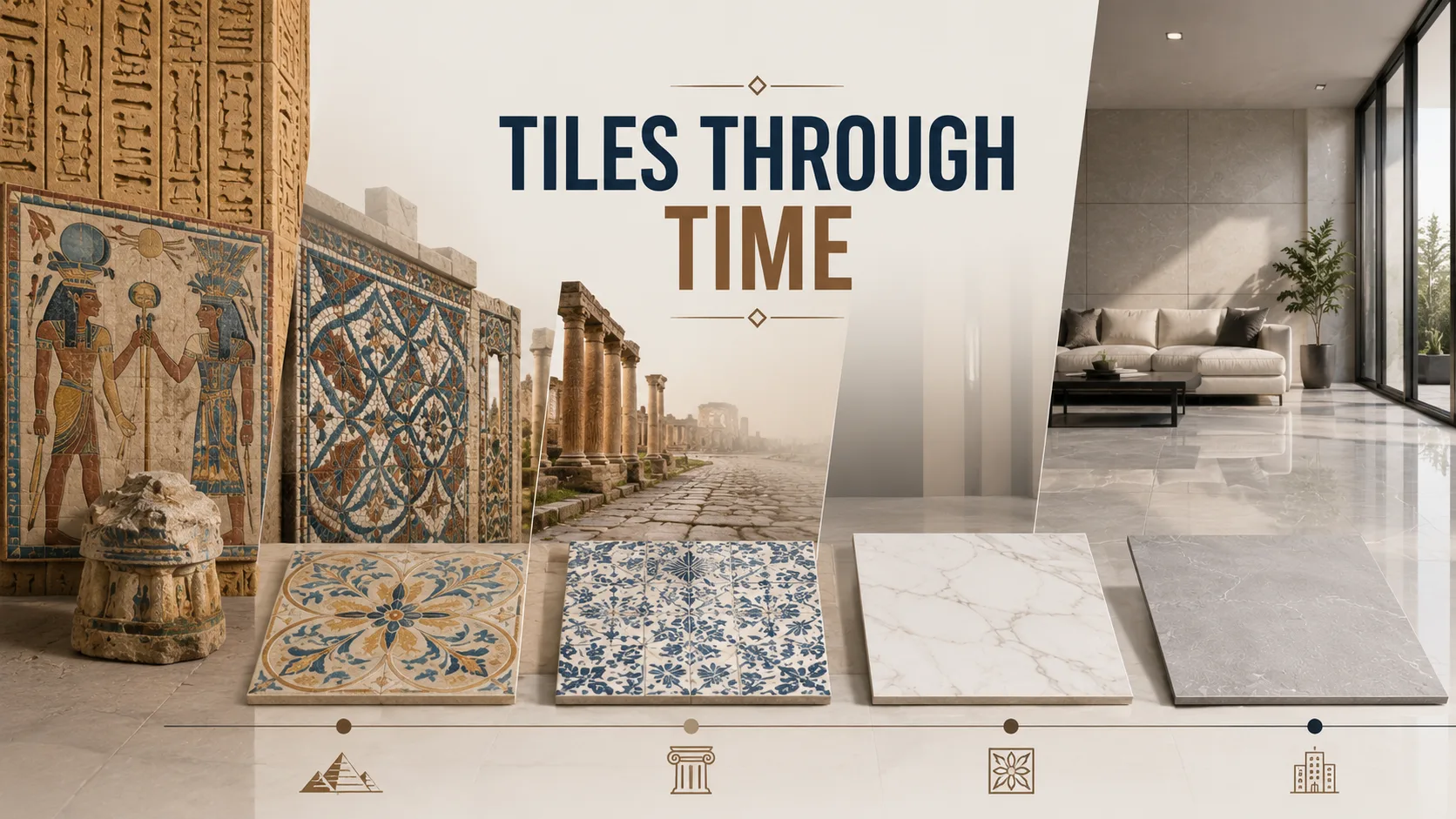
Long before porcelain tile became a byword for modern flooring and design, ceramic tile-making was already an established craft shaping the walls, floors, and monuments of some of history's great civilisations. The story of ceramic tile spans roughly six thousand years, moving through Ancient Egypt, Mesopotamia, the Islamic world, medieval Europe, and industrial-era Britain before arriving at the highly engineered porcelain slabs and digitally printed surfaces produced today.Understanding this history isn't just an exercise in trivia - it explains why tile remains one of the most enduring building materials in human history, and how techniques developed centuries ago still echo in the design language and manufacturing logic of modern porcelain production.1. Ancient Egypt: The Earliest Glazed TilesThe earliest known glazed ceramic tiles date to around 4000 BCE in Ancient Egypt, where craftsmen produced blue-green faience tiles used to decorate the walls of tombs and temples. The Step Pyramid of Djoser at Saqqara, built around 2630 BCE, contains chambers lined with faience tiles designed to imitate reed matting - one of the earliest recorded examples of tile used as a decorative architectural surface.Egyptian faience wasn't true ceramic in the modern sense - it was a quartz-based material coated in an alkaline glaze - but it established a principle that would define tile-making for millennia afterward: firing a mineral-based material to create a durable, colourful, water-resistant surface.2. Mesopotamia and Ancient Persia: Glazed Brick on a Monumental ScaleIn Mesopotamia, glazed and moulded brick became a defining feature of monumental architecture. The Ishtar Gate of Babylon, constructed around 575 BCE under Nebuchadnezzar II, was covered in vividly glazed blue bricks decorated with relief figures of dragons and bulls - a scale of glazed ceramic architecture unmatched anywhere else in the ancient world at the time.Persian craftsmen continued this tradition, refining glazing techniques that would later influence Islamic tilework across the region for centuries to come.3. Ancient Greece and Rome: Mosaics and TerracottaGreek and Roman builders relied heavily on terracotta tile for roofing, and on mosaic - small ceramic, stone, or glass pieces called tesserae - for elaborate decorative flooring in villas, bathhouses, and public buildings. Roman engineers also used fired clay tiles structurally, in hypocaust underfloor heating systems, showing an early understanding of tile's thermal and functional properties beyond pure decoration.4. The Islamic Golden Age: Geometric MasteryBetween the 8th and 15th centuries, Islamic craftsmen across Persia, North Africa, and Andalusia elevated tile-making into an art form defined by intricate geometric and calligraphic patterns. Techniques such as zellige mosaic tilework in Morocco, and the vibrant polychrome tile schemes seen at the Alhambra in Spain, demonstrated extraordinary precision in cutting, glazing, and pattern assembly.This period also refined lustreware and cuerda seca techniques, allowing multiple glaze colours to be fired on a single tile without bleeding into one another - a technical achievement that directly influenced tile-making traditions across Europe in the centuries that followed.5. Medieval Europe: Encaustic Tiles in Cathedrals and CastlesFrom roughly the 12th to 16th centuries, medieval European craftsmen developed encaustic tiles - tiles inlaid with contrasting clay colours to create durable patterns that wouldn't wear away like surface-painted decoration. These tiles became a hallmark of English and French cathedral and monastery floors, prized for their ability to withstand centuries of foot traffic while retaining their pattern.6. Chinese and Asian Ceramic TraditionsChina's ceramic tradition, running in parallel to developments in the Middle East and Europe, contributed major advances in kiln technology and high-fired glazed ceramics, including the celadon and porcelain traditions that would eventually influence global ceramic production. Glazed roof tiles became iconic features of Chinese temple and palace architecture, while regional traditions across Japan, Korea, and Southeast Asia developed their own distinct glazing and firing techniques.7. The Renaissance: Maiolica and DelftwareRenaissance Italy saw the flourishing of maiolica - tin-glazed earthenware painted with elaborate figurative and decorative scenes, produced in centres such as Florence and Faenza. This tradition spread northward, influencing Dutch Delftware in the 16th and 17th centuries, which became famous for its distinctive blue-and-white decorative tiles used extensively in domestic interiors across the Netherlands and, through trade, much of Europe.8. The Industrial Revolution: Mass Production ArrivesThe 19th century transformed tile-making from a handcrafted trade into an industrial process. British manufacturers, most notably Herbert Minton, developed encaustic tile production methods suited to mechanised manufacturing, alongside transfer-printing techniques that allowed decorative patterns to be applied consistently at scale.This period saw tile become accessible to a much broader market for the first time - used extensively in Victorian homes, railway stations, and public buildings - shifting tile from an elite architectural feature to a widely available building material.9. The 20th Century: Standardisation and New MaterialsThe 20th century brought standardised tile sizing, improved kiln technology, and the wider adoption of glazed ceramic wall and floor tiles in homes and commercial buildings worldwide. Manufacturing shifted toward higher-volume, lower-cost production, and new glazing chemistries expanded the range of colours, finishes, and durability characteristics available to designers and builders.10. The Rise of Modern Porcelain TilePorcelain tile as it's understood today emerged from advances in body composition and firing technology, particularly the development of fully vitrified bodies with very low water absorption. Key developments that shaped modern porcelain manufacturing include:•    Vitrified body technology, producing tiles with water absorption below 0.5% for significantly greater durability and frost resistance•    Digital inkjet printing, introduced widely from the 2000s onward, enabling photorealistic marble, wood, and stone-look designs at a fraction of the cost of natural material•    Large-format slab production, allowing continuous surfaces with minimal grout lines for architectural and countertop applications•    Rectified edge and precision calibration technology, enabling tighter installation tolerances and more seamless finished surfacesThese innovations collectively repositioned porcelain tile from a purely functional flooring material into a design-led surface capable of replicating natural stone, wood, concrete, and fabric textures with remarkable accuracy.11. India's Emergence as a Global Ceramic Manufacturing HubOver the past three decades, India - and the Morbi region of Gujarat in particular has emerged as one of the world's largest ceramic tile manufacturing hubs, combining large-scale production capacity with increasingly sophisticated technology, including GVT, PGVT, and large-format slab manufacturing. This growth reflects the same pattern seen throughout tile's history: each era's manufacturing centre has been defined by whoever combines craftsmanship, material innovation, and production scale most effectively for its time.Conclusion: A Craft That Never Stopped EvolvingFrom the faience tiles of Ancient Egypt to the digitally printed porcelain slabs produced today, ceramic tile has continuously adapted - technically and aesthetically - while retaining its core purpose as a durable, decorative surface for human spaces. Modern porcelain manufacturing represents the latest chapter in a six-thousand-year continuum, carrying forward the same fundamental principles of glazing, firing, and pattern-making that shaped tile's earliest beginnings.Understanding this heritage adds context to what might otherwise seem like a purely industrial product - modern porcelain tile is, in a very real sense, the current expression of one of humanity's oldest continuously practiced crafts.
Jul 14, 2026 by Probity Ceramic LLP Style & Design
Almost every experienced designer, contractor, or homeowner has a version of the same story: a tile looked perfect under the showroom lights, and looked completely different once it was installed at home. The tile did not change — the light did. Color temperature, direction, intensity, and source type all interact with a tile's surface to change how its color, undertone, and finish are actually perceived, sometimes dramatically.This guide is written for homeowners choosing tile for a renovation, interior designers and architects specifying finishes across different lit environments, and distributors helping clients avoid a costly mismatch between showroom expectation and installed reality. It explains how lighting changes the appearance of tiles — the physics behind it, how different light sources and room orientations affect specific finishes, and how to test a sample properly before committing to an order.By the end, you will know why the same tile can look like two different products depending on where it's installed, and how to avoid an unpleasant surprise after installation.1. Why Lighting Matters as Much as Tile SelectionTile color and finish are fixed once manufactured, but the light falling on them is not — and perceived color is always the product of both. Two identical tiles, installed in rooms with different light sources, orientations, or fixture placements, can look meaningfully different from one another despite being the exact same product from the exact same batch.For anyone specifying tile, this means the selection process cannot stop at choosing a color and finish in isolation. The lighting conditions of the intended space are just as much a part of the decision as the tile itself, and skipping that step is one of the most common sources of post-installation dissatisfaction in the industry.2. The Science of Light and Surface PerceptionColor perception depends on the interaction between a light source's spectral composition, the surface properties of the material it hits, and the eye's response to the light reflected back. A tile surface does not emit color; it absorbs some wavelengths of light and reflects others, and what reaches the eye is the reflected portion. Change the spectral makeup of the light source — as happens between daylight, LED, halogen, and fluorescent lighting — and the reflected wavelengths change too, even though the tile itself hasn't.This is why color temperature, measured in Kelvin (K), is central to understanding tile appearance: lower Kelvin values (around 2700–3000K) produce warmer, yellow-toned light, while higher values (4000K and above) produce cooler, bluer-toned light, and each shifts how a tile's color and undertone read to the eye.3. Natural Light: How Daylight Direction and Intensity Change Tile AppearanceDaylight itself is not constant — its color temperature and intensity shift throughout the day and depend heavily on a room's orientation:North-facing rooms (in the Northern Hemisphere) receive consistent, cooler, indirect light throughout the day, which tends to make tile tones read slightly cooler and can mute warm undertones.South-facing rooms receive stronger, warmer direct light for much of the day, which can intensify warm tones and make even neutral tiles read slightly warmer than expected.East-facing rooms receive warm morning light that cools through the day, meaning tile appearance can genuinely shift from morning to afternoon.West-facing rooms receive cooler light in the morning and warm, intense light in the late afternoon and evening, producing a similar but reversed shift.This is why a tile sample should ideally be viewed in the actual room, at more than one time of day, before a final decision — a single viewing captures only one point in a daily cycle of changing light.4. Artificial Light: Color Temperature and Its Effect on Tile ToneMost interior spaces rely on artificial lighting for a significant portion of the day, and the color temperature of that lighting has a direct, predictable effect on tile appearance:Warm white (2700–3000K): intensifies warm tile tones (terracotta, warm beige, wood-look finishes) and can slightly mute cool tones, making them read closer to neutral.Neutral white (3500–4000K): renders color relatively true to how it appears in balanced daylight, which is why many showrooms and product photography setups use this range as a baseline.Cool white / daylight (5000K+): intensifies cool tile tones (greys, blues, cool marble-look whites) and can make warm tones appear slightly washed out or less saturated.Matching a room's planned lighting color temperature to the tile's intended tonal effect — warm lighting to complement warm tile, cooler lighting to complement cool tile — is one of the simplest ways to ensure the installed result matches the design intent.5. Light Source Type: LED, Halogen, and Fluorescent ComparedBeyond color temperature, the type of light source affects how accurately and consistently it renders color, measured by a metric called Colour Rendering Index (CRI):LED lighting is now the dominant residential and commercial choice, energy-efficient and available across a wide range of color temperatures, though CRI quality varies significantly between budget and premium fixtures — a low-CRI LED can render tile color noticeably less accurately than a high-CRI one at the same color temperature.Halogen lighting produces warm, high-CRI light that renders color richly and accurately, which is part of why it remains popular in some showroom and retail lighting despite being less energy-efficient than LED.Fluorescent lighting (including older CFL fixtures) often has lower CRI and can introduce a slight green or blue cast that noticeably affects how tile tones, especially warm ones, are perceived.For rooms where accurate, consistent tile color perception matters — showrooms, galleries, and high-end residential specification — choosing high-CRI (90+) fixtures regardless of source type meaningfully improves color accuracy.6. How Finish Interacts with Light: Matte, Glossy, and Textured SurfacesFinish determines how a tile's surface handles the light hitting it, which is just as influential on final appearance as the light source itself:Glossy and polished finishes reflect light directly and specularly, intensifying brightness and color saturation but also making the surface more sensitive to glare, fixture placement, and reflected surrounding colors.Matte finishes diffuse light more evenly across the surface, producing a softer, more consistent color appearance that is less sensitive to fixture position but can appear duller under low light levels.Textured finishes create micro-shadows across the surface that add depth and can make a color appear richer or more variegated, though this effect is highly dependent on the angle and direction of the light source relative to the texture.A highly reflective glossy tile in a room with harsh, direct overhead lighting can produce glare and washed-out color in exactly the areas where light hits directly, while the same tile in softer, indirect lighting can look rich and luminous — the finish and the lighting plan need to be considered together, not separately.7. Undertones: Why the Same Tile Looks Different in Different RoomsAlmost every tile, even a tile marketed as "pure white" or "neutral grey," carries a subtle undertone — a faint warm, cool, or grey-based cast that becomes more or less visible depending on the light around it. Undertones are typically invisible in isolation but become obvious in contrast: a warm-undertone white tile can look distinctly cream or yellow next to a cool-undertone white tile under the same light, even though both would be independently described as "white."This is why lighting-driven appearance shifts are often most noticeable at room transitions — a hallway tile that looked identical to an adjoining room's tile in the showroom can suddenly reveal a mismatched undertone once both are installed under their respective room's lighting conditions.8. Room Orientation and Time of Day EffectsBeyond the general north/south/east/west patterns covered earlier, practical orientation planning should also account for:•     Window size and placement, which determine how much natural light actually reaches the tiled surface versus how much is blocked by furniture, walls, or partial shading•     Seasonal variation, since daylight angle and intensity shift meaningfully between summer and winter in most climates, changing how a room's tile reads across the year•     Artificial lighting layering, since most rooms rely on a mix of ambient, task, and accent lighting that combine to produce the room's overall effective color temperature, rather than a single fixture type9. Lighting Tiles for Specific Spaces: Kitchens, Bathrooms, and Living AreasKitchens: typically combine bright, high-CRI task lighting over work areas with warmer ambient lighting elsewhere — plan for warm-toned or neutral tile to read well under both, and test backsplash tile specifically under under-cabinet lighting if installed, since that fixture sits closest to the surface.Bathrooms: often rely heavily on artificial lighting due to limited natural light and privacy considerations — cool or neutral tile under neutral-to-cool white lighting (3500–4000K) tends to produce the cleanest, most consistent result.Living areas: usually see the widest swing between daytime natural light and evening artificial light, so testing tile samples at both times is particularly important for floors and feature walls in these spaces.10. Common Mistakes When Selecting Tile Under Showroom LightingTrusting showroom lighting as representative. Showrooms are frequently lit with high-CRI, carefully positioned fixtures designed to show product at its best — rarely a match for typical residential or commercial lighting conditions.Selecting from a digital image or small swatch alone. Screen color rendering and small-sample viewing both distort perceived color relative to a full installed surface under real light.Not testing at multiple times of day. A single viewing captures only one point in a room's daily lighting cycle, missing how the tile will look for the rest of the day.Ignoring planned lighting changes. Selecting tile under existing lighting without accounting for a planned fixture upgrade or color temperature change can produce a mismatch once the new lighting is installed.Assuming all "white" or "grey" tiles are interchangeable. Undertone differences that are invisible in isolation can become obvious once installed next to another surface under the same light.11. How to Test Tile Samples Correctly Before Buying15.Request a full-size or large-format physical sample rather than a small swatch or digital image.16.View the sample in the actual room where it will be installed, not in the showroom or a different room.17.Check the sample at multiple times of day — morning, midday, and evening — to capture the room's full natural light cycle.18.View the sample under the room's actual or planned artificial lighting, ideally after dark when natural light is not a factor.19.Compare the sample against adjoining surfaces (walls, cabinetry, existing flooring) to check for undertone clashes.20.If ordering a large volume, request the sample from the same batch or a batch-matched reference to avoid a shade shift between the sample and the delivered order.12. Working with Probity Ceramic LLP: What Sets Us ApartProbity Ceramic LLP supports designers, distributors, and homeowners in making lighting-informed tile decisions, backed by consistent, batch-matched production that ensures what arrives on site matches what was sampled.How we help buyers avoid a lighting-driven mismatch:•     Full-size physical samples provided on request, rather than small swatches that understate real-world color and finish behaviour•     Batch and shade documentation on every order, so a large installation reads as one consistent surface under any lighting condition•     A finish range spanning matte, glossy, and textured options across most collections, allowing the same base tone to be matched to a space's specific lighting plan•     Technical data sheets covering surface reflectance characteristics to support designers planning lighting alongside tile specificationWhat our buyers consistently tell us:Physical samples, viewed on-site under real lighting, remain the single most reliable way to avoid a post-installation surprise — and consistent batch matching is what ensures a large order looks the way the sample promised, wall to wall or floor to floor.We work with:Interior designers and architects coordinating tile specification with lighting plans, distributors advising retail customers on sample testing, and construction companies managing large, consistently lit installations across multi-unit or commercial projects.
Jul 10, 2026 by Probity Ceramic Style & Design
Long before anyone consciously registers a room's layout or furniture, they register its color. Tile, more than almost any other interior material, sets that first impression — it covers large, continuous surfaces, reflects light in a particular way, and rarely changes once installed. Getting the color right is not a decorative afterthought; it is one of the most influential decisions in how a space actually feels to live in, work in, or move through.This guide is written for homeowners planning a renovation, interior designers and architects specifying finishes for a project, and distributors advising clients on collection choices. It looks at how tile color influences mood in interior design — the psychology behind specific tones, how finish and light interact with color perception, and how to apply that understanding practically, room by room.By the end, you will have a working framework for choosing tile color with intention, rather than by trend or instinct alone.1. Why Color Psychology Matters in Tile SelectionTile covers more continuous surface area than almost any other interior finish — floors, sometimes full walls, often both in the same room. That scale means its color does more psychological work than a paint accent wall or a piece of furniture ever could, simply by virtue of dominating the visual field. A kitchen floor, a bathroom wall, or a lobby floor sets the emotional tone of a space before anyone consciously evaluates the layout, lighting, or furnishings within it.Because tile is also one of the least frequently replaced interior finishes — often outlasting paint colors, furniture, and even full renovation cycles — the color decision carries more long-term weight than most other material choices in a project. Understanding the psychology behind it helps ensure that weight is used deliberately.2. The Science Behind Color and MoodColor psychology in interior design draws on a well-established body of research showing that hue, saturation, and brightness each independently affect physiological and emotional response — from measurable changes in heart rate and perceived room temperature to shifts in focus and perceived spaciousness. Warmer hues (reds, oranges, warm yellows) tend to read as energising and can make a space feel physically warmer and more intimate. Cooler hues (blues, greens, cool greys) tend to read as calming and can make a space feel more spacious and restful. Brightness and saturation modulate intensity — a muted, desaturated version of a color reads very differently from a bold, saturated version of the same hue.None of this operates in isolation from culture and personal association — but the broad physiological patterns are consistent enough that they form a reliable starting point for tile color decisions across most residential and commercial design contexts.3. Warm Tones: Energy, Warmth, and Social SpacesWarm-toned tiles — terracotta, warm beige, amber, rust, and warm wood-look finishes — tend to create spaces that feel inviting, energetic, and socially engaging. They work particularly well in:•     Kitchens and dining areas, where warmth supports a sense of gathering and appetite stimulation, both well-documented associations with warm color tones.•     Living and family rooms, where warm flooring can offset cooler wall colors or minimalist furniture to keep the space feeling lived-in rather than clinical.•     Entryways and hospitality lobbies, where a warm first impression sets a welcoming tone before a visitor has engaged with anything else in the space.The risk with warm tones is oversaturation — a fully warm-toned room, floor to ceiling, can start to feel closed-in or visually heavy. Warm tile is generally most effective when balanced against cooler or neutral wall colors and adequate natural light.4. Cool Tones: Calm, Focus, and Restorative SpacesCool-toned tiles — blues, soft greens, cool greys, and blue-undertone whites — tend to create spaces that feel calm, orderly, and restful. They are especially effective in:•     Bathrooms and spa-style spaces, where a cool, clean palette reinforces a sense of restoration and hygiene.•     Bedrooms, where cool tones support the calming, low-stimulation environment associated with better rest.•     Home offices and study spaces, where cooler tones are associated with improved focus and reduced visual fatigue over long periods.Cool tones can read as cold or sterile if overused without any warmth to offset them — a common fix is pairing cool tile with warm wood accents, textiles, or lighting with a warmer color temperature.5. Neutral Tones: Versatility and Timeless BalanceNeutral tiles — whites, greys, greiges, and warm or cool-toned taupes — remain the most widely specified tile category precisely because they offer psychological flexibility. A well-chosen neutral can read as calming or grounding without pulling strongly toward either the "energising" or "restful" end of the color spectrum, letting furniture, art, and accent colors do more of the emotional work in a space.Neutrals also carry practical advantages that reinforce their psychological role: they age well against changing furniture and decor trends, and they photograph and show well in resale contexts, which is part of why they dominate both residential flipping and large-scale commercial specification.6. Color by Room: Matching Tile Tone to FunctionKitchens: warm neutrals or warm accent tones support appetite and social energy; balance with cooler countertop or cabinet tones to avoid visual heaviness.Bathrooms: cool tones or clean whites reinforce a restorative, spa-like feel; warmer tones work well in powder rooms designed for a bolder, more social statement.Bedrooms: muted cool tones or soft neutrals support rest; avoid highly saturated warm tones that can feel overstimulating in a space meant for winding down.Living rooms: warm neutrals or mid-tone wood-look finishes support a lived-in, social atmosphere while remaining versatile against changing furniture.Home offices: cool or neutral tones support sustained focus; avoid highly saturated or high-contrast patterns that can become visually fatiguing over a full working day.Commercial and hospitality lobbies: bold or contrasting tones can be used deliberately to make a strong first impression, provided the intensity is balanced by the scale and lighting of the space.7. The Role of Finish and Texture in Perceived MoodColor does not act alone — finish changes how a color is actually perceived. A glossy finish reflects more light and tends to intensify a color's brightness and vibrancy, while a matte finish absorbs more light and softens the same color, often reading as more grounded or muted. Textured surfaces add depth and shadow variation that can make a color feel richer and more tactile, while a smooth, uniform finish reads as cleaner and more minimal.This means the same base color can produce noticeably different moods depending on finish choice — a matte cool grey feels calm and grounded, while a high-gloss version of the same grey can feel sharper, more formal, and more reflective of surrounding light and color.8. Light, Shadow, and How They Change Tile Color PerceptionTile color is never seen in isolation from the light around it, and this is one of the most commonly underestimated factors in color selection. Natural daylight shifts color temperature throughout the day, artificial lighting varies significantly in color temperature between warm (2700–3000K) and cool (4000K+) fixtures, and a room's orientation (north-facing versus south-facing, for example) changes how much and what quality of natural light a tile receives.The same tile sample can look noticeably different in a showroom under commercial lighting than it will in the actual installation space. Always view physical samples in the room and lighting conditions where the tile will actually be installed — ideally at different times of day — before finalising a color decision, particularly for large-format or highly saturated tiles where the effect is most pronounced.9. Combining Colors: Contrast, Harmony, and Accent TilesMost interior spaces benefit from a considered color relationship rather than a single uniform tone throughout. Common, well-tested approaches include:•     Monochromatic harmony: varying tones and finishes within a single color family for a cohesive, calming effect without visual flatness.•     Warm-cool balance: pairing a dominant warm or cool tile with an opposing accent (warm wood tones against cool tile, or vice versa) to prevent a space from feeling one-dimensional.•     Accent or feature tiling: using a bolder color or pattern on a single wall, backsplash, or floor inset to create a deliberate focal point without overwhelming the whole space.•     Transitional zoning: using tone shifts between connected spaces (a warmer kitchen tile transitioning to a cooler adjacent living area) to subtly signal a change in function without a hard visual break.10. Common Mistakes in Color Selection for Interior TilingChoosing color from a small sample or digital image alone. Color perception shifts significantly at full scale and under real lighting conditions — always view a large physical sample in situ.Ignoring the room's natural light orientation. A cool tone that feels calm in a bright, south-facing room can feel cold and flat in a north-facing room with limited natural light.Over-committing to a trend-driven bold color. Because tile is a long-lifecycle material, a highly trend-specific color can date a space faster than paint or furnishings, which are easier and cheaper to update.Underestimating the emotional weight of large surface areas. A color that feels fine in a small sample or accent piece can become overwhelming across an entire floor or wall.Not considering finish alongside color. Selecting a color without testing it in the intended finish (matte, glossy, textured) can produce a noticeably different result than expected once installed.11. Emerging Color Trends in Porcelain and Ceramic TilesCurrent design direction in porcelain and ceramic tile has moved toward warm, earthy neutrals — terracotta, warm greige, and soft clay tones — alongside continued strong demand for classic marble-look whites and greys with warm undertones. There is also growing interest in deeper, more saturated accent tones (forest green, deep terracotta, charcoal) used deliberately in smaller applications such as kitchen islands, powder rooms, and feature walls, reflecting a broader design shift toward spaces that feel warmer and more personal rather than purely minimal.12. Working with Probity Ceramic LLP: What Sets Us ApartProbity Ceramic LLP manufactures porcelain tiles across an extensive color and finish range, built to give designers and distributors the flexibility to specify tone, warmth, and finish precisely rather than settling for a limited palette.Our color and finish capability covers:•     Warm and cool marble-look collections including Calacatta, Statuario, Carrara, and Onyx, each available across multiple undertone variations•     Wood Finish, Stone Finish, and Concrete Finish ranges spanning warm, neutral, and cool tonal families•     Matte, glossy, polished, and textured finish options across most collections, allowing the same base tone to be adapted to different mood requirements•     Large-format slabs that minimise grout lines for a more seamless, immersive color effect across floors and walls•     OEM and private label color development for distributors building a differentiated, mood-led collectionWhat designers and distributors consistently ask us for:Physical, full-size samples rather than digital renders, consistent shade matching across large orders so a full floor or feature wall reads as one continuous tone, and finish options that let the same base color serve both calming and energising design briefs.We work with:Interior designers and architects specifying finishes for residential and hospitality projects, distributors curating mood-led collections for their retail customers, and construction companies sourcing consistent, large-volume color-matched tile for multi-unit developments.ConclusionTile color is one of the most consequential and longest-lasting decisions in any interior design project — it sets the emotional register of a space before anyone consciously registers why. Understanding how warm, cool, and neutral tones function, how finish and light reshape color perception, and how to apply that knowledge room by room turns color selection from a matter of taste alone into a deliberate design tool.Whether the goal is a warm, social kitchen, a calming spa-like bathroom, or a focused home office, the right tile color — chosen with an understanding of how it will actually be seen, lived in, and lit — does more to shape how a space feels than almost any other single material decision.
Jul 09, 2026 by Probity Ceramic News
For decades, the global tile hierarchy was settled: Italy and Spain sat at the top, prized for design leadership and manufacturing precision, while India was known as a source of functional, budget-tier product. That hierarchy is being actively renegotiated. India has become one of the world's largest tile producers by volume, and a growing share of its output is no longer competing on price alone — it is competing on design, technology, and certification, in categories that were once considered exclusively European territory.This piece is written for importers, distributors, architects, and construction companies reassessing where premium tile sourcing decisions should sit. It looks at how the traditional hierarchy formed, what specifically changed in Indian manufacturing over the past decade, where the comparison genuinely holds up and where it doesn't, and what the shift means practically for anyone building a sourcing strategy today.This is not a claim that India has replaced Italy and Spain — it is a look at where the gap has closed, where it hasn't, and how a buyer should think about the decision now.1. A Changing Global Tile MapThe global ceramic and porcelain tile industry has historically been mapped around a handful of manufacturing centres: Sassuolo in Italy, Castellón in Spain, and a cluster of Chinese production hubs, with India positioned further down the value chain as a high-volume, lower-cost alternative. Over the past decade, that map has been redrawn. India now ranks among the world's largest tile producers by volume, and — more significantly for the premium conversation — a meaningfully growing share of that production is aimed squarely at design-led, mid-to-premium market segments rather than entry-level product alone.This shift matters to buyers because it changes the calculus of a sourcing decision. "Italian quality at Italian prices" versus "Indian tiles at a discount" is no longer the full picture — the more relevant question for many buyers today is where on the price-to-design-to-compliance spectrum a specific Indian manufacturer actually sits, and whether that meets the project's requirement without paying a legacy premium for the country of origin alone.2. The Traditional Hierarchy: Italy and Spain's Legacy of DominanceItaly and Spain's position at the top of the global tile industry was built over decades on genuine foundations: early and sustained investment in kiln and glazing technology, design schools and trade fairs (Cersaie in Bologna, Cevisama in Valencia) that positioned both countries as the industry's aesthetic reference point, and an export infrastructure and brand reputation built up long before other producing nations entered premium categories.That legacy still carries real weight — Italian and Spanish brands remain the reference point architects and designers train on, and "Made in Italy" or "Made in Spain" continues to function as a genuine trust signal in specification documents worldwide, independent of the product's actual technical performance.3. Where India Started: The Budget Tile PerceptionIndia's tile industry, concentrated heavily around Morbi in Gujarat, built its initial global position on cost-competitive, high-volume ceramic tile production — largely wall tiles and basic floor tiles serving price-sensitive residential markets across the Middle East, Africa, and South Asia. Design was largely derivative, following European trends with a lag rather than setting them, and the perception among many international buyers was straightforward: Indian tile meant acceptable quality at a low price point, not a genuine alternative for premium specification.That starting point is important context, because the shift discussed in this piece did not happen by accident or overnight — it followed a deliberate, sustained investment cycle across the industry.4. What Changed: Technology, Scale, and Design InvestmentSeveral converging factors have driven India's move up the value chain over the past decade or so:Technology adoption. Indian manufacturers, particularly larger Morbi-based producers, have invested heavily in the same digital printing, glazing, and pressing technology used by leading Italian and Spanish plants — much of it sourced from the same European equipment manufacturers.Scale-driven capital reinvestment. High production volumes have generated the capital base for continuous reinvestment in larger presses (enabling large-format slabs), advanced kilns, and automated quality control.Design talent and studio investment. A growing number of manufacturers now run dedicated design studios, some collaborating with international design consultants, moving beyond replication toward original surface design and finish development.Export market exposure. Sustained exposure to demanding export markets — the GCC, Europe, and increasingly the Americas — has pushed manufacturers to meet international certification and consistency standards as a condition of doing business, not an optional upgrade.5. Comparing Manufacturing Capability: India, Italy, and SpainOn core manufacturing capability — pressing technology, digital glazing, large-format production, and kiln technology — leading Indian manufacturers now operate equipment that is broadly comparable to their Italian and Spanish counterparts, in many cases purchased from the same equipment suppliers (predominantly Italian and Spanish machinery manufacturers themselves).The meaningful differences that remain are less about the machinery and more about production culture: the depth of in-house design R&D, the maturity of quality-consistency systems built up over generations of production, and the density of specialised, tile-focused supporting industries in regions like Sassuolo and Castellón that took decades to develop and are not replicated overnight anywhere else.6. Design Evolution: From Imitation to InnovationThe most visible shift for buyers is design. A decade ago, Indian tile catalogues were widely seen as following European design trends a season or two behind. Today, a growing number of manufacturers are releasing original marble-look, concrete, wood-finish, and textured stone collections developed through in-house design studios, some ahead of rather than behind prevailing European trends, and increasingly shown at international trade fairs alongside established European and other Asian competitors.This does not mean design leadership has fully transferred — but the direction of travel, from imitation toward original design development, is one of the clearest indicators of the industry's broader maturation.7. Price-to-Performance: Why Global Buyers Are ReconsideringThe core commercial argument for Indian tile has always been price. What has changed is that the price advantage is now frequently being delivered alongside technical performance and design quality that would previously have commanded a much higher price bracket from a European source. For distributors and construction companies working to a project budget, this reframes the sourcing decision: rather than "premium European versus budget Indian," many buyers are now evaluating "comparable design and performance, at a materially different price point," and making sourcing decisions accordingly for a meaningful share of their product range.This is particularly visible in large-format porcelain slabs and premium marble-look collections, categories that were almost exclusively European-dominated until relatively recently and where competitively priced Indian alternatives are now a standard line item in many distributors' catalogues.8. Certifications and Quality: Closing the Compliance GapA premium reputation is inseparable from certification and consistency, and this is where the industry-wide shift has been most deliberate. A growing number of established Indian manufacturers now test to ISO 13006, EN 14411 (for CE marking), and ASTM standards concurrently, supported by documented Factory Production Control systems required to serve EU and North American markets credibly.The gap that remains is consistency across the industry rather than at its leading edge — the best Indian manufacturers now match international certification standards reliably, but the sector overall still has a wider quality spread than the more consolidated Italian and Spanish industries, making manufacturer selection and verification more important for buyers sourcing from India than it typically is when sourcing from Sassuolo or Castellón.9. Export Trends and Market ShareIndia has steadily grown into one of the world's largest tile exporters by volume over the past decade, expanding well beyond its traditional Middle Eastern and South Asian markets into Europe, Africa, and the Americas. Industry trade data consistently shows this volume growth trending alongside a gradual shift in product mix toward higher-value categories — large-format slabs, premium marble-look collections, and OEM/private-label programme supply — rather than volume growth in budget categories alone.Buyers evaluating this trend should treat headline export volume as one data point among several; the more meaningful indicator for a premium sourcing decision is the growth specifically within higher-value product categories and certified export lines, which is where the real competitive pressure on established European suppliers is emerging.10. Where Italy and Spain Still LeadA balanced comparison has to acknowledge where the traditional leaders retain a genuine, defensible edge:Design origination and trend-setting. Italy and Spain remain the industry's primary design reference point, with deeper design heritage and the trade fair infrastructure (Cersaie, Cevisama) that still shapes global trends first.Brand equity in luxury and architectural specification. For flagship architectural and luxury residential projects, Italian and Spanish brand names continue to carry a specification weight that is not yet matched by Indian brands, regardless of underlying product quality.Consistency at the top end. The most established European manufacturers have generations of accumulated production discipline that translates into extremely tight batch-to-batch consistency, an area where even leading Indian manufacturers are still closing the gap.Niche and artisanal categories. Handcrafted, small-batch, and highly specialised decorative tile categories remain a European (and increasingly artisanal Mexican and Moroccan) stronghold that mass-production models are not built to compete in directly.11. Why Morbi Is at the Centre of India's RiseMorbi's role in this shift is foundational rather than incidental. The town's concentration of manufacturers created the scale and competitive pressure that funded rapid technology reinvestment, while its density of supporting industries — raw material suppliers, kiln and machinery manufacturers, glaze producers, and freight forwarders — replicates, on a compressed timeline, the industrial ecosystem effect that took Sassuolo and Castellón decades to build.For buyers, this concentration is also a practical advantage: it allows direct comparison across dozens of manufacturers' technology, design capability, and certification standards within a single sourcing trip, in a way that is simply not possible when evaluating suppliers spread across a wider geography.12. Working with Probity Ceramic LLP: What Sets Us ApartProbity Ceramic LLP is positioned at the premium end of this shift — a Morbi-based manufacturer built specifically to compete on design and certification, not price alone, for importers, distributors, and construction companies who want the commercial advantage of Indian manufacturing without compromising on specification.Where we compete directly with European-standard product:•     Large-format porcelain slabs up to 1200×2400mm and 800×3000mm, matching the formats driving premium demand globally•     In-house design development across Calacatta, Statuario, Carrara, Onyx, Wood Finish, and Concrete Finish collections•     Concurrent testing to ISO 13006, EN 14411, and ASTM standards, with product-specific Declarations of Performance available on request•     Documented Factory Production Control supporting consistent batch-to-batch quality•     OEM and private label manufacturing for distributors building premium branded rangesWhat premium-focused buyers consistently tell us:They are comparing our large-format and marble-look collections directly against European alternatives on design and finish, not evaluating us as a discount substitute — and the deciding factor is increasingly landed cost and lead time rather than a perceived quality gap.We work with:Distributors repositioning their catalogue toward premium categories, construction and hospitality projects specifying large-format porcelain at scale, and retail chains developing branded collections that need to compete visually with established European ranges.13. Frequently Asked QuestionsQ1: Are Indian tiles now comparable in quality to Italian and Spanish tiles? At the leading edge of the industry, yes — top Indian manufacturers now use comparable pressing, glazing, and kiln technology and test to the same international standards. Quality varies more widely across the Indian industry overall, so manufacturer selection matters more than it typically does when sourcing from Italy or Spain.Q2: Why were Indian tiles historically seen as lower quality? Earlier production was concentrated in high-volume, price-sensitive categories with largely derivative design, and certification to international standards was not yet widespread. Sustained technology and design investment over the past decade has shifted a significant share of the industry toward premium, certified production.Q3: Do Indian manufacturers use the same equipment as Italian and Spanish factories? Many leading Indian manufacturers use pressing, digital printing, and glazing equipment sourced from the same predominantly Italian and Spanish machinery manufacturers that supply European tile producers.Q4: Is it cheaper to import tiles from India than from Italy or Spain? Generally yes, on a landed-cost basis, even accounting for freight — India's cost advantage typically persists even in premium and large-format categories, though buyers should compare actual quotations and landed cost rather than assuming a fixed differential.Q5: Can Indian tiles be CE certified for the European market? Yes. A growing number of established Indian manufacturers issue product-specific Declarations of Performance under EN 14411 and are actively exporting CE-compliant product to the EU.Q6: What categories still favour Italian and Spanish manufacturers? Handcrafted and artisanal decorative tile, flagship luxury architectural specification where brand heritage carries specification weight, and categories requiring extremely tight batch-to-batch consistency at the very top end of the market.Q7: How do I evaluate whether an Indian manufacturer meets premium standards? Review their certification documentation (ISO, EN 14411/CE, ASTM as relevant), request production samples rather than catalogue images, ask about in-house design capability, and where possible arrange a factory audit before committing to a large order.14. Conclusion: What This Means for Importers and DistributorsThe gap between Indian and European tile manufacturing has not disappeared, but it has narrowed significantly at the leading edge of the industry — closely enough that treating "Indian" and "budget" as synonymous is now an outdated assumption for a meaningful share of the market, particularly in large-format porcelain and marble-look categories.For importers, distributors, and construction companies, the practical takeaway is to evaluate individual manufacturers on their actual design capability, certification, and production consistency, rather than defaulting to country-of-origin assumptions in either direction. The buyers capturing the most value from this shift are the ones building direct, verified relationships with the Indian manufacturers operating at the top of that range — where the design and compliance gap with Italy and Spain has genuinely closed, and the price gap has not.
Jul 08, 2026 by Probity Ceramic LLP Technical
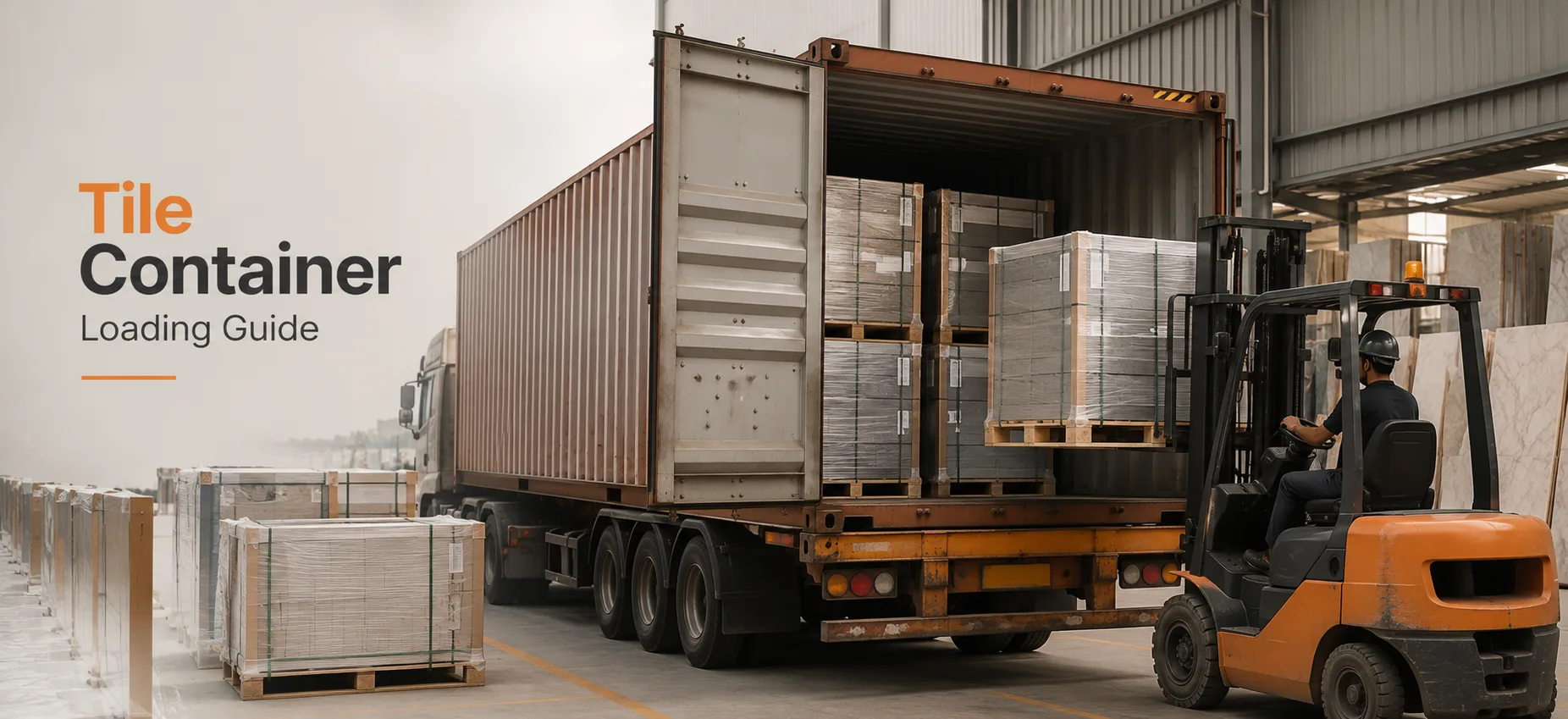
A tile order can be specified perfectly — right size, right finish, right certification — and still arrive damaged, short-counted, or unusable if the container loading was done poorly. Loading is where the commercial order becomes a physical shipment, and it is one of the least visible parts of the import process to a buyer who is not physically present at the factory.This guide is written for importers and distributors planning their first or next FCL tile shipment, and for procurement and logistics teams who need to sanity-check a manufacturer's loading plan, packaging specification, and container utilisation. It covers how container capacity is actually calculated, what proper tile packaging looks like, how loading is carried out and supervised at the factory, and the mistakes that most commonly lead to breakage claims or short shipments.By the end, you will know what to specify, what to inspect, and what a well-loaded tile container should look like before the doors close.1. Why Container Loading Matters for Tile ImportersTiles are dense, rigid, and brittle under point-load pressure — a combination that makes them straightforward to overpack by weight but easy to damage through poor stacking, inadequate cushioning, or shifting during transit. Loading quality affects an importer directly in three ways:Breakage rate. Poorly loaded containers routinely produce breakage claims well above the industry-standard contingency allowance, eating directly into margin.Container utilisation. Inefficient loading wastes payable container space, pushing your effective per-square-metre freight cost higher than it needs to be.Dispute risk. Shortages or damage discovered on arrival, without clear loading documentation from the factory, can turn into a lengthy and unproductive claims process between buyer, seller, and freight forwarder.Understanding loading fundamentals lets you specify requirements clearly, evaluate a manufacturer's process before you commit to a large order, and know what to check when the container is opened.2. Understanding Container Types Used for Tile ShipmentsTile shipments are almost always moved in standard dry containers, most commonly:20-foot container (20' GP): holds roughly 18–22 tonnes of tile depending on size and packaging, and is the most common choice for tile shipments given the product's density — volume space typically runs out well before the container's weight limit does.40-foot container (40' GP / 40' HC): offers roughly double the floor length but is used less often for tile alone, since tiles reach the container's maximum payload weight before filling the available volume, leaving unused space. It becomes efficient when combined with lighter cargo or for large-format, lower-density product.Confirm with your manufacturer and freight forwarder which container size makes commercial sense for your specific tile size and order volume — defaulting to a 40-foot container for a standard porcelain tile order often means paying for space you cannot use.3. How Many Tiles Fit in a Container: Calculating Load CapacityCapacity is governed by two constraints, and whichever is reached first determines your effective load: the container's maximum payload weight, and the available internal volume once packaging and bracing are accounted for.15.Calculate carton weight: box quantity per carton × tile weight (based on size and thickness) + packaging weight.16.Divide the container's maximum payload weight by the carton weight to estimate a weight-based carton count.17.Cross-check against volume: carton dimensions × available container floor and stacking space, allowing for bracing and access clearance.18.Apply the lower of the two figures as your realistic loading capacity, then reduce by a small margin to account for even, secure stacking rather than a theoretical maximum.As a general guide, standard 600×600mm porcelain tiles at 9–10mm thickness typically load at approximately 1,600–1,900 square metres per 20-foot container, while larger-format or thicker tiles reduce that figure. Always request the manufacturer's specific loading calculation for your exact product rather than relying on generic industry figures, since thickness, box configuration, and packaging all shift the number.4. Packaging Standards That Protect Tiles in TransitPackaging is the primary defence against breakage, and it is worth specifying rather than leaving to default factory practice. Key elements to confirm:•     Corrugated carton strength: double-wall or triple-wall corrugated board for export shipments, rated to withstand stacking pressure across a full container height.•     Inner protection: foam sheets, honeycomb paper, or corner protectors between tiles, particularly for polished or high-gloss surfaces prone to edge chipping and surface scratching.•     Edge and corner reinforcement: cartons with reinforced edges resist crushing when stacked multiple boxes high.•     Moisture protection: shrink wrap or moisture-resistant lining, especially relevant for shipments crossing humid climates or long transit routes.•     Carton labelling: product code, size, shade/batch number, and quantity clearly marked on every carton, enabling verification without opening every box.•     Palletisation: shrink-wrapped or strapped pallets for added stability, particularly valuable for large-format tiles and slabs.5. Palletised vs Loose-Loaded Cartons: Which Is BetterBoth approaches are used across the industry, and the right choice depends on tile format and priorities.Loose-loaded cartons (stacked directly on the container floor without pallets) maximise usable volume, since pallets themselves consume space and add dead weight. This is the standard approach for most standard-size porcelain and ceramic tiles and gives the highest square-metre yield per container.Palletised loading trades some volume efficiency for stability and easier handling at destination, particularly for large-format slabs, fragile finishes, or where the destination warehouse is set up for forklift unloading rather than manual carton handling. It also generally reduces handling-related breakage during unloading.For large or repeat orders, discuss both options with your manufacturer and factor in your destination warehouse's unloading capability, not just the loading efficiency at origin.6. Step-by-Step: How a Tile Container Is Loaded at the Factory19.Container is inspected for cleanliness, structural integrity, and absence of moisture or odour before loading begins.20.Flooring or dunnage material is laid where required to protect the lowest layer of cartons.21.Cartons are loaded from the rear of the container forward, typically in a criss-cross or interlocking stack pattern for stability.22.Weight is distributed evenly across the container floor, with heavier cartons generally positioned lower.23.Bracing material — airbags, timber battens, or void-fill — is installed to prevent shifting during transit.24.A final tally count is taken against the packing list before the doors are closed and sealed.25.A container seal number is recorded and shared with the buyer for verification against the Bill of Lading.7. Weight Distribution and Container BalanceUneven weight distribution is a safety issue as well as a damage risk — an imbalanced container can shift dangerously during ocean transit and road handling, and concentrated weight in one section increases the crushing pressure on cartons at the base of that stack. A properly loaded container distributes weight evenly across the floor area and keeps the centre of gravity low and centred, with heavier cartons never stacked directly on top of lighter, more fragile ones.8. Common Loading Mistakes That Cause Breakage or Rejected ShipmentsOverstacking beyond carton-rated height. Exceeding the corrugated board's rated stacking strength crushes cartons at the bottom of the stack, even when the container itself is not overloaded by weight.Inadequate bracing. Without proper void-fill or bracing, cartons shift during transit, and repeated micro-movement over a multi-week voyage causes edge chipping even in well-packaged product.Mixing incompatible products without separation. Loading polished and matte finishes, or different sizes, without clear separation and correct stacking order increases handling errors at destination.Loading without a final count against the packing list. Skipping this step is a common source of shortage disputes that are difficult to resolve after the container has sailed.No photographic or video record of loading. Without documentation, a damage or shortage dispute has no independent reference point to fall back on.9. Pre-Shipment Inspection and Loading SupervisionFor first orders, large-volume shipments, or high-value product, arranging pre-shipment inspection and loading supervision is a standard, cost-effective safeguard. This typically covers:•     Verification of product specification, quantity, and shade/batch consistency before loading begins•     Photographic or video documentation of the loading process•     Confirmation of correct packaging and bracing standards•     An independent final tally count against the purchase order and packing list•     Container seal verification and recordingThis can be arranged directly with the manufacturer's export team or through an independent third-party inspection agency, and is generally a small cost relative to the value of the shipment and the disputes it can prevent.10. Documentation Generated During Container LoadingA well-run loading process produces a documented paper trail that supports both customs clearance and any post-shipment claims process:•     Loading photographs or video, dated and matched to the container/seal number•     Final packing list, confirmed against the physical loaded count•     Container seal number, recorded and shared with the buyer•     Weight and measurement (W/M) certificate, where required for freight billing•     Pre-shipment inspection report, where independent inspection was arrangedRequest this documentation as a standard part of your order process rather than only after a problem arises — most established exporters will provide it without difficulty.11. How Morbi Manufacturers Optimise Container LoadingMorbi's concentration of export-focused tile manufacturers has produced a mature, specialised loading discipline: dedicated loading bays, trained loading crews familiar with tile-specific stacking patterns, and established relationships with freight forwarders operating regular FCL lanes to Mundra and Kandla ports. Many manufacturers now use standardised carton and pallet configurations calculated specifically for common export tile sizes, allowing accurate capacity quotes before an order is even confirmed.For importers, this means a well-established Morbi manufacturer should be able to provide a precise, size-specific loading calculation, not a rough estimate, as part of the initial quotation process.12. Working with Probity Ceramic LLP: What Sets Us ApartProbity Ceramic LLP manages container loading as a controlled, documented process, built around the specific needs of importers, distributors, and construction companies moving bulk and repeat volumes.Our loading process covers:•     Product-specific capacity calculations provided at the quotation stage, based on your exact tile size and thickness•     Double-wall corrugated cartons with foam or honeycomb inner protection as standard for export shipments•     Trained loading crews following standardised, tile-specific stacking and bracing protocols•     Photographic documentation of every loaded container, matched to seal number•     Final tally verification against the packing list before container sealing•     Support for third-party pre-shipment inspection on requestWhat our buyers consistently tell us matters most:A precise loading count they can plan around, packaging that survives long-transit routes without a rise in breakage claims, and full documentation available proactively rather than only when something goes wrong.We work with:Importers placing their first FCL order who want a transparent loading process before committing, distributors managing recurring container shipments, and construction companies coordinating phased deliveries where consistent packaging and documentation across shipments genuinely matters.ConclusionContainer loading is where a well-negotiated tile order either holds together or falls apart — quite literally. Understanding how capacity is calculated, what packaging standard to insist on, and what a properly supervised loading process looks like gives you the ability to specify it clearly upfront and verify it when the container is opened at destination.A manufacturer that can produce a precise, product-specific loading calculation and documented loading process at the quotation stage is telling you something real about how seriously they take the physical side of export — not just the commercial side.
Jul 07, 2026 by Probity Ceramic LLP Technical
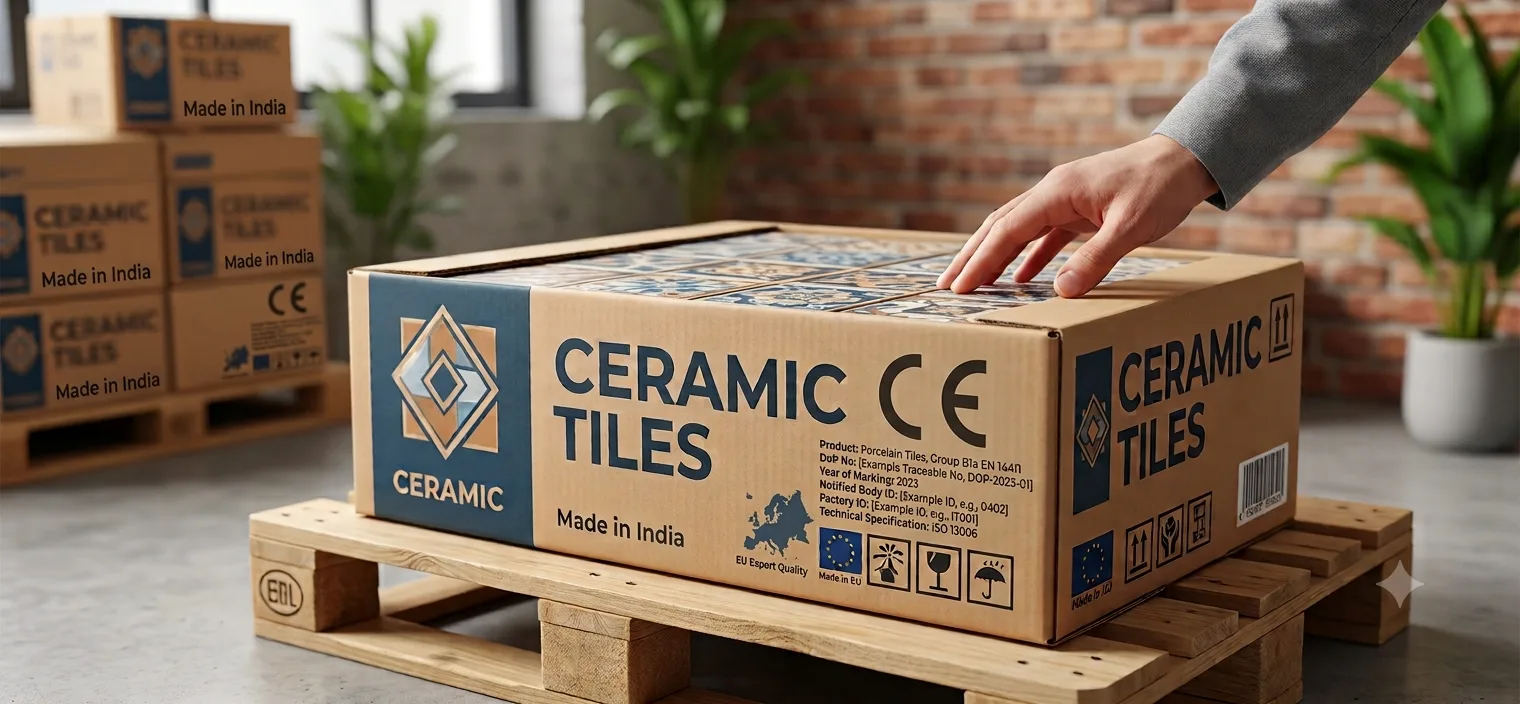
If you are importing or distributing tiles into the European Union — or into any market that recognises CE marking as a benchmark — you will run into the term "CE certified" on almost every manufacturer's product sheet. Yet it is one of the most misunderstood certifications in the tile trade. It is not a quality award, not optional paperwork, and not something a manufacturer can simply claim without a documented process behind it.This guide is written for importers preparing to sell into the EU market, distributors auditing their supplier's compliance documentation, and construction companies specifying tiles for projects where CE marking is a contractual or regulatory requirement. It explains what CE certification actually covers, the regulatory framework behind it, how to read a Declaration of Performance, and how to verify that a supplier's CE claim is genuine rather than printed on a catalogue for effect.By the end, you will know exactly what to ask for — and what a real CE-compliant tile supplier should be able to hand you without hesitation.1. What Is CE Certification for TilesCE marking on a tile is a manufacturer's declaration that the product has been assessed against the harmonised European standard for ceramic tiles — EN 14411 — and that its performance characteristics (dimensional tolerance, water absorption, breaking strength, slip resistance, frost resistance, and chemical resistance, among others) have been tested and documented.CE stands for "Conformité Européenne." It is not a quality grade — a CE-marked tile is not automatically "better" than a non-CE-marked one — it is a regulatory statement that the product's declared performance has been verified through a defined assessment process and that the manufacturer takes legal responsibility for the accuracy of that declaration.For tiles specifically, CE marking is mandatory for products placed on the market within the European Economic Area under the EU's Construction Products Regulation (CPR). Outside the EEA, many markets (including the GCC, parts of Africa, and Latin America) accept or increasingly request CE marking as a recognised proxy for verified product performance, even where it is not a legal requirement.2. Why CE Certification Matters for Importers and DistributorsFor any business bringing tiles into the EU, CE marking is not optional paperwork — it is a legal precondition for placing the product on the market. Beyond legal compliance, it matters commercially for several reasons:Customs clearance risk. EU customs authorities and market surveillance bodies can and do request CE documentation. Product without a valid Declaration of Performance can be held, rejected, or subject to a market withdrawal order.Contractual requirement. Architects, specifiers, and main contractors on commercial and infrastructure projects routinely require CE documentation as a condition of product approval, regardless of the tile's origin.Liability protection. A verified Declaration of Performance gives the importer a documented basis to demonstrate due diligence if a product performance dispute arises after installation.Buyer confidence. For distributors selling to retailers or contractors, being able to produce genuine CE documentation on request is a straightforward trust signal in a market where certification fraud does occur.3. The Legal Framework: EN 14411 and the Construction Products RegulationCE marking for tiles sits within a specific legal structure, and understanding it helps you ask the right questions of a supplier.EN 14411 is the harmonised European product standard for ceramic tiles. It defines classification (by manufacturing method and water absorption), dimensional and surface quality tolerances, and the physical, chemical, and mechanical properties that must be declared — including breaking strength, water absorption, slip resistance, frost resistance, and resistance to staining and chemicals.The Construction Products Regulation (CPR, EU No. 305/2011) is the overarching EU regulation that makes CE marking mandatory for construction products — including tiles — covered by a harmonised standard. It sets out the manufacturer's legal obligations: testing, documentation, ongoing production control, and issuing a Declaration of Performance for every product placed on the EU market.Together, EN 14411 defines what must be tested and declared, and the CPR defines the legal process a manufacturer must follow to affix the CE mark honestly.4. Which Tiles Fall Under CE MarkingCE marking under EN 14411 applies broadly across ceramic and porcelain tile categories intended for wall and floor covering, including:•     Porcelain (fully vitrified) tiles•     Glazed and unglazed ceramic floor and wall tiles•     Extruded and pressed tiles•     Large-format porcelain slabs•     Outdoor and frost-resistant tiles intended for exterior or freeze-exposed applicationsThe specific performance requirements and test thresholds vary by tile classification group under EN 14411 (based on manufacturing method and water absorption category), so the applicable Declaration of Performance should always reference the correct classification for the exact product being purchased.5. How CE Certification Works: The AVCP System ExplainedCE marking is issued through a defined Assessment and Verification of Constancy of Performance (AVCP) process, not a one-time test. For ceramic tiles, this typically follows System 4, under which:15.The manufacturer determines the product type through initial type testing (ITT), carried out by an accredited laboratory.16.The manufacturer implements and maintains Factory Production Control (FPC) — a documented, ongoing internal quality system that ensures every subsequent batch continues to meet the declared performance.17.The manufacturer issues a Declaration of Performance (DoP) for the product and affixes the CE mark.Because System 4 relies on manufacturer self-declaration backed by accredited initial testing (rather than mandatory third-party certification body oversight, as required for some other construction products), the integrity of the Factory Production Control system — and the manufacturer's willingness to share genuine ITT reports — is the real indicator of whether a CE claim can be trusted.6. What's Included in a Declaration of Performance (DoP)A genuine Declaration of Performance is a specific legal document, not a generic certificate. A valid DoP for tiles should include:•     A unique identification number for the product type•     The intended use of the product•     The manufacturer's name and registered address•     The applicable harmonised standard (EN 14411) and classification•     The declared performance values for each essential characteristic (water absorption, breaking strength, slip resistance, frost resistance, etc.), or "NPD" (No Performance Determined) where a characteristic does not apply•     The name and signature of the person responsible for the declaration, on behalf of the manufacturerIf a supplier provides only a CE logo on packaging or a marketing brochure without a product-specific DoP referencing actual tested values, that is not valid CE documentation.7. How to Verify a Supplier's CE Certification Is GenuineCE marking is a self-declaration system, which unfortunately makes it possible for the mark to be applied without genuine testing behind it. Before accepting a supplier's CE claim, take these verification steps:Request the actual Declaration of Performance for the specific product code you are ordering — not a generic company-level certificate.Request the Initial Type Testing (ITT) report and confirm it was issued by an accredited, recognised testing laboratory, with test methods referencing EN ISO 10545 (the test method series underlying EN 14411).Cross-check the declared values against the DoP — a legitimate DoP will show specific, plausible test figures, not round or suspiciously uniform numbers across an entire catalogue.Ask about Factory Production Control documentation — a manufacturer with a genuine FPC system should be able to describe their internal batch testing and calibration checks without hesitation.Commission an independent test on production samples for large or first-time orders, particularly where CE compliance is contractually critical to your project.8. CE Marking vs Other International Standards (ISO, ASTM, BIS)Buyers sourcing globally often need to map between certification systems, since different destination markets recognise different standards:ISO 13006 is the international reference standard for ceramic tiles and forms the technical basis that EN 14411 is closely aligned with — many manufacturers test to both simultaneously.ASTM standards (C373, C485, C648, C1026) are the equivalent test methods used in North America and are not interchangeable with a CE DoP, even where underlying performance is similar.BIS is India's domestic standard and does not substitute for CE marking in EU-bound shipments, though many Indian manufacturers now test to BIS, ISO, and EN standards concurrently to serve multiple export markets from a single production run.ISO 9001:2015 is a quality management system certification, not a product performance certification — it says the manufacturer runs a consistent process, but does not itself substitute for a product-specific CE DoP.For any shipment destined for the EU, CE marking under EN 14411 is the specific requirement — equivalent-sounding certifications from other regions do not satisfy it.9. Common Mistakes Importers Make with CE ComplianceAccepting a company-level certificate instead of a product-specific DoP. CE compliance is declared per product type, not as a blanket claim covering an entire catalogue.Not checking the classification group. A DoP issued for one EN 14411 classification (e.g., a different water absorption group) does not cover a different product line.Assuming ISO 9001 covers CE requirements. A quality management certificate is not a substitute for product performance testing and declaration.Not retaining documentation. Importers should keep the DoP on file for every shipment, as EU market surveillance authorities can request it after the product has already been sold.Relying solely on a printed CE logo on the box. The logo itself carries no verification value without the underlying declaration and test reports behind it.10. What to Request from Your Tile Manufacturer: A Checklist•     Declaration of Performance (DoP) specific to the product code being ordered•     Initial Type Testing (ITT) report from an accredited laboratory•     Confirmation of the EN 14411 classification group for the product•     A summary of the manufacturer's Factory Production Control process•     Test method references (EN ISO 10545 series)•     Willingness to support an independent third-party test on production samples, for large or first orders11. Why Morbi Manufacturers Are Increasingly CE-CompliantAs European demand for Indian porcelain and ceramic tile has grown, established manufacturers in Morbi have invested in accredited testing relationships and Factory Production Control systems specifically to serve the EU market on equal footing with European and other Asian competitors. This has meant upgrading calibration equipment, formalising batch documentation, and building export teams capable of issuing accurate, product-specific Declarations of Performance rather than generic paperwork.For importers, this means a well-audited Morbi manufacturer is now a realistic, cost-competitive route to CE-compliant product — provided the verification steps outlined above are actually carried out before the order is placed, rather than assumed from a catalogue claim.12. Working with Probity Ceramic LLP: What Sets Us ApartProbity Ceramic LLP is a premium porcelain tile manufacturer and exporter based in Morbi, Gujarat, with production and documentation processes built to serve CE-compliant markets alongside GCC, African, and Southeast Asian requirements.Our compliance capability covers:•     Product-specific Declarations of Performance issued for our export product lines under EN 14411•     Initial Type Testing carried out through accredited, recognised laboratories•     Documented Factory Production Control covering raw material intake, pressing, firing, and final batch inspection•     Concurrent testing to ISO 13006, EN 14411, and BIS standards to support multi-market shipments•     Export documentation support for CE-requiring markets, prepared alongside standard shipping paperworkWhat CE-focused buyers consistently ask us for:A product-specific DoP before order confirmation, transparency on which classification group a product falls under, and, for larger or first orders, willingness to support independent verification testing. Our export team handles all three as a standard part of the order process, not an exception.We work with:EU-based importers and distributors requiring verified CE documentation, construction and project companies specifying CE compliance contractually, and retail and wholesale distributors who need to stand behind their supplier's paperwork when a customer or auditor asks for it.ConclusionCE certification for tiles is a legal and technical framework, not a marketing badge — and treating it as the latter is exactly how importers end up with product they cannot legally place on the EU market, or documentation that falls apart under a customer's or auditor's scrutiny. Understanding the EN 14411 standard, the Construction Products Regulation, and the specific structure of a genuine Declaration of Performance gives you the ability to tell real compliance from a printed logo.As more manufacturers — including a growing number in Morbi — invest in accredited testing and documented production control, verified CE-compliant sourcing from India is increasingly realistic. The task, as with any certification claim, is verifying it directly rather than taking it on faith.
Jul 06, 2026 by Probity Ceramic LLP Technical
India ships porcelain and ceramic tiles to more than 150 countries every year, and for good reason: competitive manufacturing cost, rapidly improving product quality, and an export ecosystem built specifically around container-scale shipments. But "importing tiles from India" is not a single transaction — it is a process with a dozen decision points, any one of which can turn a good deal into a costly delay.This guide is written for first-time importers placing their initial container order, regional distributors formalising a repeat supply chain, and construction or project companies sourcing tiles at scale for developments. It walks through the entire import journey in order: finding and vetting a supplier, understanding product specification, agreeing commercial terms, managing shipping and documentation, calculating true landed cost, and avoiding the mistakes that most commonly derail first-time imports.By the end, you will have a working process you can apply to your own import — from enquiry to container delivery.1. Why Import Tiles from IndiaIndia is the world's second-largest producer and exporter of ceramic and porcelain tiles after China, with Morbi in Gujarat accounting for the overwhelming majority of that output. For importers, distributors, and construction companies, the appeal comes down to five factors:Cost efficiency without a quality trade-off. Lower labour and energy costs, combined with proximity to raw material deposits, let Indian manufacturers price competitively while running modern production lines.Scale. A single Morbi manufacturer can often supply full-container volumes on a recurring monthly basis — a meaningful advantage for construction companies with large, phased projects.Product breadth. From 300×600mm wall tiles to 1200×2400mm porcelain slabs, one supply relationship can cover an entire project specification.Mature export infrastructure. Ports at Mundra, Kandla, and Nhava Sheva handle high tile-export volumes with established FCL shipping lanes to the Middle East, Europe, Africa, Southeast Asia, and the Americas.OEM and private label flexibility. Distributors building their own branded ranges can commission custom collections at a scale that is difficult to replicate elsewhere.2. Manufacturers vs. Traders vs. Export Houses: Who You're Actually Buying FromBefore you request a single quotation, understand who you are actually dealing with — it changes everything downstream.Direct manufacturers own their kilns, pressing lines, and glazing equipment. You get factory audit access, direct MOQ negotiation, and accountability if a batch fails quality checks.Trading companies and agents represent multiple factories and offer wide catalogue variety, but add a margin layer and cannot guarantee production quality or facilitate a factory audit.Export houses sometimes run partial production and supplement with third-party manufacturing, which introduces batch-to-batch shade and calibration inconsistency — a real risk for large or phased construction projects that need to match tiles ordered months apart.For bulk and repeat imports, a direct manufacturer relationship is almost always the safer commercial choice. Request the GST registration number, IEC (Import Export Code), and factory address, and verify all three independently before proceeding.3. Step-by-Step Process to Import Tiles from IndiaThis is the sequence a professional import follows, from first enquiry to goods received at destination.1.Define your specification — size, finish, surface, quantity, and target price band.2.Shortlist manufacturers — direct factories only, verified against GST/IEC records.3.Request quotations (proforma invoices) — compare on a like-for-like Incoterm basis.4.Request production samples — never rely on display samples or catalogue photography.5.Negotiate MOQ, pricing, and payment terms — typically 30% advance, balance against shipping documents.6.Confirm the order in writing — every specification detail stated explicitly on the proforma invoice.7.Arrange or confirm freight — FCL booking, Incoterm, and estimated transit time.8.Track production and pre-shipment inspection — third-party inspection is standard practice for first orders.9.Review shipping documents — Bill of Lading, Commercial Invoice, Packing List, Certificate of Origin.10.Clear customs at destination — using a licensed customs broker familiar with tile HS codes and duty structure.11.Receive and inspect the container — check for transit damage and cross-verify quantity, shade, and batch against the purchase order.4. Defining Your Product Specification Before You EnquireA vague enquiry produces a vague — and often misleading — quotation. Before contacting any manufacturer, define:•     Tile category: porcelain, GVT/PGVT, double charge vitrified, full body, or outdoor/parking tiles.•     Size and format: common export sizes range from 300×600mm to 1200×2400mm, and up to 800×3000mm for large-format slabs.•     Finish: matte, glossy, polished, textured, or anti-skid, depending on application.•     Surface design: marble look, wood finish, stone finish, concrete finish, or a specific colour/collection reference.•     Calibration tolerance: typically ±0.5mm for premium product — specify this explicitly.•     Application: residential, commercial, hospitality, or infrastructure use, which determines the abrasion and load-bearing standard required.•     Target market standards: CE, ASTM, or ISO 13006, depending on your destination country.5. Certifications and Quality Standards You Must VerifyCertifications are the contractual basis for market entry in most destination countries, not marketing collateral. Confirm which of the following apply to your specific product line and target market:ISO 9001:2015 — quality management system; confirms documented production control and batch traceability.ISO 13006 / EN 14411 — the international reference standard for ceramic tiles, used by most global importers.CE Marking — required for entry into the European market.ASTM Standards (C373, C485, C648, C1026) — covering water absorption, warpage, breaking strength, and frost resistance for North America.REACH Compliance — European chemical regulation compliance for glazed and surface-treated tiles.BIS — India's domestic standard, a useful baseline indicator even for export-focused manufacturers.Always request the certificate number and verify it directly with the issuing body's registry rather than accepting a printed certificate at face value.6. MOQ, Pricing, and Payment TermsMinimum order quantities for standard catalogue product typically start at one FCL — approximately 18–22 tonnes depending on tile size and packaging. Larger manufacturers may offer flexibility on MOQ for trial orders from new buyers, particularly where a longer-term relationship is being developed.Pricing is generally quoted in USD on an FOB (Free on Board) or CIF (Cost, Insurance, Freight) basis — confirm which Incoterm applies to every quotation you receive, since comparing an FOB quote against a CIF quote without adjustment will produce a misleading price comparison.Standard payment terms for new export relationships are 30% advance against the proforma invoice, with the balance due against shipping documents. Established buyers with a longer trading history may be able to negotiate letter of credit (LC) terms.Treat quotations that sit well below the going market rate with caution. Unusually low prices typically point to reduced vitrification density, wider calibration tolerances, unverified certifications, or a trader quoting on a manufacturer's product without an actual supply agreement in place.7. Shipping, Incoterms, and Logistics ExplainedUnderstanding Incoterms is essential to knowing exactly what you are paying for and where risk transfers from seller to buyer.FOB (Free on Board): the manufacturer's responsibility ends once goods are loaded onto the vessel at the Indian port (commonly Mundra or Kandla). You arrange and pay for ocean freight, insurance, and destination charges.CIF (Cost, Insurance, Freight): the manufacturer arranges and pays for freight and insurance to your destination port, simplifying logistics for first-time importers.Standard catalogue product typically ships within 15–30 days of order confirmation; custom OEM or large-format slab orders may need 45–60 days. Add 15–35 days of transit time depending on destination, plus customs clearance time at your end. Always get lead time commitments in writing, and build a realistic buffer into any construction project schedule that depends on the shipment.Packaging quality directly affects your claim rate. Confirm corrugated box thickness, inner foam or bubble-wrap lining for polished surfaces, palletisation for FCL stability, and box-level labelling (product code, size, shade, batch number).8. Import Documentation and Customs ClearanceA complete, accurate document set is the difference between a routine customs clearance and a container held at port accruing demurrage. For most markets, you will need:•     Commercial Invoice•     Packing List•     Bill of Lading (or Airway Bill for air freight)•     Certificate of Origin (standard, or Form A for GSP-eligible markets)•     Test Reports / Material Safety Data Sheet, where required by your market•     Phytosanitary Certificate, where wooden pallets are usedAt your end, work with a licensed customs broker who is familiar with the HS code classification for ceramic and porcelain tiles and with your country's specific duty and compliance requirements. Confirm with your manufacturer's export team that they are experienced in preparing documentation for your specific destination market — this single factor accounts for a large share of avoidable customs delays.9. Calculating True Landed CostThe FOB or CIF quotation is only the starting point. Your true landed cost — the figure that actually determines your margin — includes:•     FOB/CIF product cost•     Ocean freight (if buying FOB)•     Marine insurance•     Destination port handling and terminal charges•     Import duty and applicable taxes (e.g., VAT/GST in your market)•     Customs clearance and broker fees•     Inland transportation to your warehouse or site•     Breakage or shortage allowance, typically built in as a contingency percentageConstruction companies and distributors budgeting a project should calculate landed cost per square metre, not per container, since this is the figure that compares meaningfully against local or alternative-origin product.10. Common Risks and How to Avoid ThemBuying through an agent with no factory access. Unless the agent has a demonstrated track record and contractual standing with the manufacturer, deal direct wherever the order size allows it.Selecting on price alone. The lowest quotation from an unverified supplier frequently produces the highest total landed cost once quality failures and delays are factored in.Not specifying shade and batch on the purchase order. Tiles are produced in shades and batches; a repeat order months later will not automatically match the first shipment unless this is documented and agreed.Vague proforma invoices. Every specification — size, finish, thickness, shade, batch, Incoterm, packaging, and lead time — should be explicitly stated. A vague proforma invoice is an early warning sign, not a minor omission.Underestimating lead times. Build production, loading, ocean transit, and customs clearance time into your project schedule realistically rather than optimistically.Skipping a factory audit or sample order. For first orders, a video or physical factory audit and a production sample (not a display sample) are standard, inexpensive risk mitigation steps.11. Why Morbi, Gujarat Is India's Tile Export HubMorbi is not simply a manufacturing location — it is a concentrated ecosystem. Within roughly 50 kilometres sits the world's highest density of ceramic and porcelain tile manufacturers, supported by raw material suppliers, kiln manufacturers, glaze producers, packaging suppliers, and freight forwarders, all specialising in tile.For importers, this concentration means competitive pricing driven by manufacturer density, proximity to Gujarat's kaolin and feldspar deposits, access to the latest European kiln and digital glazing technology, and mature freight lanes directly to Mundra and Kandla ports. A single sourcing visit to Morbi can realistically cover twenty to thirty manufacturer evaluations in three to four days — a level of efficiency that is difficult to match anywhere else in the world.12. Working with Probity Ceramic LLP: What Sets Us ApartProbity Ceramic LLP is a premium porcelain tile manufacturer and exporter based in Morbi, Gujarat, built specifically around the needs of importers, distributors, and construction companies managing bulk, repeat, and project-scale orders.Our manufacturing capability covers:•     Porcelain tiles and full-body slabs from 300×600mm to 1200×2400mm and 800×3000mm•     GVT, PGVT, Double Charge Vitrified Tiles, Outdoor and Parking Tiles•     Premium collections including Calacatta, Statuario, Carrara, Onyx, Wood Finish, Marble Look, Stone Finish, and Concrete Finish•     OEM and Private Label manufacturing for regional distributors and retail chains•     Programme supply for residential, commercial, hospitality, and infrastructure projectsWhat importers and project buyers consistently tell us:Shade consistency across shipments, dependable lead time delivery, and an export documentation team that understands the compliance requirements of the GCC, EU, West Africa, and beyond are the non-negotiables our operation is built around.We work with:Importers placing first container orders with a development roadmap, distributors expanding or replacing their Indian supply source, construction and project companies requiring phased programme supply across multiple product categories, and retail chains developing private label collections.We offer factory audits, production samples, and technical data sheets on request. Our export team is available to walk through specification, MOQ, pricing, and supply structure directly.ConclusionImporting tiles from India is a well-worn process — but it rewards buyers who treat it as a process rather than a single transaction. Defining your specification precisely, verifying who you are actually buying from, understanding Incoterms and true landed cost, and building documentation and lead time discipline into your plan are what separate a smooth, repeatable supply chain from one that generates disputes and delays.India's tile manufacturing sector, anchored in Morbi, has the depth, technology, and export experience to serve importers, distributors, and construction companies at any scale. The task is applying the right process to find and work with the manufacturers capable of delivering on it consistently.
Jul 03, 2026 by Probity Ceramic LLP Technical
When selecting porcelain or ceramic tiles, buyers often focus on design, finish, size, and colour. While these factors are important, one technical specification significantly impacts the performance, durability, and application of a tile—tile thickness.Whether you are an architect, interior designer, builder, contractor, distributor, or importer, understanding tile thickness helps ensure the right product is selected for the intended application.A tile that performs exceptionally well on a residential wall may not be suitable for a heavy commercial floor. Similarly, outdoor areas and industrial environments require tiles with different structural characteristics than indoor living spaces.This guide explains everything you need to know about porcelain and ceramic tile thickness, including standard thicknesses, applications, advantages, selection criteria, and common misconceptions.Why Tile Thickness MattersTile thickness is more than just a physical dimension. It influences the tile’s structural performance, installation requirements, load-bearing capacity, and long-term durability.Selecting the appropriate thickness ensures the flooring or wall installation performs as expected throughout its service life.The correct tile thickness helps achieve:·        Better durability·        Improved load-bearing performance·        Higher impact resistance·        Longer service life·        Proper installation stability·        Suitable application for residential or commercial projectsAlthough thicker tiles generally provide greater strength, thickness alone does not determine tile quality. Manufacturing technology, raw materials, firing temperature, density, and installation quality all contribute to overall performance.Understanding Tile ThicknessTile thickness refers to the measurement from the back of the tile to its finished surface.It is usually measured in millimetres (mm).Common porcelain and ceramic tile thicknesses include:·        6 mm·        8 mm·        9 mm·        10 mm·        12 mm·        15 mm·        20 mmEach thickness is designed for specific applications depending on traffic levels, installation methods, and project requirements.6 mm Porcelain TilesUltra-thin porcelain tiles are becoming increasingly popular for modern architecture and renovation projects.Their lightweight construction makes transportation, handling, and installation easier while maintaining the strength expected from premium porcelain.Typical applications include:·        Interior wall cladding·        Bathroom walls·        Kitchen backsplashes·        Furniture surfaces·        Renovation over existing tilesThese tiles are generally not recommended for heavy floor applications unless specifically engineered for that purpose.8 mm Porcelain TilesEight-millimetre porcelain tiles are commonly used in residential flooring where moderate traffic is expected.They provide a good balance between strength, weight, and cost.Common applications include:·        Bedrooms·        Living rooms·        Dining areas·        Residential apartments·        Interior wall applicationsThis thickness is one of the most widely used for standard residential projects.9–10 mm Porcelain TilesThe majority of premium porcelain floor tiles are manufactured in the 9 mm to 10 mm range.This thickness offers excellent structural stability while remaining suitable for large-format tile production.Applications include:·        Luxury residences·        Hotels·        Corporate offices·        Shopping centres·        Restaurants·        Retail stores·        Educational institutions·        Healthcare facilitiesMany marble-look porcelain collections, wood-look porcelain tiles, and contemporary designer surfaces are available in this category.12 mm Porcelain TilesWhen projects demand higher structural performance, 12 mm porcelain tiles provide additional strength and durability.They are frequently specified for demanding commercial environments.Typical applications include:·        Commercial buildings·        High-traffic public spaces·        Premium office buildings·        Airports·        Hotel reception areas·        Industrial interiorsThe additional thickness increases impact resistance while maintaining the elegant appearance of porcelain.20 mm Outdoor Porcelain TilesTwenty-millimetre porcelain pavers have become increasingly popular for exterior architectural applications.Designed specifically for outdoor use, these heavy-duty porcelain tiles withstand harsh weather conditions while supporting higher loads.Applications include:·        Garden pathways·        Swimming pool surrounds·        Outdoor terraces·        Rooftop gardens·        Driveways (when specified)·        Public walkways·        Commercial landscapesTheir low water absorption and frost resistance make them suitable for demanding climates across Europe, North America, and other international markets.Does Thicker Always Mean Better?One of the most common misconceptions is that thicker tiles are automatically stronger.In reality, tile performance depends on several manufacturing factors.·        Quality of raw materials·        Pressing pressure·        Kiln firing temperature·        Tile density·        Water absorption·        Manufacturing precision·        Installation qualityFor example, a premium 9 mm porcelain tile manufactured using advanced technology may outperform a lower-quality 12 mm tile.This is why buyers should evaluate technical specifications alongside thickness rather than relying on thickness alone.Tile Thickness for Different ApplicationsSelecting the correct thickness depends primarily on where the tile will be installed.Residential interiors generally perform well with standard porcelain thicknesses between 8 mm and 10 mm because daily foot traffic is relatively moderate.Commercial environments often benefit from thicker porcelain products that provide additional resistance to heavy loads and continuous use.Outdoor installations require specially engineered porcelain pavers, typically around 20 mm thick, to withstand weather exposure, moisture, and external loads.Wall applications generally use thinner products because structural load requirements are significantly lower than flooring applications.Tile Thickness and Large-Format Porcelain SlabsLarge-format porcelain slabs have become one of the fastest-growing trends in modern architecture.Despite their impressive dimensions, many porcelain slabs are manufactured in relatively thin profiles.Advanced manufacturing technology allows these slabs to maintain exceptional strength while reducing overall weight.Large-format porcelain slabs are commonly used for:·        Feature walls·        Kitchen countertops·        Bathroom walls·        Reception areas·        Luxury living rooms·        Furniture applicationsThe reduced thickness makes transportation and installation more efficient while preserving structural performance.Installation ConsiderationsTile thickness directly influences installation methods.Professional installers must consider:·        Adhesive selection·        Subfloor preparation·        Expansion joints·        Level transitions·        Cutting equipment·        Edge protectionProper installation is essential regardless of tile thickness.Even the highest-quality porcelain tile cannot perform correctly if installed on an uneven or poorly prepared substrate.Technical Performance Beyond ThicknessProfessional buyers should evaluate additional technical specifications before selecting porcelain or ceramic tiles.These include:·        Water absorption rate·        Breaking strength·        Modulus of rupture·        Surface hardness·        Slip resistance·        Abrasion resistance·        Chemical resistance·        Stain resistance·        Frost resistance·        Dimensional accuracyTogether, these characteristics provide a more complete picture of tile quality than thickness alone.Choosing the Right Thickness for Your ProjectThe ideal tile thickness depends on the intended application rather than a universal standard.For residential interiors, standard porcelain tiles between 8 mm and 10 mm offer an excellent combination of strength, aesthetics, and installation efficiency.Commercial developments with heavy pedestrian traffic may require thicker porcelain products that deliver additional structural performance.Outdoor projects benefit from dedicated porcelain pavers engineered specifically for exterior environments.Consulting with a professional tile manufacturer or project specialist helps ensure the selected thickness aligns with both design expectations and technical requirements.Why Global Buyers Choose Premium Porcelain TilesImporters, distributors, architects, and builders increasingly prefer premium porcelain tiles because they combine durability with sophisticated design.Modern porcelain products deliver:·        Low water absorption below 0.5%·        High mechanical strength·        Excellent stain resistance·        Superior scratch resistance·        Long service life·        Easy maintenance·        Consistent production quality·        Wide design varietyThese qualities make porcelain one of the most reliable surface materials for residential, commercial, and architectural projects.Manufactured to International StandardsAt Probity Ceramic LLP, every porcelain tile is manufactured using advanced production technology, premium raw materials, and strict quality control procedures.Our collections are designed to meet international standards for durability, dimensional accuracy, surface finish, and long-term performance.As a trusted porcelain tile manufacturer and exporter from India, we supply premium porcelain solutions to distributors, wholesalers, architects, builders, and project developers across global markets.ConclusionTile thickness is an important technical specification, but it should never be evaluated in isolation.The right tile combines appropriate thickness with high-quality raw materials, advanced manufacturing technology, excellent technical performance, and proper installation practices.Understanding how thickness relates to specific applications enables buyers to make informed decisions that improve durability, safety, and long-term project performance.Whether selecting porcelain tiles for a luxury residence, a commercial development, or an outdoor architectural project, choosing the correct thickness ensures the finished installation delivers both beauty and reliability for years to come.
Jul 02, 2026 by Probity Ceramic LLP News
The ceramic tile industry has experienced one of its most significant transformations since the introduction of vitrified and porcelain tiles. While improvements in raw materials, manufacturing processes, and quality control have contributed to this evolution, one innovation has fundamentally changed the way tiles are designed and manufactured—digital printing technology.Today, architects, interior designers, builders, and homeowners expect ceramic tiles to offer more than durability. They seek surfaces that replicate the beauty of natural marble, wood, concrete, onyx, terrazzo, and other premium materials while delivering superior performance and easy maintenance.Digital printing has made this possible.From luxury residential interiors to large commercial developments, digitally printed porcelain tiles have redefined design possibilities and established a new benchmark for quality in the ceramic tile industry.What Is Digital Printing Technology in Ceramic Tiles?Digital printing is an advanced manufacturing process that uses high-resolution inkjet technology to apply detailed designs directly onto the surface of ceramic and porcelain tiles before they are fired in the kiln.Unlike traditional screen-printing methods, digital printing allows manufacturers to reproduce natural textures, colour variations, and intricate patterns with remarkable precision.The printed design becomes permanently fused with the tile during the firing process, resulting in a surface that combines authentic aesthetics with exceptional durability.This technology has transformed ceramic tiles from simple construction materials into architectural design elements.The Evolution from Traditional Printing to Digital InnovationBefore digital printing, ceramic tiles were produced using rotary screens or roller printing systems.Although these methods were reliable for mass production, they had several limitations.·        Limited colour combinations·        Repetitive patterns·        Lower image resolution·        Less realistic natural stone effects·        Restricted design flexibilityAs architectural trends shifted towards premium and natural-looking surfaces, manufacturers required a technology capable of producing greater realism.Digital printing answered this need by enabling virtually unlimited design possibilities while maintaining consistent production quality.Today, almost every premium porcelain tile collection is manufactured using digital printing technology.Creating Natural Marble with Incredible AccuracyOne of the greatest achievements of digital printing is its ability to recreate natural marble.Premium collections inspired by Carrara, Calacatta, Statuario, Travertine, and Onyx now feature intricate veining, subtle colour transitions, and realistic textures that closely resemble genuine stone.This allows architects and designers to achieve luxurious interiors without the higher maintenance requirements associated with natural marble.The combination of porcelain technology and digital printing provides an elegant alternative that balances beauty with practicality.Bringing the Warmth of Wood into Modern SpacesDigital printing has also transformed the popularity of wood-look porcelain tiles.Using high-definition scanning and precision inkjet printing, manufacturers can replicate the grain patterns, knots, textures, and colour variations found in natural timber.The result is flooring that captures the warmth of wood while offering the durability, water resistance, and easy maintenance of porcelain.This has made wood-look porcelain a preferred choice for contemporary homes, hotels, restaurants, and commercial buildings around the world.Unlimited Design PossibilitiesModern architecture demands creativity.Digital printing enables manufacturers to develop collections inspired by a wide variety of natural and contemporary materials.·        Marble-look porcelain tiles·        Wood-look porcelain tiles·        Concrete-effect tiles·        Terrazzo designs·        Natural stone finishes·        Metallic textures·        Fabric-inspired surfaces·        Contemporary geometric patternsThis versatility allows architects to specify materials that perfectly match the vision of each project.Superior Design ConsistencyNatural stone varies significantly from slab to slab.While this uniqueness is attractive, it can also create challenges for large architectural projects where visual consistency is important.Digital printing allows manufacturers to maintain precise colour control while introducing multiple face variations that preserve a natural appearance.The result is a collection that looks authentic while remaining consistent across large installations.This is particularly valuable for hotels, shopping malls, airports, hospitals, corporate offices, and residential developments.Faster Product DevelopmentTraditional tile design often required the production of physical screens and lengthy setup processes.Digital printing has dramatically reduced product development time.Designers can create, modify, and test new collections digitally before production begins.This allows manufacturers to respond quickly to changing architectural trends and international market demand.As a result, new collections reach customers faster while maintaining high production standards.Improved Manufacturing EfficiencyDigital printing has enhanced manufacturing efficiency throughout the ceramic tile industry.The technology reduces production waste by eliminating many of the limitations associated with traditional printing methods.Manufacturers benefit from improved colour accuracy, streamlined production, and greater flexibility when switching between designs.These efficiencies contribute to better product quality while supporting more sustainable manufacturing practices.Supporting Sustainable ManufacturingSustainability has become an important consideration in modern construction.Digital printing contributes to environmentally responsible manufacturing in several ways.·        Reduced material waste·        More efficient ink usage·        Lower production setup requirements·        Greater production accuracy·        Reduced rejection ratesCombined with the long lifespan of porcelain tiles, these improvements support more sustainable building practices.Why Architects Prefer Digitally Printed Porcelain TilesModern architecture demands materials that combine aesthetics with long-term performance.Digitally printed porcelain tiles provide exactly that balance.They offer realistic natural designs while maintaining the technical advantages expected from premium porcelain.·        Low water absorption·        Excellent stain resistance·        High scratch resistance·        Easy maintenance·        Long service life·        Consistent production quality·        Suitable for floor and wall applicationsBecause of these characteristics, digitally printed porcelain tiles have become a preferred choice for residential, hospitality, retail, healthcare, and commercial projects worldwide.Applications Across Every IndustryThe versatility of digitally printed porcelain allows it to be used in almost every type of architectural project.Luxury residences benefit from elegant marble-inspired interiors.Hotels create sophisticated reception areas and guest rooms.Retail stores use premium flooring to enhance customer experience.Corporate offices achieve clean and contemporary workspaces.Restaurants, healthcare facilities, educational institutions, and public buildings all benefit from the durability and design flexibility of digitally printed porcelain.This broad range of applications demonstrates how digital printing has reshaped modern construction.The Future of Ceramic Tile ManufacturingDigital printing technology continues to evolve.Manufacturers are now integrating artificial intelligence, automated quality inspection, advanced surface texturing, and larger-format porcelain production to create even more realistic and innovative collections.Future developments are expected to deliver greater customization, improved efficiency, and enhanced sustainability while maintaining the premium quality demanded by architects and designers.The ceramic tile industry is moving beyond simple manufacturing toward intelligent, design-driven production.Innovation at Probity Ceramic LLPAt Probity Ceramic LLP, advanced digital printing technology plays an essential role in creating premium porcelain collections for international markets.Our manufacturing process combines high-definition digital decoration with strict quality control to produce porcelain tiles that meet the expectations of architects, distributors, wholesalers, builders, and project developers worldwide.From marble-look and wood-look collections to contemporary designer surfaces, every tile reflects our commitment to innovation, precision, and export-quality manufacturing.ConclusionDigital printing technology has fundamentally transformed the ceramic tile industry.What was once limited by traditional printing methods has evolved into a world of limitless design possibilities, allowing porcelain tiles to replicate the beauty of natural materials with remarkable realism.Beyond aesthetics, digital printing has improved manufacturing efficiency, product consistency, sustainability, and design flexibility, making it one of the most important innovations in modern ceramic production.As architecture continues to evolve, digitally printed porcelain tiles will remain at the forefront of design, offering architects and homeowners the perfect combination of creativity, durability, and performance.For manufacturers committed to quality and innovation, digital printing is no longer simply a production technique—it is the foundation of the future of ceramic surfaces.
Jun 30, 2026 by Probity Ceramic Technical
When selecting tiles for a residential or commercial project, one of the most common questions architects, interior designers, builders, and homeowners ask is:Should I choose GVT or PGVT tiles?At first glance, both may appear similar. They are manufactured using advanced digital printing technology, available in a wide range of designs, and suitable for modern interiors. However, their surface finish, manufacturing process, applications, and performance characteristics differ significantly.Understanding these differences is essential to selecting the right tile for your project.This guide explains the technical distinctions between GVT (Glazed Vitrified Tiles) and PGVT (Polished Glazed Vitrified Tiles) to help you make an informed decision.What Are GVT Tiles?GVT (Glazed Vitrified Tiles) are porcelain or vitrified tiles coated with a high-quality glaze layer before firing. This glaze protects the surface while allowing advanced digital printing to reproduce natural stone, marble, wood, concrete, and designer finishes.Unlike polished tiles, GVT tiles retain their original surface texture after manufacturing, making them suitable for areas where slip resistance or matte aesthetics are preferred.Key Features·        Digitally printed surface·        Matte, satin, sugar, carving or textured finish·        High stain resistance·        Low water absorption·        Easy maintenance·        Suitable for walls and floorsWhat Are PGVT Tiles?PGVT (Polished Glazed Vitrified Tiles) are manufactured using the same glazing process as GVT tiles but undergo an additional polishing stage after firing.This polishing process produces a smooth, reflective surface that closely resembles polished natural marble while maintaining the technical advantages of vitrified porcelain.Because of their luxurious appearance, PGVT tiles are widely used in premium residential and commercial interiors.Key Features·        Mirror-like glossy finish·        Premium marble appearance·        High-definition digital printing·        Excellent stain resistance·        Low porosity·        Elegant luxury aestheticsManufacturing ProcessAlthough GVT and PGVT share similar production methods, the final finishing process creates the main difference.GVT Manufacturing1.     Premium raw materials are mixed.2.     Tiles are pressed under high pressure.3.     Glaze coating is applied.4.     Digital printing creates the design.5.     Tiles are fired at temperatures exceeding 1200°C.6.     Surface finish remains matte or textured.PGVT ManufacturingThe process follows the same initial stages as GVT manufacturing.After firing, the surface undergoes precision polishing using diamond abrasives to create a smooth, glossy finish.This additional step gives PGVT its luxurious reflective appearance.Surface Finish ComparisonGVT Tiles·        Matte finish·        Satin finish·        Carving finish·        Sugar finish·        Structured finish·        Better grip underfootSuitable for modern minimalist interiors and outdoor covered spaces.PGVT Tiles·        High-gloss finish·        Reflective surface·        Premium marble appearance·        Luxurious aesthetics·        Brightens interiors by reflecting lightIdeal for elegant indoor spaces.Water AbsorptionBoth GVT and PGVT belong to the vitrified tile category.Their water absorption is generally below 0.5%, making them highly resistant to moisture.Because of this, both are suitable for:·        Living rooms·        Bedrooms·        Kitchens·        Bathrooms·        Commercial interiorsStrength and DurabilityBoth tile types offer excellent mechanical strength because they are manufactured using vitrified technology.Benefits include:·        High breaking strength·        Excellent wear resistance·        Impact resistance·        Long service life·        Resistance to daily foot trafficFor heavy commercial applications, the choice depends more on the required finish than on structural performance.Scratch and Stain ResistanceBoth GVT and PGVT provide outstanding stain resistance due to their glazed surface.However:GVT·        Better at hiding light scratches·        Suitable for high-traffic areas·        Easier to maintain in busy environmentsPGVT·        Highly stain resistant·        Glossy surface may show dust and footprints more easily·        Requires more frequent cleaning to maintain its shineApplicationsBest Applications for GVT Tiles·        Kitchens·        Bathrooms·        Bedrooms·        Living rooms·        Offices·        Retail stores·        Restaurants·        Covered balconies·        Feature wallsTheir textured finishes also make them suitable for areas requiring improved slip resistance.Best Applications for PGVT Tiles·        Luxury living rooms·        Hotel lobbies·        Reception areas·        Premium offices·        Villas·        Shopping malls·        Showrooms·        High-end residential projectsPGVT is chosen primarily for its luxurious visual appeal.Design PossibilitiesModern digital printing allows both GVT and PGVT to replicate:·        Marble·        Wood·        Concrete·        Terrazzo·        Onyx·        Travertine·        Natural stoneLarge-format porcelain has further expanded these possibilities by creating seamless contemporary interiors.Which Tile Should You Choose?Choose GVT Tiles if your project requires:·        Matte finishes·        Better slip resistance·        Contemporary aesthetics·        Low-maintenance flooring·        High-traffic applicationsChoose PGVT Tiles if you want:·        Luxurious interiors·        Premium marble appearance·        Bright reflective spaces·        Elegant reception areas·        Luxury residential projectsBoth products offer excellent durability—the decision largely depends on the desired finish and application.Why International Buyers Prefer Premium Vitrified TilesArchitects, builders, and distributors worldwide increasingly specify vitrified porcelain because it combines aesthetics with long-term performance.Premium GVT and PGVT tiles offer:✔ Low water absorption✔ High dimensional accuracy✔ Consistent digital designs✔ Easy maintenance✔ Excellent stain resistance✔ Long service life✔ Suitable for residential and commercial projectsManufactured to Global StandardsAt Probity Ceramic LLP, we manufacture premium GVT and PGVT porcelain tiles using advanced digital printing technology and strict quality control processes.Our collections are designed to meet international architectural standards and are supplied to distributors, wholesalers, architects, builders, and project developers across global markets.Whether you require contemporary matte finishes or luxurious polished marble-look surfaces, our vitrified tile collections combine design excellence with export-quality manufacturing.ConclusionThere is no universal “better” option between GVT and PGVT tiles—only the right choice for your project.If functionality, subtle elegance, and improved grip are priorities, GVT tiles are an excellent solution.If your goal is to create luxurious interiors with the brilliance of polished marble, PGVT tiles provide exceptional visual impact.Understanding the technical differences between these two tile categories helps architects, designers, builders, and homeowners make confident decisions that balance aesthetics, performance, and long-term value.
Jun 29, 2026 by Probity Ceramic LLP Technical
Every summer, Europe experiences rising temperatures that challenge homeowners, architects, and designers to create interiors that remain comfortable without sacrificing style.From Southern Europe to Central Europe, modern residential and commercial projects are increasingly focusing on materials that combine aesthetics, durability, and thermal comfort. Flooring, in particular, plays an important role in how a space feels during warmer months.Among the materials gaining popularity, wood-look porcelain tiles have emerged as a smart alternative to traditional hardwood flooring. They offer the warmth and elegance of natural timber while delivering the performance benefits of porcelain—making them an ideal choice for contemporary European homes, hotels, villas, and commercial spaces.Why Flooring Matters During Hot WeatherWhen outdoor temperatures rise, every design decision influences indoor comfort.While no flooring material can cool a room on its own, certain materials naturally remain cooler underfoot than others. Porcelain is one of them.Thanks to its dense composition and thermal properties, porcelain flooring typically feels cooler to the touch than wood or carpet, creating a more comfortable walking surface during warm weather. This characteristic makes porcelain particularly attractive in regions experiencing increasingly hot summers.For homeowners looking to reduce reliance on air conditioning, porcelain flooring also works exceptionally well alongside passive cooling strategies such as natural ventilation, shading, and underfloor cooling systems.The Beauty of Wood Without the MaintenanceNatural wood flooring has undeniable charm, but it also presents several challenges, especially in climates where temperature and humidity fluctuate.Solid wood may expand, contract, scratch, fade, or require periodic refinishing over time.Modern wood-look porcelain tiles provide the visual warmth of oak, walnut, ash, or teak while eliminating many of these concerns.Using advanced digital printing technology, manufacturers now reproduce authentic wood grains, textures, and natural colour variations with remarkable realism.The result is a surface that captures the timeless character of timber while delivering the durability expected from porcelain.Why Wood-Look Porcelain Tiles Are Becoming a European FavouriteAcross Europe, architects and homeowners are increasingly specifying wood-effect porcelain tiles because they combine elegant design with practical performance.Their advantages include:✔ Cooler underfoot during warm weather✔ Water-resistant construction✔ Scratch and stain resistance✔ No sanding, polishing, or sealing✔ Suitable for indoor and outdoor continuity✔ Compatible with underfloor heating systems✔ Long service life✔ Easy everyday maintenanceThis balance of beauty and practicality makes them suitable for both residential and commercial projects.Perfect for Modern European ArchitectureContemporary European architecture embraces simplicity, natural materials, and seamless indoor-outdoor living.Wood-look porcelain complements these principles perfectly.It pairs beautifully with:Minimalist interiorsScandinavian designMediterranean villasContemporary apartmentsLuxury hospitality projectsModern office spacesLarge-format wood-look porcelain planks create continuous visual flow while enhancing the spaciousness of interiors.Sustainability Without CompromiseAs sustainable construction becomes increasingly important across Europe, wood-look porcelain offers another significant advantage.By replicating the appearance of natural timber, porcelain reduces dependence on hardwood while delivering a product designed for decades of use.Its durability reduces replacement frequency, making it a practical long-term flooring investment.Ideal ApplicationsWood-look porcelain tiles perform exceptionally well in:Living RoomsBedroomsKitchensDining AreasBathroomsHotelsResortsRestaurantsCafésRetail StoresCorporate OfficesOutdoor TerracesPoolside AreasTheir versatility allows designers to maintain the same natural wood aesthetic throughout multiple spaces.Premium Wood-Look Porcelain from IndiaIndia has become one of the world's leading manufacturers of premium porcelain surfaces, supplying architects, distributors, wholesalers, and project developers across Europe and international markets.At Probity Ceramic LLP, we manufacture export-quality wood-look porcelain tiles that combine authentic timber aesthetics with advanced porcelain technology.Designed to meet international quality standards, our collections provide architects and builders with flooring solutions that balance luxury, durability, and everyday performance.ConclusionAs Europe continues to experience warmer summers, architects and homeowners are placing greater emphasis on materials that improve comfort while maintaining timeless design.Wood-look porcelain tiles offer exactly that balance.They provide the elegance of natural wood, remain pleasantly cool underfoot during warm weather, require minimal maintenance, and deliver the durability expected from premium porcelain.For modern homes, hotels, and commercial projects, they represent more than a flooring trend—they are a smarter approach to designing beautiful spaces for today's climate.
Jun 28, 2026 by Probity Ceramic LLP Style & Design
Few materials have influenced interior architecture as profoundly as Carrara marble. Characterized by its soft white background and delicate grey veining, Carrara has remained one of the most admired natural stones for centuries, appearing in iconic architecture, luxury residences, boutique hotels, and sophisticated commercial spaces around the world.Today, however, the expectations of architects and developers have evolved. Beautiful surfaces must also deliver durability, consistency, and long-term performance. This is where Carrara porcelain tiles have emerged as one of the most compelling solutions in contemporary architecture.The Carrara Collection recreates the timeless beauty of natural marble while offering the strength, reliability, and practicality of premium porcelain.Why Carrara Never Goes Out of StyleUnlike design trends that change over time, Carrara remains timeless.Its subtle veining creates elegant interiors without overwhelming surrounding materials, making it equally suitable for minimalist homes, luxury villas, five-star hotels, corporate offices, and premium retail environments.Because of its versatility, Carrara complements:Natural woodBrass accentsBlack metal finishesContemporary furnitureClassic interiorsMinimalist architectureIts understated luxury allows designers to create spaces that remain relevant for decades.Carrara Porcelain Tiles: Beauty Without CompromiseNatural marble offers exceptional visual appeal but requires ongoing care.Carrara porcelain tiles provide the same refined appearance while eliminating many of marble's practical limitations.Key advantages include:Water absorption below 0.5%Scratch resistanceStain resistanceFade resistanceEasy maintenanceLong service lifeConsistent colour and patternSuitable for heavy-traffic environmentsThis combination makes porcelain an ideal choice for projects where aesthetics and performance must coexist.The Rise of Carrara Porcelain SlabsLarge-format Carrara porcelain slabs are becoming increasingly popular in modern architecture because they create expansive, uninterrupted surfaces.With fewer grout joints, these slabs enhance the perception of space while maintaining the elegant flow of natural marble.Luxury porcelain slabs are widely specified for:Hotel lobbiesLiving roomsReception areasFeature wallsKitchen islandsBathroom wallsCorporate officesRetail showroomsTheir seamless appearance adds sophistication while simplifying maintenance.Perfect for Floors and WallsThe Carrara Collection offers exceptional versatility.Carrara Floor TilesDesigned to withstand everyday use, Carrara floor tiles combine premium aesthetics with outstanding durability, making them suitable for residential and commercial flooring.Carrara Wall TilesFor interior feature walls, bathrooms, hotel receptions, and luxury commercial spaces, Carrara wall tiles create elegant vertical surfaces that elevate the overall design.Using the same finish across both floors and walls creates a harmonious, contemporary environment.Polished Carrara Porcelain for Luxury InteriorsFor projects where elegance is paramount, polished Carrara porcelain offers a refined, reflective finish that enhances natural light and creates a luxurious atmosphere.The polished surface highlights the intricate marble veining while adding depth and sophistication to modern interiors.Applications Across Modern ArchitectureThe Carrara Collection is suitable for:Luxury residencesVillasPremium apartmentsHotelsResortsCorporate officesRestaurantsRetail storesCommercial buildingsPublic spacesIts timeless design ensures every project remains elegant for years to come.Manufactured for Global MarketsAt Probity Ceramic LLP, every tile is manufactured using advanced porcelain technology and strict quality standards.As a trusted Carrara porcelain manufacturer and Carrara porcelain exporter, we supply premium porcelain solutions to distributors, architects, builders, wholesalers, and project developers worldwide.Whether you're looking for premium Carrara porcelain, luxury Carrara slabs, or wholesale Carrara porcelain, our collection is designed to meet the expectations of international markets.ConclusionThe Carrara Collection demonstrates how timeless Italian-inspired design can be reimagined through modern porcelain technology.Combining elegance, durability, and easy maintenance, Carrara porcelain tiles continue to shape contemporary architecture across residential, hospitality, and commercial projects worldwide.For designers seeking the beauty of marble without compromising on performance, the Carrara Collection offers a surface that is both timeless and future-ready.
Jun 26, 2026 by Probity Ceramic LLP Style & Design
Walk into any luxury residence, boutique hotel, or premium corporate lobby, and you'll notice a common design language: clean lines, open spaces, natural light, and surfaces that quietly command attention. Among these, few materials have had as lasting an influence on interior architecture as Calacatta marble.Celebrated for its luminous white background and expressive grey veining, Calacatta has long been regarded as one of the world's most prestigious natural stones. For decades, it has represented refinement, exclusivity, and timeless elegance. Yet, despite its undeniable beauty, natural marble presents practical challenges that today's architects and property owners cannot ignore. It is porous, requires regular sealing, demands careful maintenance, and often comes with significant installation and lifecycle costs.As architecture evolves toward materials that balance aesthetics with performance, a new generation of surfaces has emerged. The Porcelain Calacatta Series captures the visual richness of authentic Calacatta marble while delivering the durability, consistency, and practicality expected in modern construction.Rather than imitating marble, today's premium porcelain has redefined what is possible. Advanced digital decoration technologies reproduce intricate veining with remarkable precision, while high-temperature manufacturing creates a dense, low-porosity body capable of performing in demanding residential and commercial environments.The result is a surface that preserves the emotional appeal of natural stone while meeting the technical expectations of contemporary architecture.Why Calacatta Continues to Influence Contemporary DesignDesign trends evolve, but certain materials remain timeless. Calacatta is one of them.Its restrained colour palette allows it to complement a wide variety of architectural styles—from minimalist residences and Scandinavian interiors to luxury hospitality projects and modern commercial spaces.Unlike heavily patterned materials that dominate a room, Calacatta provides a sophisticated backdrop that enhances natural light, creates visual continuity, and introduces quiet luxury without overwhelming the surrounding design elements.This versatility explains why architects continue to specify Calacatta-inspired surfaces across diverse projects around the world.The Shift from Natural Marble to Marble-Look PorcelainThe conversation within architecture has gradually shifted from appearance alone to overall performance.Today's projects must satisfy multiple requirements simultaneously:Long-term durabilityEase of maintenanceSustainable material selectionCost efficiency over the building lifecycleDesign consistency across large installationsReliable availability for international projectsNatural marble continues to hold a prestigious position, but porcelain has become the material that better aligns with these practical expectations.Its extremely low water absorption, resistance to staining, superior mechanical strength, and minimal maintenance requirements make it particularly attractive for projects where longevity is as important as aesthetics.This shift is one of the reasons marble-look porcelain has become increasingly prominent in luxury architecture.Crafted for Modern LivingThe Porcelain Calacatta Series is designed for spaces that experience everyday life—not just admiration.Whether installed in a contemporary residence, luxury hotel, corporate headquarters, retail showroom, or high-end apartment, the collection offers an elegant foundation that remains beautiful year after year.Its refined marble patterns create interiors that feel spacious, calm, and sophisticated while its porcelain body provides confidence that the surface will continue performing under daily use.This combination of visual elegance and technical reliability is what makes porcelain one of the defining materials of modern architecture.Where the Porcelain Calacatta Series ExcelsBecause of its versatility, the collection integrates naturally into a wide range of architectural environments.Luxury residences benefit from bright, seamless living spaces that require little maintenance. Hotels and hospitality projects gain premium aesthetics capable of withstanding constant foot traffic. Commercial developments appreciate the consistency, durability, and ease of cleaning that porcelain provides. Even retail environments and corporate offices increasingly specify marble-look porcelain to create sophisticated spaces that reinforce brand quality.Across every application, the material delivers the same objective: timeless design supported by long-term performance.A Material That Reflects the Future of ArchitectureModern architecture increasingly values materials that are beautiful, responsible, and enduring.The Porcelain Calacatta Series represents this evolution. It demonstrates how technological innovation can preserve the visual language of natural marble while addressing the practical realities of contemporary construction.For architects, designers, and developers, this is no longer simply an alternative to natural stone—it is a material that expands creative possibilities while reducing many of the limitations associated with traditional marble.About Probity Ceramic LLPAt Probity Ceramic LLP, we believe that exceptional architecture begins with exceptional materials. Our Porcelain Calacatta Series is manufactured using advanced porcelain technology, combining authentic marble-inspired aesthetics with export-quality standards trusted by distributors, architects, builders, and project developers worldwide.Designed for luxury residential, hospitality, and commercial applications, the collection reflects our commitment to craftsmanship, innovation, and reliable performance.Because in modern architecture, timeless luxury should never come at the expense of practicality.
Jun 25, 2026 by Probity Ceramic LLP Style & Design
Modern architecture is constantly evolving, driven by a demand for materials that combine timeless aesthetics with exceptional performance. Today, architects, interior designers, builders, and developers are looking beyond traditional materials to create luxurious, durable, and sustainable spaces. One material that has emerged as a clear favorite is marble-look porcelain tile.Offering the elegance of natural marble with the strength and practicality of porcelain, marble-look tiles have become an essential element in residential, commercial, and hospitality projects worldwide. Their ability to deliver premium aesthetics while minimizing maintenance has made them one of the most sought-after surface solutions in modern construction.What Are Marble-Look Porcelain Tiles?Marble-look porcelain tiles are premium porcelain surfaces manufactured using advanced digital printing technology to replicate the natural beauty of marble. Every tile showcases intricate veining, rich textures, and elegant finishes inspired by luxurious stones such as Statuario, Calacatta, Carrara, and other premium marbles.Unlike natural marble, porcelain tiles offer superior durability, low water absorption, stain resistance, and long-term performance, making them suitable for both residential and commercial applications.Why Modern Architecture Is Embracing Marble-Look Porcelain Tiles1. Timeless Luxury Without the Limitations of Natural MarbleNatural marble has always been associated with elegance and prestige. However, it requires continuous maintenance, regular sealing, polishing, and careful handling.Marble-look porcelain tiles provide the same luxurious appearance while eliminating these challenges.Benefits include:Elegant marble aestheticsSuperior durabilityNo polishing requiredNo sealing requiredEasy maintenanceLong-lasting beautyThis makes porcelain an ideal choice for architects designing spaces that must remain beautiful for years.2. Creates Bright, Spacious and Sophisticated InteriorsOne of the biggest advantages of marble-look porcelain tiles is their ability to visually enlarge interior spaces.The bright white backgrounds combined with elegant natural veining help to:Reflect natural lightCreate open and airy interiorsEnhance minimalist architectureAdd timeless sophisticationWhether used in luxury villas, apartments, hotels, or offices, marble-look porcelain creates an inviting atmosphere.3. Ideal for Contemporary and Minimalist DesignModern interior design emphasizes clean lines, open layouts, neutral colors, and seamless finishes.Marble-look porcelain perfectly complements these principles by offering:Minimal visual clutterElegant natural patternsHarmonious interiorsPremium contemporary appearanceIts versatility allows designers to create both classic and ultra-modern spaces.4. Large Format Tiles Create Seamless SpacesLarge-format porcelain slabs have become increasingly popular because they reduce grout joints and create a continuous marble appearance.Benefits include:Spacious interiorsLuxury aestheticsEasier maintenanceFewer grout linesPremium visual impactLarge-format marble-look tiles are now widely used in luxury residences, hotels, airports, and commercial buildings.5. Exceptional Strength for Everyday LivingPorcelain is one of the strongest surface materials available today.Compared with natural marble, marble-look porcelain offers:Scratch resistanceHigh impact strengthWear resistanceFade resistanceLong service lifeThese qualities make it suitable for both high-traffic commercial spaces and busy family homes.6. Water and Stain ResistanceNatural marble is porous and requires regular sealing to prevent stains and moisture damage.Premium porcelain tiles have water absorption below 0.5%, making them highly resistant to:WaterMoistureStainsMoldHumidityThis makes them an excellent choice for bathrooms, kitchens, living rooms, hotel lobbies, restaurants, and outdoor covered spaces.7. Easy MaintenanceOne of the main reasons homeowners and commercial developers prefer porcelain is its low maintenance requirements.Unlike natural marble, marble-look porcelain tiles require:No polishingNo sealingNo waxingRoutine cleaning with water and a mild detergent is enough to maintain their original appearance for years.Applications in Modern ArchitectureThe versatility of marble-look porcelain tiles makes them suitable for a wide range of architectural projects.Residential SpacesLiving RoomsBedroomsKitchensBathroomsDining AreasStaircasesAccent WallsHospitality ProjectsLuxury hotels and resorts use marble-look porcelain tiles for:Hotel LobbiesReception AreasGuest RoomsRestaurantsSpa AreasCorridorsCommercial BuildingsArchitects frequently specify marble-look porcelain for:Corporate OfficesShopping MallsRetail StoresShowroomsRestaurantsAirportsBusiness CentersPublic InfrastructureTheir durability and easy maintenance make them ideal for:HospitalsEducational InstitutionsGovernment BuildingsConvention CentersSustainability Meets LuxuryModern architecture increasingly focuses on sustainable building materials.Marble-look porcelain contributes to environmentally responsible construction by:Reducing dependence on natural stone quarryingOffering a long service lifeRequiring minimal maintenance chemicalsSupporting sustainable building practicesReducing replacement frequencyThis makes porcelain a smart choice for green building projects.Why Architects Prefer Marble-Look Porcelain TilesArchitects and designers worldwide appreciate marble-look porcelain because it successfully combines aesthetics with performance.Key Advantages✔ Authentic marble appearance✔ Premium surface finishes✔ Low water absorption✔ Water and stain resistant✔ Scratch resistant✔ Suitable for floor and wall applications✔ Easy maintenance✔ Large-format availability✔ Long-lasting durability✔ Consistent quality and finishPremium Marble Collections by Probity Ceramic LLPAt Probity Ceramic LLP, we offer an exclusive range of marble-look porcelain collections designed to meet the highest architectural standards.Our premium collections include:Statuario ScalaStatuario NaturalStatuario SilkEach collection is carefully crafted using advanced manufacturing technology to recreate the luxurious beauty of natural marble while delivering the superior performance expected from premium porcelain tiles.Designed for luxury homes, hotels, offices, commercial buildings, and large-scale architectural projects, our collections combine elegance, durability, and export-quality manufacturing standards.Why Choose Probity Ceramic LLP?As a trusted Porcelain Tile Manufacturer and Exporter from India, Probity Ceramic LLP is committed to delivering products that meet the expectations of architects, builders, distributors, wholesalers, and project buyers across global markets.Our porcelain tiles are manufactured using advanced production technology and undergo strict quality control to ensure:Exceptional durabilityPrecise dimensionsConsistent finishesLow water absorptionInternational export standardsConclusionModern architecture demands materials that offer more than just beauty. It requires surfaces that are durable, practical, sustainable, and capable of maintaining their appearance for years.Marble-look porcelain tiles successfully bridge the gap between timeless luxury and modern performance. Whether designing a luxury residence, a premium hotel, a commercial office, or a large-scale public project, these tiles provide architects and designers with the flexibility to create elegant spaces without compromising on durability or maintenance.With premium collections like Statuario Scala, Statuario Natural, and Statuario Silk, Probity Ceramic LLP continues to deliver porcelain tile solutions that meet the evolving demands of contemporary architecture around the world.Experience the elegance of marble with the strength of porcelain—crafted for modern living and built to last.
Jun 24, 2026 by Probity Ceramic LLP Style & Design
The bathroom is no longer just a functional space. Modern bathrooms have become personal retreats where comfort, style, and practicality come together.One of the most important decisions when designing or renovating a bathroom is selecting the right tiles. The best bathroom tiles not only enhance aesthetics but also provide durability, water resistance, safety, and easy maintenance.With countless options available in today's market, choosing the perfect bathroom tile can feel overwhelming.In this comprehensive guide, we'll explore the best bathroom tiles, popular design trends, tile materials, finishes, sizes, and expert tips to help you create a beautiful and long-lasting bathroom.Why Choosing the Right Bathroom Tiles MattersBathrooms are exposed to:High moisture levelsWater splashesTemperature fluctuationsDaily wear and tearCleaning chemicalsThe right tile selection ensures:✔ Long-term durability✔ Excellent water resistance✔ Easy maintenance✔ Enhanced safety✔ Timeless aestheticsChoosing quality bathroom tiles is an investment that can improve both the functionality and value of your property.What Are the Best Bathroom Tiles?While several tile materials are available, porcelain tiles are widely considered the best bathroom tiles due to their superior performance and versatility.Other popular options include:Porcelain TilesCeramic TilesMarble Look TilesStone Effect TilesWood Look Porcelain TilesMosaic TilesLet's explore each option.1. Porcelain Tiles: The Best Overall ChoicePorcelain tiles are one of the most popular choices for modern bathrooms.They are manufactured using refined clay and fired at extremely high temperatures, resulting in a dense and durable surface.Benefits of Porcelain TilesLow water absorptionHigh durabilityScratch resistanceStain resistanceEasy maintenanceSuitable for floors and wallsAvailable in countless designsBecause of their exceptional moisture resistance, porcelain tiles are ideal for bathrooms of all sizes.Best For:Bathroom floorsShower wallsWet areasLuxury bathroomsCommercial bathrooms2. Ceramic Tiles: Affordable and StylishCeramic tiles remain a popular option for bathroom walls and decorative applications.They offer:Cost-effective solutionsEasy installationWide variety of colors and patternsLow maintenanceWhile ceramic tiles are suitable for many bathroom applications, porcelain tiles generally provide better durability and moisture resistance.Best For:Bathroom wallsFeature wallsDecorative areasBudget-conscious projects3. Marble Look Tiles: Luxury Without the MaintenanceNatural marble has always been associated with luxury.Today, advanced digital printing technology allows porcelain tiles to replicate the appearance of marble with remarkable realism.AdvantagesElegant appearanceEasy maintenanceLower cost than natural marbleExcellent durabilityConsistent patternsPopular marble-inspired designs include:StatuarioCalacattaCarraraArabescatoBest For:Luxury bathroomsHotel projectsModern residential interiors4. Stone Effect Tiles: Natural Beauty and DurabilityStone effect porcelain tiles combine the beauty of natural stone with the performance of porcelain.Popular stone-inspired looks include:SlateTravertineLimestoneSandstoneConcreteThese tiles create a sophisticated and contemporary atmosphere.Best For:Spa-inspired bathroomsContemporary designsMinimalist interiors5. Wood Look Porcelain TilesMany homeowners love the warmth of wood but worry about moisture damage.Wood look porcelain tiles offer the perfect solution.Benefits include:Realistic wood appearanceWaterproof performanceScratch resistanceLong-lasting durabilityBest For:Warm contemporary bathroomsScandinavian interiorsLuxury residential projects6. Mosaic Tiles for Feature AreasMosaic tiles continue to be popular for creating visual interest.They can be used on:Shower nichesAccent wallsBathroom backsplashesDecorative bordersAvailable materials include:PorcelainGlassStoneMixed materialsBest For:Feature wallsDecorative accentsLuxury bathroom designsBest Bathroom Tile FinishesThe finish of a tile affects both appearance and functionality.Matt FinishBenefits:Modern appearanceBetter slip resistanceEasy maintenanceIdeal for bathroom floors.Glossy FinishBenefits:Reflects lightCreates a spacious feelElegant appearanceIdeal for bathroom walls.Structured or Anti-Slip FinishBenefits:Enhanced gripImproved safetySuitable for wet areasRecommended for shower floors and outdoor bathrooms.Best Bathroom Tile SizesTile size significantly impacts the overall look of a bathroom.Large Format TilesPopular sizes:600x1200 mm800x1600 mm1200x2400 mmAdvantages:Fewer grout linesSeamless appearanceEasier cleaningPremium aestheticsMedium Format TilesPopular sizes:600x600 mm800x800 mmIdeal for most residential bathrooms.Mosaic TilesTypically used as accents rather than covering entire surfaces.Bathroom Tile Design Trends for 2026Interior designers are increasingly embracing:Marble Look Porcelain TilesLuxury aesthetics with practical performance.Large Format SurfacesCreating clean, uninterrupted visual flow.Warm Neutral ColorsSoft beige, ivory, taupe, and sand tones.Stone Effect FinishesNatural textures inspired by earth materials.Wood Look Porcelain TilesBringing warmth into contemporary bathrooms.Seamless Indoor DesignUsing the same tile across floors and walls for a cohesive look.How to Choose the Best Bathroom TilesBefore selecting bathroom tiles, consider the following factors.Water ResistanceBathrooms require tiles that can withstand constant exposure to moisture.Porcelain tiles are among the most water-resistant options available.Slip ResistanceSafety should always be a priority.Choose anti-slip or matt finishes for flooring areas.MaintenanceSelect tiles that are easy to clean and resistant to stains and mold growth.Design StyleConsider whether your bathroom design is:ModernTraditionalLuxuryMinimalistContemporaryYour tile selection should complement the overall aesthetic.BudgetWhile premium porcelain tiles may have a higher initial cost, they often provide better long-term value due to their durability and low maintenance requirements.Why Porcelain Tiles Are the Preferred Choice for Modern BathroomsWhen comparing all available materials, porcelain tiles consistently rank among the best bathroom tiles because they offer:Superior durabilityExcellent moisture resistanceWide design varietyLow maintenanceLong lifespanPremium appearanceThis is why architects, designers, builders, and homeowners around the world continue to choose porcelain for bathroom projects.ConclusionThe best bathroom tiles combine beauty, durability, safety, and long-term performance.While ceramic, stone, marble, and mosaic tiles each have their advantages, porcelain tiles remain the preferred choice for modern bathrooms due to their exceptional water resistance, strength, and versatility.Whether you're designing a compact residential bathroom, a luxury master suite, a hotel project, or a commercial facility, selecting high-quality bathroom tiles will ensure lasting beauty and functionality for years to come.Premium Bathroom Tiles from Probity Ceramic LLPAt Probity Ceramic LLP, we offer premium-quality porcelain and ceramic tiles designed to meet the needs of modern residential and commercial bathroom projects.Our collections include:Marble Look Porcelain TilesStone Effect TilesWood Look Porcelain TilesLarge Format Porcelain SlabsBathroom Wall TilesBathroom Floor TilesWith a commitment to quality, innovation, and global standards, we proudly serve importers, distributors, architects, contractors, and project developers worldwide.
Jun 24, 2026 by Probity Ceramic LLP Style & Design
Natural wood has long been admired for its warmth, elegance, and timeless appeal. Whether in residential homes, luxury hotels, modern offices, or commercial spaces, wooden flooring creates a welcoming atmosphere that few materials can match.However, natural wood comes with challenges such as moisture sensitivity, scratches, maintenance requirements, and higher long-term costs. This is where wood look porcelain tiles have emerged as a game-changing solution.Combining the authentic beauty of natural wood with the strength, durability, and low maintenance of porcelain, wood look porcelain tiles are becoming one of the most sought-after flooring and wall solutions worldwide.In this guide, we explore why wood look porcelain tiles are rapidly replacing traditional hardwood flooring and why architects, designers, builders, and homeowners are choosing them for modern projects.What Are Wood Look Porcelain Tiles?Wood look porcelain tiles are high-performance porcelain surfaces designed to replicate the appearance, texture, and natural grain patterns of real wood.Advanced digital printing technology allows manufacturers to recreate the authentic look of oak, walnut, maple, teak, ash, and other wood species with remarkable precision.The result is a surface that delivers the visual warmth of natural timber while offering the technical advantages of porcelain.Why Are Wood Look Porcelain Tiles Becoming So Popular?The demand for wood look porcelain tiles has grown significantly across Europe, North America, the Middle East, Australia, and Asia.The reason is simple:People love the appearance of wood but want a flooring solution that is more durable, water-resistant, and easier to maintain.Wood effect porcelain tiles offer the perfect balance between aesthetics and performance.The Advantages of Wood Look Porcelain Tiles1. Authentic Natural Wood AppearanceModern porcelain manufacturing technology can reproduce:Natural wood grainsKnots and texturesColor variationsRustic finishesContemporary wood aestheticsMany visitors cannot distinguish high-quality wood look porcelain tiles from real hardwood flooring.Whether you prefer Scandinavian oak, rich walnut, weathered timber, or contemporary ash tones, there is a porcelain tile design to suit every style.2. Superior DurabilityOne of the biggest limitations of natural wood is its vulnerability to wear and tear.Wood can:Scratch easilyDent under heavy furnitureFade over timeWarp due to moistureIn contrast, wood look porcelain tiles are designed for long-term performance.Benefits include:High scratch resistanceImpact resistanceFade resistanceExcellent structural stabilityThis makes them ideal for both residential and commercial environments.3. Excellent Water ResistanceNatural wood and moisture rarely work well together.Bathrooms, kitchens, outdoor areas, and humid climates can cause wood flooring to swell, crack, or warp.Porcelain tiles have an extremely low water absorption rate, making them suitable for:BathroomsKitchensLaundry roomsBalconiesPatiosOutdoor terracesPoolside areasThis is one of the key reasons why architects increasingly specify wood look porcelain tiles instead of hardwood.4. Low Maintenance RequirementsMaintaining natural wood flooring often requires:PolishingRefinishingSealingSpecialized cleaning productsWood look porcelain tiles eliminate these concerns.Routine maintenance usually involves:SweepingVacuumingMopping with waterThe surface remains attractive for years with minimal effort.5. Ideal for High-Traffic AreasCommercial environments require flooring that can withstand constant use.Wood look porcelain tiles are widely used in:HotelsRestaurantsShopping centersRetail storesCorporate officesEducational institutionsHealthcare facilitiesTheir durability ensures they retain their appearance even in demanding conditions.Applications of Wood Look Porcelain TilesOne of the greatest strengths of wood effect porcelain tiles is their versatility.Residential ApplicationsPerfect for:Living roomsBedroomsKitchensBathroomsHallwaysBalconiesOutdoor patiosThey provide a seamless, elegant appearance throughout the home.Commercial ApplicationsPopular in:HotelsResortsCafésRestaurantsCorporate officesRetail outletsLuxury showroomsBusinesses benefit from both aesthetics and long-term performance.Outdoor ApplicationsUnlike natural wood, porcelain can withstand changing weather conditions.Wood look porcelain tiles are excellent for:Garden pathwaysTerracesRooftop spacesOutdoor loungesPool surroundingsThey maintain their appearance without rotting, warping, or fading.Wood Look Porcelain Tiles vs Natural WoodAppearanceNatural Wood: Authentic grain and texture.Wood Look Porcelain Tiles: Realistic wood visuals with advanced printing technology.Water ResistanceNatural Wood: Vulnerable to moisture.Wood Look Porcelain Tiles: Highly water-resistant.DurabilityNatural Wood: Can scratch and dent.Wood Look Porcelain Tiles: Highly durable and wear-resistant.MaintenanceNatural Wood: Requires periodic refinishing.Wood Look Porcelain Tiles: Easy cleaning and minimal maintenance.Outdoor UseNatural Wood: Limited suitability.Wood Look Porcelain Tiles: Excellent performance outdoors.LifespanNatural Wood: Depends on maintenance.Wood Look Porcelain Tiles: Long-lasting with minimal upkeep.Popular Design Trends in Wood Look Porcelain TilesInterior design trends continue to drive innovation in porcelain surfaces.Current favorites include:Light Oak TonesPerfect for Scandinavian and minimalist interiors.Natural Walnut FinishesAdds richness and sophistication.Rustic Timber EffectsIdeal for farmhouse and industrial-inspired spaces.Grey Wood FinishesPopular in contemporary architecture.Large Plank FormatsCreates a seamless, luxurious appearance.Indoor-Outdoor ContinuityUsing the same wood look porcelain tiles inside and outside enhances visual flow and modern aesthetics.Why Architects and Designers Prefer Wood Look Porcelain TilesToday's architectural projects demand materials that are:BeautifulDurableSustainableEasy to maintainWood look porcelain tiles satisfy all these requirements.Architects appreciate their ability to:Replicate natural materialsReduce maintenance costsImprove project longevityCreate sophisticated environmentsThis is why wood effect porcelain surfaces are increasingly specified in residential, hospitality, and commercial projects around the world.Sustainability BenefitsAs environmental awareness grows, many designers seek alternatives to natural hardwood.Wood look porcelain tiles help:Reduce demand for timber harvestingExtend flooring lifespanLower replacement frequencySupport sustainable construction practicesThey offer the visual appeal of wood while helping preserve natural resources.How to Choose the Right Wood Look Porcelain TilesBefore selecting tiles, consider:ColorChoose tones that complement your design style and lighting conditions.FinishOptions include:MattStructuredNaturalAnti-slipTile SizeLarge plank formats often create a more realistic wood appearance.Application AreaSelect appropriate finishes for indoor, outdoor, residential, or commercial use.Traffic RequirementsHigh-traffic spaces may benefit from heavier-duty porcelain specifications.The Future of Flooring DesignAs technology advances, wood look porcelain tiles continue to become more realistic and versatile.They offer the perfect combination of:Natural beautyModern performanceLow maintenanceLong-term durabilityFor homeowners, designers, builders, distributors, and architects, they represent one of the smartest flooring investments available today.ConclusionWood look porcelain tiles have transformed the way people think about flooring and surface design.They provide the warmth and timeless beauty of natural wood while eliminating many of the challenges associated with hardwood flooring.Whether used in homes, hotels, offices, restaurants, outdoor spaces, or large commercial projects, wood look porcelain tiles offer exceptional aesthetics, superior durability, and outstanding value.As global demand for practical yet beautiful building materials continues to grow, wood look porcelain tiles remain one of the most innovative and sought-after solutions in modern architecture and interior design.Premium Wood Look Porcelain Tiles from Probity Ceramic LLPAt Probity Ceramic LLP, we offer premium-quality wood look porcelain tiles designed to combine natural elegance with long-lasting performance.Our collections are suitable for:Residential projectsCommercial developmentsHospitality spacesOutdoor applicationsArchitectural projects worldwideWith a commitment to quality, innovation, and international standards, we proudly serve importers, distributors, contractors, architects, and project developers across global markets.
Jun 23, 2026 by Probity Ceramic LLP Technical
Choosing the right tiles is one of the most important decisions when designing a home, office, hotel, retail store, or commercial building. Among the various tile options available today, two of the most popular choices are Ceramic Tiles and Porcelain Tiles.Many homeowners, architects, interior designers, contractors, and importers often ask:What is the difference between Ceramic Tiles and Porcelain Tiles? Which one is better?The answer depends on your project requirements, budget, location, and expected performance. While both tile types offer excellent aesthetics and functionality, understanding their differences can help you make the right investment.In this comprehensive guide, we’ll compare Ceramic Tiles and Porcelain Tiles in terms of durability, strength, water resistance, maintenance, applications, cost, and overall value.What Are Ceramic Tiles?Ceramic tiles are manufactured using natural clay, minerals, and water. The mixture is molded into shape and fired at high temperatures to create durable and attractive tiles suitable for residential and commercial interiors.Ceramic tiles are known for their versatility, affordability, and wide variety of designs, colors, textures, and finishes.Key Features of Ceramic Tiles·        Lightweight and easy to handle·        Cost-effective flooring and wall solution·        Available in countless designs and patterns·        Easy to cut and install·        Suitable for decorative applications·        Low maintenance requirements·        Excellent choice for interior wallsCeramic tiles have become a preferred option for homeowners seeking stylish yet budget-friendly tile solutions.What Are Porcelain Tiles?Porcelain tiles are a premium category of ceramic tiles manufactured using refined clay and fired at much higher temperatures. This process creates a denser, harder, and less porous tile.Due to their exceptional durability and moisture resistance, porcelain tiles are widely used in residential, commercial, and outdoor applications.Key Features of Porcelain Tiles·        High density and superior strength·        Extremely low water absorption rate·        Scratch-resistant surface·        Stain-resistant properties·        Suitable for heavy foot traffic·        Long lifespan·        Ideal for indoor and outdoor applicationsPorcelain tiles are often considered the gold standard for modern flooring and high-performance architectural projects.Ceramic Tiles vs Porcelain Tiles: Major Differences1. Raw Material CompositionCeramic TilesCeramic tiles are produced using natural red, brown, or white clay combined with minerals and water.Porcelain TilesPorcelain tiles use highly refined clay and finer raw materials, resulting in a denser body structure.Winner: Porcelain TilesThe refined composition gives porcelain superior performance characteristics.2. Manufacturing ProcessCeramic tiles are fired at relatively lower temperatures.Porcelain tiles are fired at significantly higher temperatures, creating a harder and less porous product.The higher firing temperature increases strength, density, and durability.Winner: Porcelain Tiles3. DurabilityOne of the most important considerations when choosing tiles is durability.Ceramic TilesCeramic tiles provide good durability for residential applications and low-to-medium traffic areas.Porcelain TilesPorcelain tiles are highly durable and designed to withstand heavy foot traffic, impact, and daily wear.Winner: Porcelain TilesFor shopping malls, hotels, airports, offices, and commercial spaces, porcelain tiles are generally the preferred choice.4. Water Absorption and Moisture ResistanceWater resistance is critical for bathrooms, kitchens, balconies, swimming pool surroundings, and outdoor areas.Ceramic TilesCeramic tiles offer moderate moisture resistance but may absorb more water than porcelain.Porcelain TilesPorcelain tiles have an extremely low water absorption rate, usually below 0.5%, making them highly resistant to moisture.Winner: Porcelain TilesThis is why porcelain tiles are widely recommended for wet and humid environments.5. Strength and Impact ResistanceCeramic TilesCeramic tiles perform well under normal residential use but can chip more easily under heavy impact.Porcelain TilesPorcelain tiles have higher density and superior impact resistance.Winner: Porcelain TilesFor commercial flooring and high-traffic areas, porcelain tiles deliver better long-term performance.6. InstallationCeramic TilesCeramic tiles are easier to cut, drill, and install.Porcelain TilesDue to their density, porcelain tiles require specialized tools and skilled installation.Winner: Ceramic TilesFor projects prioritizing ease of installation, ceramic tiles may be more convenient.7. MaintenanceBoth ceramic and porcelain tiles are relatively easy to maintain.Ceramic Tiles·        Easy cleaning·        Low maintenance·        Suitable for daily household usePorcelain Tiles·        Highly stain-resistant·        Easy to clean·        Resistant to chemicals and moistureWinner: Porcelain TilesIts dense structure makes it more resistant to stains and dirt penetration.8. Indoor vs Outdoor ApplicationsCeramic TilesBest suited for:·        Living room walls·        Kitchen backsplashes·        Decorative walls·        Bedroom walls·        Indoor residential flooringPorcelain TilesIdeal for:·        Outdoor patios·        Balconies·        Terraces·        Commercial flooring·        Hotel lobbies·        Bathrooms·        Kitchens·        Swimming pool areasWinner: Porcelain TilesIts weather resistance makes it suitable for both indoor and outdoor environments.9. Design and Aesthetic AppealModern manufacturing technology allows both ceramic and porcelain tiles to mimic natural materials.Available designs include:·        Marble look tiles·        Stone finish tiles·        Wood look tiles·        Concrete finish tiles·        Metallic finish tiles·        Designer decorative tilesToday, both categories offer premium visual appeal.Winner: TieBoth ceramic and porcelain tiles provide stunning design possibilities.10. Cost ComparisonCeramic TilesGenerally more affordable due to lower manufacturing costs.Porcelain TilesHigher initial investment but offers greater durability and lifespan.Winner: Ceramic Tiles (Budget)Winner: Porcelain Tiles (Long-Term Value)Ceramic Tiles vs Porcelain Tiles - Quick Comparison🔹 Durability·        Ceramic Tiles: Good durability for residential and light commercial applications.·        Porcelain Tiles: Exceptional durability, designed for heavy traffic and long-term performance.🔹 Water Resistance·        Ceramic Tiles: Moderate water resistance.·        Porcelain Tiles: Very low water absorption, making them ideal for wet areas.🔹 Strength·        Ceramic Tiles: Medium strength and suitable for everyday use.·        Porcelain Tiles: High strength with excellent impact resistance.🔹 Maintenance·        Ceramic Tiles: Easy to clean and maintain.·        Porcelain Tiles: Highly stain-resistant and requires minimal maintenance.🔹 Indoor Applications·        Ceramic Tiles: Excellent for walls, backsplashes, and decorative interiors.·        Porcelain Tiles: Suitable for both walls and floors in residential and commercial spaces.🔹 Outdoor Applications·        Ceramic Tiles: Primarily recommended for indoor use.·        Porcelain Tiles: Ideal for patios, balconies, terraces, and outdoor areas.🔹 Traffic Resistance·        Ceramic Tiles: Suitable for low to medium foot traffic.·        Porcelain Tiles: Excellent choice for high-traffic residential and commercial areas.🔹 Installation·        Ceramic Tiles: Easier to cut and install.·        Porcelain Tiles: Requires specialized cutting tools and experienced installers.🔹 Cost·        Ceramic Tiles: More budget-friendly.·        Porcelain Tiles: Higher initial investment but better long-term value.🔹 Lifespan·        Ceramic Tiles: Long-lasting when properly maintained.·        Porcelain Tiles: Extra-long lifespan with superior performance over time.Which Tile Is Better for Homes?For residential projects:Choose Ceramic Tiles If:·        You have a limited budget·        You need wall tiles·        You want decorative interiors·        You prefer easy installationChoose Porcelain Tiles If:·        You need long-lasting flooring·        You want better moisture resistance·        You require premium aesthetics·        You need outdoor applicationsWhich Tile Is Better for Commercial Projects?Commercial spaces demand durability, safety, and longevity.Porcelain tiles are generally the preferred choice for:·        Hotels·        Shopping malls·        Airports·        Restaurants·        Hospitals·        Office buildings·        Educational institutionsTheir strength and resistance to heavy traffic make them ideal for commercial environments.Why Porcelain Tiles Are Becoming the Preferred Choice WorldwideThe global demand for porcelain tiles continues to rise due to:·        Superior durability·        Premium appearance·        Better moisture resistance·        Lower maintenance costs·        Longer lifespan·        Sustainability benefitsModern architects and developers increasingly choose porcelain tiles for both luxury residential and commercial projects.Frequently Asked Questions (FAQs)Are porcelain tiles stronger than ceramic tiles?Yes. Porcelain tiles are denser, harder, and more impact-resistant than ceramic tiles.Can ceramic tiles be used for flooring?Yes. Ceramic tiles can be used for residential flooring and low-traffic areas.Are porcelain tiles waterproof?Porcelain tiles are highly water-resistant due to their extremely low water absorption rate.Which tile lasts longer?Porcelain tiles generally have a longer lifespan because of their superior strength and durability.Which tile is better for bathrooms?Porcelain tiles are recommended because of their moisture resistance and low porosity.Are porcelain tiles worth the higher cost?Yes. Although the initial investment is higher, porcelain tiles offer better long-term value and performance.Final Verdict: Ceramic Tiles or Porcelain Tiles?Both ceramic and porcelain tiles offer unique advantages.If affordability, decorative flexibility, and ease of installation are your priorities, ceramic tiles are an excellent choice.However, if you are looking for maximum durability, moisture resistance, long-term performance, and premium aesthetics, porcelain tiles are the superior option.For modern homes, luxury projects, commercial buildings, hotels, and outdoor spaces, porcelain tiles continue to be the preferred choice among architects, designers, and builders worldwide.Premium Ceramic & Porcelain Tiles from Probity Ceramic LLPAt Probity Ceramic LLP, we specialize in manufacturing and exporting premium-quality ceramic and porcelain tiles for residential, commercial, and architectural projects worldwide.Our product range includes:·        Porcelain Wall Tiles·        Porcelain Floor Tiles·        Large Format Slabs·        Kitchen Top Tiles·        Outdoor Porcelain Tiles·        Digital Wall Tiles·        Decorative Ceramic Tiles·        Commercial Flooring SolutionsWith a commitment to quality, innovation, and global standards, we serve importers, distributors, wholesalers, contractors, and construction companies across international markets.
Jun 19, 2026 by Probity Ceramic LLP Style & Design
Contemporary architecture is increasingly defined by clean lines, premium materials, and surfaces that seamlessly combine beauty with functionality. Whether designing a luxury residence, a boutique hotel, a sophisticated office, or a high-end retail environment, architects and designers are constantly seeking materials that create visual impact while delivering long-term performance.Among the most sought-after choices in modern interior and exterior design are French Grey and Nero Statuario Porcelain Slabs. Inspired by the elegance of natural stone and marble, these large-format porcelain surfaces offer refined aesthetics, exceptional durability, and remarkable versatility across various applications.French Grey Porcelain Slabs are characterized by soft grey tones and subtle stone-inspired patterns that create a calm and sophisticated atmosphere. Their neutral appearance makes them highly adaptable to contemporary interiors, allowing them to blend effortlessly with wood, metal, glass, and minimalist décor elements. Nero Statuario Porcelain Slabs, on the other hand, offer a bolder and more dramatic visual appeal. Their rich dark surfaces accented by elegant veining create spaces that exude luxury and exclusivity.The growing popularity of these porcelain slabs can largely be attributed to the evolution of large-format surfaces in modern construction. Large slabs create expansive, seamless surfaces with minimal joints, making rooms appear larger, cleaner, and more luxurious. This uninterrupted visual continuity has made porcelain slabs increasingly desirable for both residential and commercial projects worldwide.In modern kitchens, French Grey and Nero Statuario Porcelain Slabs have become a preferred surface solution because they combine aesthetics with practical performance. Kitchen islands, countertops, backsplashes, and full-height wall applications benefit from their sophisticated appearance while enjoying the advantages of low maintenance and excellent resistance to everyday use. Unlike many natural materials that require continuous care, porcelain surfaces maintain their beauty with minimal effort, making them highly suitable for busy modern lifestyles.Bathrooms have also evolved into spaces dedicated to comfort and wellness, where materials play a significant role in creating a relaxing atmosphere. The seamless appearance of large-format porcelain slabs transforms ordinary bathrooms into spa-inspired environments. French Grey creates a calming and contemporary ambiance, while Nero Statuario introduces an element of dramatic luxury and timeless elegance. Their low water absorption and resistance to moisture make them particularly suitable for wet environments where both aesthetics and durability are essential.The versatility of these porcelain slabs extends far beyond kitchens and bathrooms. In living spaces, feature walls finished with French Grey or Nero Statuario become focal points that add depth, character, and sophistication to interiors. Their ability to cover large wall areas with minimal joints creates an uninterrupted architectural expression that feels both modern and timeless.Floor applications have also witnessed a significant shift toward large-format porcelain surfaces. French Grey and Nero Statuario Porcelain Slabs offer the visual richness of natural stone while delivering the superior performance of engineered porcelain. Their dense and vitrified body structure contributes to long-term durability, allowing floors to maintain their appearance even in areas subjected to frequent use. This balance between elegance and functionality has made them increasingly popular in luxury residences, hospitality projects, and premium commercial developments.The appeal of these porcelain slabs is not limited to indoor environments. Contemporary architecture often seeks continuity between interior and exterior spaces, and porcelain slabs are exceptionally suited for this design approach. Their low porosity and dimensional stability enable them to perform reliably in outdoor settings, including terraces, patios, landscaped areas, and poolside environments. French Grey, in particular, is frequently selected for exterior applications because its natural stone-inspired aesthetics integrate beautifully with outdoor architecture and greenery.Commercial projects demand materials that are both visually impressive and technically reliable. Hotels, corporate offices, retail stores, restaurants, and public spaces increasingly prefer large-format porcelain slabs because they offer long-term performance without compromising on design. French Grey and Nero Statuario surfaces provide an upscale appearance that enhances brand perception while delivering the durability required for high-traffic environments.One of the most important technical characteristics behind the success of porcelain slabs is their exceptionally low water absorption, generally below 0.5 percent. This low porosity contributes to improved structural stability, greater resistance to moisture, easier maintenance, and long-lasting performance. It is one of the fundamental reasons why porcelain has become one of the most preferred surface materials in contemporary construction and interior design.At Probity Ceramic LLP, every French Grey and Nero Statuario Porcelain Slab is manufactured through a highly controlled process that combines carefully selected raw materials, advanced pressing technologies, digital surface design, and high-temperature firing. The result is a premium porcelain surface that captures the beauty of natural stone while delivering exceptional performance and consistency.As global design preferences continue to evolve, French Grey and Nero Statuario Porcelain Slabs represent a new generation of architectural surfaces that combine timeless elegance with modern engineering. Whether applied in kitchens, bathrooms, walls, floors, outdoor areas, or commercial environments, these large-format porcelain slabs are designed to create sophisticated spaces that remain beautiful and functional for years to come.Probity Ceramic LLP – Manufacturing Premium Porcelain Slabs Inspired by Natural Beauty and Engineered for Modern Living.
Jun 18, 2026 by Probity Ceramic LLP News
India's ceramic industry has undergone a remarkable transformation over the past two decades, emerging as one of the country's most dynamic manufacturing sectors. At the heart of this transformation lies Morbi, Gujarat, a city that has earned global recognition as one of the largest ceramic manufacturing hubs in the world.Today, Morbi is far more than a regional industrial cluster. It has become a strategic contributor to India's export economy, supplying high-quality ceramic and porcelain tiles to international markets and strengthening the country's position in global trade.The rapid expansion of Morbi's ceramic industry is not only creating manufacturing opportunities but also significantly enhancing India's export capabilities, competitiveness, and reputation as a reliable sourcing destination for premium ceramic products.The Rise of Morbi as a Global Ceramic Manufacturing HubLocated in Gujarat, Morbi has transformed itself into one of the world's leading ceramic manufacturing ecosystems. The region has developed an extensive industrial network comprising tile manufacturers, machinery suppliers, raw material providers, packaging companies, logistics operators, and export service providers.This integrated ecosystem has enabled Morbi to build exceptional manufacturing capabilities and scale production efficiently.Today, thousands of ceramic manufacturing units in Morbi collectively produce a wide range of products, including:Porcelain TilesGlazed Vitrified Tiles (GVT)Double Charge Vitrified TilesFull Body Porcelain TilesLarge Format SlabsWall TilesOutdoor and Parking TilesDecorative Ceramic ProductsThe concentration of manufacturing expertise and infrastructure has positioned Morbi as one of the most important contributors to India's ceramic exports.Manufacturing Expansion Driving Export GrowthOne of the key factors behind Morbi's success is its continuous investment in manufacturing expansion and technological advancement.Manufacturers in the region have increasingly adopted:Advanced production machineryAutomated manufacturing systemsDigital inkjet printing technologyLarge format tile production linesEnergy-efficient kilnsModern quality control systemsThese investments have significantly increased production capacities while improving product quality and design capabilities.As a result, manufacturers in Morbi can meet the growing international demand for premium ceramic and porcelain tiles while maintaining competitive pricing and consistent quality standards.Strengthening India's Position in Global MarketsThe global construction and interior design industries are increasingly seeking materials that offer durability, aesthetics, and long-term performance.Indian ceramic manufacturers, particularly those based in Morbi, have successfully responded to these evolving market requirements by offering products that combine:Modern designsAdvanced manufacturing standardsExcellent technical performanceLarge production capacitiesCompetitive pricingReliable supply capabilitiesAs a result, India has emerged as one of the world's leading exporters of ceramic and porcelain tiles.Today, Indian ceramic products are supplied to markets across:EuropeUnited KingdomUnited StatesMiddle EastAfricaAustraliaSouth AmericaSoutheast AsiaThe ability to serve diverse international markets has significantly strengthened India's export footprint in the ceramic sector.Technological Advancements Fueling CompetitivenessTechnology has played a transformative role in Morbi's industrial growth.Modern ceramic manufacturing facilities in the region now utilize sophisticated technologies that enable the production of highly innovative products, including:Large Format Porcelain TilesLarge slabs and large-format porcelain tiles have become increasingly popular in modern architecture due to their seamless appearance and premium aesthetics.Wood Look Porcelain TilesAdvanced digital printing technologies allow manufacturers to replicate natural timber surfaces with remarkable realism.Marble and Stone Finish TilesHigh-definition printing systems recreate the elegance of natural marble and stone while delivering the superior performance of porcelain.Surface InnovationModern production facilities now manufacture:Matte surfacesHigh-gloss finishesStructured texturesCarving surfacesAnti-slip solutionsPremium decorative surfacesThese technological capabilities have significantly enhanced India's competitiveness in global markets.Robust Supply Chain and Logistics InfrastructureAnother major strength of Morbi's ceramic industry is its highly developed supply chain ecosystem.The region benefits from:Availability of raw materialsExtensive transportation networksEfficient packaging solutionsContainer accessibilityProximity to major portsEstablished export infrastructureThis well-connected ecosystem enables manufacturers to fulfill large export orders efficiently and maintain reliable delivery schedules.For global buyers, supply chain reliability is a critical factor when selecting sourcing destinations. Morbi's mature infrastructure has therefore become a major competitive advantage.Employment Generation and Economic ContributionThe expansion of Morbi's ceramic industry has also created substantial economic benefits.The sector supports employment opportunities across various segments, including:ManufacturingEngineeringQuality controlDesign and product developmentPackagingTransportationLogisticsInternational trade servicesThe industry's growth has contributed significantly to regional development while strengthening India's manufacturing and export ecosystem.Growing Demand for Export Quality Porcelain TilesInternational buyers increasingly prefer sourcing from India because of the country's ability to provide:Consistent product qualityWide design selectionsCompetitive pricingLarge production volumesCustomization capabilitiesReliable export supportMorbi's manufacturers have continuously invested in improving product quality and meeting international expectations.Today, export-quality porcelain tiles manufactured in India are widely appreciated for:Low Water AbsorptionPremium porcelain tiles generally exhibit water absorption below 0.5%, making them highly suitable for demanding residential and commercial applications.Superior DurabilityDense vitrified structures provide excellent resistance to wear, scratches, and heavy traffic conditions.Design VersatilityModern production technologies allow manufacturers to create a broad range of designs inspired by natural materials such as marble, wood, stone, and concrete.Long-Term ValueThe combination of performance, aesthetics, and low maintenance requirements makes Indian porcelain tiles highly attractive to international buyers.Sustainability and Responsible ManufacturingAs sustainability becomes increasingly important worldwide, ceramic manufacturers in Morbi are adopting environmentally responsible practices.Many facilities are investing in:Water recycling systemsEnergy-efficient technologiesWaste management processesResource optimization initiativesSustainable manufacturing practicesThese efforts align with global green building trends and further enhance India's appeal as a responsible manufacturing destination.Why Global Buyers Are Increasingly Choosing IndiaThe expansion of Morbi's ceramic industry has created a compelling value proposition for international buyers.India today offers:Advanced manufacturing capabilitiesExport-oriented production systemsTechnological innovationExtensive product portfoliosCompetitive pricingReliable supply chainsInternational quality standardsStrong logistics supportThese advantages have positioned India as one of the preferred sourcing destinations for ceramic and porcelain products worldwide.The Future of India's Ceramic Export IndustryThe global demand for high-performance building materials continues to rise, driven by rapid urbanization, infrastructure development, hospitality projects, and modern residential construction.Morbi's ceramic industry is exceptionally well-positioned to capitalize on these opportunities.Continued investments in technology, capacity expansion, sustainability initiatives, and product innovation are expected to further strengthen India's leadership in the global ceramic sector.The success of Morbi demonstrates how manufacturing excellence, industrial collaboration, and export-oriented growth can transform a regional cluster into an internationally recognized manufacturing powerhouse.ConclusionMorbi's remarkable growth story represents far more than industrial expansion. It reflects India's increasing capability to compete successfully in global markets through innovation, manufacturing excellence, and export-driven development.As one of the world's leading ceramic manufacturing hubs, Morbi continues to play a vital role in strengthening India's export capabilities and establishing the country as a trusted global supplier of premium ceramic and porcelain tiles.At Probity Ceramic LLP, we are proud to be part of this thriving ecosystem, contributing to India's growing reputation for quality, innovation, and reliable ceramic exports to customers around the world.
Jun 18, 2026 by Probity Ceramic LLP Style & Design
Discover premium Wood Look Porcelain Tiles that combine the warmth and elegance of natural timber with the exceptional durability and performance of porcelain.IntroductionWood has always been associated with warmth, sophistication, and timeless design. From luxury residences and boutique hotels to contemporary offices and commercial developments, wooden surfaces create an inviting atmosphere that few materials can replicate. However, natural wood often presents challenges such as moisture damage, scratches, fading, termite attacks, regular maintenance, and higher long-term costs.This is where Wood Look Porcelain Tiles have transformed modern architecture and interior design.At Probity Ceramic LLP, we manufacture and export premium Wood Look Porcelain Tiles that beautifully replicate the appearance and texture of natural wood while offering the superior strength, durability, and low maintenance of porcelain. Our collection is thoughtfully designed to meet the requirements of modern residential, commercial, and hospitality projects across global markets.What Are Wood Look Porcelain Tiles?Wood Look Porcelain Tiles are advanced porcelain surfaces engineered to mimic the appearance of natural wooden planks. Using high-definition digital printing technology and specialized surface textures, these tiles recreate the grain patterns, knots, textures, and rich tones found in premium wood species such as oak, walnut, teak, maple, and ash.The result is a sophisticated flooring and wall solution that delivers the visual appeal of natural timber without its inherent limitations.Why Are Wood Look Porcelain Tiles Becoming Increasingly Popular?Architects, interior designers, builders, and homeowners worldwide are increasingly choosing Wood Look Porcelain Tiles because they offer the perfect balance between aesthetics and performance.The growing demand is driven by:Natural and timeless appearanceExceptional durabilityMinimal maintenance requirementsResistance to water and stainsSuitability for both indoor and outdoor applicationsSustainable alternative to hardwood flooringExcellent long-term valueToday, Wood Look Porcelain Tiles are widely used in homes, hotels, offices, retail stores, restaurants, resorts, and commercial developments.Authentic Beauty of Natural WoodOne of the most significant advantages of Wood Look Porcelain Tiles is their ability to closely resemble genuine hardwood flooring.Modern digital printing technology accurately reproduces:Natural wood grainsRealistic surface texturesKnot patternsColor variationsPremium timber finishesThe result is an elegant and sophisticated surface that creates a warm and inviting atmosphere in virtually any environment.Unlike natural wood, porcelain maintains its beauty and structural integrity without requiring extensive maintenance.Water Resistance: A Major Advantage Over Natural WoodNatural wood is highly susceptible to moisture. Continuous exposure to water can result in:SwellingWarpingCrackingDiscolorationMold growthPorcelain tiles, on the other hand, are engineered with an extremely low water absorption rate, generally below 0.5%.This makes Wood Look Porcelain Tiles ideal for:Living roomsKitchensBathroomsBalconiesBasementsSwimming pool areasOutdoor patiosCommercial spacesEven in humid environments, porcelain retains its shape, appearance, and performance for years.Stain Resistance and Easy MaintenanceNatural wooden flooring requires regular polishing, sealing, and careful cleaning to maintain its appearance.Wood Look Porcelain Tiles offer a significantly simpler maintenance routine.Key benefits include:Resistance to common household stainsEasy cleaning with water and mild detergentNo polishing or sealing requirementsResistance to spills and dirt accumulationLong-lasting appearance with minimal upkeepThis low-maintenance nature makes them particularly attractive for both residential and commercial applications.Exceptional Durability for High-Traffic AreasPorcelain is one of the strongest surface materials available today.Compared to natural wood, Wood Look Porcelain Tiles offer:Superior scratch resistanceExcellent abrasion resistanceHigh impact strengthResistance to fadingLong service lifeExcellent dimensional stabilityThey perform exceptionally well in high-traffic environments such as:Hotels and resortsRestaurants and cafésShopping centersCorporate officesEducational institutionsLuxury villasResidential developmentsTheir durability makes them an ideal solution where both aesthetics and long-term performance are essential.Suitable for Both Floor and Wall ApplicationsModern architecture increasingly emphasizes seamless designs and material continuity.Wood Look Porcelain Tiles are versatile enough to be installed on both floors and walls.Flooring ApplicationsLiving roomsBedroomsHallwaysKitchensOfficesCommercial interiorsWall ApplicationsFeature wallsBedroom accent wallsReception areasRestaurantsHotel lobbiesRetail interiorsThe ability to use the same material across floors and walls creates visually cohesive and sophisticated spaces.Sustainable Alternative to Natural TimberGrowing environmental concerns have increased the demand for sustainable building materials.Wood Look Porcelain Tiles provide an environmentally responsible solution because they:Reduce dependence on hardwood extractionOffer an exceptionally long life cycleRequire minimal maintenance chemicalsReduce replacement frequencySupport sustainable construction practicesFor architects and developers pursuing green building initiatives, porcelain wood tiles offer both aesthetic and environmental advantages.Wide Range of Designs and FinishesModern Wood Look Porcelain Tiles are available in an extensive range of designs and finishes.Wood InspirationsOak FinishWalnut FinishTeak FinishMaple FinishAsh FinishRustic Wood FinishSurface OptionsMatte FinishStructured FinishTextured FinishAnti-Slip FinishColor VariationsLight Natural WoodHoney BrownDark WalnutGrey WoodRustic BrownThese design possibilities allow architects and designers to create spaces that complement both contemporary and traditional interiors.Applications Across Multiple IndustriesResidential ProjectsLiving roomsBedroomsKitchensBalconiesOutdoor decksHospitality ProjectsHotelsResortsRestaurantsCafésReception areasCommercial ProjectsOfficesRetail storesShopping centersCorporate buildingsPublic SpacesEducational institutionsHealthcare facilitiesAirportsExhibition centersTheir versatility makes Wood Look Porcelain Tiles one of the most preferred materials across multiple industries.Manufacturing Excellence Behind Premium Wood Look Porcelain TilesAt Probity Ceramic LLP, every Wood Look Porcelain Tile is manufactured through a highly controlled process that ensures both aesthetics and performance.Selection of Premium Raw MaterialsHigh-quality minerals and carefully sourced raw materials are selected to ensure superior strength and consistency.Advanced Pressing TechnologyTiles are compacted under high pressure to achieve excellent density and mechanical strength.High-Definition Digital PrintingAdvanced digital printing technology reproduces authentic wood grains and textures with remarkable precision.High-Temperature FiringTiles are fired at extremely high temperatures, resulting in:High mechanical strengthLow water absorptionEnhanced durabilitySuperior dimensional stabilityStrict Quality ControlEvery batch undergoes rigorous testing to ensure:Surface qualitySize accuracyWater absorption performanceStain resistanceAbrasion resistanceExport-quality standardsExport Quality Wood Look Porcelain Tiles from IndiaIndia has emerged as one of the world's leading manufacturing hubs for premium porcelain tiles and is recognized globally for:Advanced manufacturing facilitiesCompetitive pricingConsistent quality standardsLarge production capacitiesInternational design capabilitiesReliable global supply chainsAs a trusted Porcelain Tiles Manufacturer and Exporter from India, Probity Ceramic LLP supplies premium Wood Look Porcelain Tiles to:ImportersDistributorsWholesalersArchitectsBuildersProject developersRetail chainsOur products are manufactured according to international quality standards and are designed to meet the evolving requirements of global markets.Why Choose Probity Ceramic LLP Wood Look Porcelain Tiles?Authentic wood aestheticsPremium surface texturesLow water absorption below 0.5%Water and stain resistanceScratch and wear resistanceEasy maintenanceSuitable for floor and wall applicationsLong-lasting durabilityContemporary designs and finishesExport-quality manufacturing standardsBring Nature Indoors with Premium Wood Look Porcelain TilesThe beauty of natural wood and the strength of porcelain no longer have to be separate choices. Wood Look Porcelain Tiles offer the perfect combination of timeless elegance, exceptional performance, and practical maintenance.Whether you are designing a luxury residence, a hospitality project, a commercial development, or a modern office space, Probity Ceramic LLP's Premium Wood Look Porcelain Tiles deliver a sophisticated surface solution built to perform for years to come.Experience the warmth of wood with the reliability of porcelain. Choose Probity Ceramic LLP – Your Trusted Porcelain Tiles Manufacturer and Exporter from India.
Jun 18, 2026 by Probity Ceramic LLP Style & Design
In today's construction industry, the definition of a premium building material has changed significantly. Modern architects, developers, designers, and homeowners no longer choose materials based solely on appearance. They are increasingly prioritizing durability, performance, sustainability, ease of maintenance, and long-term value.This shift in buying behavior has positioned porcelain tiles as one of the most preferred surface materials across the world. From luxury residences and commercial buildings to hospitality projects and outdoor landscapes, porcelain tiles are rapidly replacing conventional flooring and wall materials.But what exactly makes porcelain tiles different? Why are they becoming the preferred choice in modern construction? The answer lies in their advanced engineering, superior manufacturing process, and exceptional performance characteristics.Understanding Porcelain TilesPorcelain tiles are advanced ceramic surfaces manufactured using highly refined natural minerals such as fine clay, feldspar, silica, and various mineral additives. These raw materials undergo rigorous processing, high-pressure compaction, and firing at temperatures exceeding 1200°C.The result is a highly dense, vitrified, and low-porosity tile body that offers remarkable strength and durability. Unlike ordinary ceramic tiles, porcelain tiles are specifically engineered to withstand demanding conditions while maintaining their appearance for years.This unique combination of aesthetics and technical performance has made porcelain tiles a preferred material for modern construction projects worldwide.The Manufacturing Process of Premium Porcelain TilesThe exceptional performance of porcelain tiles begins with a highly controlled and technologically advanced manufacturing process.1. Selection of Premium Raw MaterialsThe manufacturing process starts with carefully selected minerals and refined clays. The quality of raw materials directly impacts the strength, density, and durability of the finished tile.Manufacturers use fine-grade clay, feldspar, silica, and mineral additives to ensure consistency and superior technical properties.2. Grinding and HomogenizationThe selected raw materials are wet-ground into extremely fine particles and blended to create a homogeneous mixture. This process ensures uniform composition and improves the structural integrity of the tile body.3. Spray DryingThe prepared slurry is converted into powder granules with controlled moisture content. Uniform moisture distribution is essential because it enables consistent compaction during pressing.4. High-Pressure PressingThe powder granules are compressed using hydraulic presses that apply enormous pressure. This high-pressure compaction significantly reduces internal air gaps and creates a highly dense body structure.The dense composition of porcelain tiles is one of the primary reasons behind their superior mechanical strength and long-term performance.5. Digital Surface TechnologyModern porcelain tile manufacturing uses advanced digital inkjet printing technology that allows manufacturers to create incredibly realistic surface designs, including:Marble effectsNatural stone texturesWood finishesConcrete appearancesMetallic surfacesCarving and 5D decorative effectsThese technologies enable porcelain tiles to replicate premium natural materials while offering significantly better performance and easier maintenance.6. High-Temperature FiringPorcelain tiles are fired in roller kilns at temperatures exceeding 1200°C. During firing, the materials undergo vitrification, a process that creates an extremely dense and compact structure.This vitrified body gives porcelain tiles their superior durability, low porosity, and excellent resistance to environmental conditions.Why Water Absorption MattersOne of the most important technical characteristics of porcelain tiles is their exceptionally low water absorption.Premium porcelain tiles generally have water absorption below 0.5%, making them highly resistant to moisture penetration.This low absorption rate offers several significant advantages:Superior Moisture ResistanceWater absorption directly affects the longevity and structural stability of surface materials. Because porcelain tiles absorb minimal moisture, they are highly suitable for wet environments such as bathrooms, kitchens, swimming pool areas, and outdoor installations.Better Performance in Outdoor ApplicationsMaterials with higher absorption rates may expand, crack, or deteriorate when exposed to moisture and changing temperatures. Porcelain tiles maintain their structural stability under varying environmental conditions, making them ideal for exterior applications.Resistance to Freeze-Thaw ConditionsIn colder regions, absorbed water can freeze and expand, causing surface damage. The low porosity of porcelain tiles significantly reduces this risk and improves their performance in freeze-thaw climates.Enhanced DurabilityMinimal moisture penetration helps preserve the strength and integrity of porcelain tiles, contributing to their long service life and lower maintenance requirements.Exceptional Strength and DurabilityModern construction projects demand materials capable of performing under challenging conditions. Porcelain tiles excel because of their dense and compact body structure.They offer:High impact resistanceExcellent load-bearing capacitySuperior wear resistanceBetter scratch resistanceLong-term dimensional stabilityResistance to heavy foot trafficThese characteristics make porcelain tiles suitable for:Luxury residencesCommercial complexesShopping mallsHotels and resortsAirportsCorporate officesEducational institutionsPublic infrastructure projectsLow Maintenance and Easy CleaningMaintenance costs are an increasingly important factor in construction planning.Unlike many natural materials that require periodic sealing and specialized care, porcelain tiles are relatively easy to clean and maintain.Their dense, low-porosity surface helps resist:Water stainsDirt accumulationSurface discolorationEveryday wearThis ease of maintenance makes porcelain tiles highly attractive for both residential and commercial environments.Design Flexibility and Aesthetic ExcellenceThe evolution of digital surface technologies has transformed porcelain tiles into one of the most versatile design materials available today.Modern porcelain collections can accurately replicate:Italian marbleNatural stoneHardwoodConcreteMetallic texturesContemporary decorative patternsThis versatility allows architects and interior designers to achieve sophisticated aesthetics without compromising performance.The Rise of Large Format Porcelain TilesModern architecture increasingly embraces minimalism and seamless design concepts.Large-format porcelain tiles, including:600×1200 mm800×1600 mmLarge porcelain slabshave become increasingly popular because they create:Fewer jointsLarger visual spacesSeamless appearancesPremium aestheticsEasier maintenanceThese characteristics have made large-format porcelain surfaces highly desirable in luxury residential and commercial projects.Sustainability and Responsible ManufacturingSustainability has become a major consideration in modern construction.Leading porcelain manufacturers are increasingly investing in environmentally responsible production practices, including:Water recycling systemsEnergy-efficient kilnsWaste recovery processesResource optimizationSustainable manufacturing technologiesBecause of these initiatives, porcelain tiles are becoming an important component of green building and sustainable construction discussions globally.Export Quality Porcelain Tiles from IndiaIndia has emerged as one of the world's leading manufacturers and exporters of premium porcelain tiles.The ceramic manufacturing hub of Morbi, Gujarat, has gained international recognition for its advanced production capabilities and extensive product range.Indian porcelain tile manufacturers supply export-quality products to numerous markets, including:United KingdomUnited StatesEuropeMiddle EastAustraliaAfricaSouth AmericaExport-quality porcelain tiles from India are increasingly appreciated for:International manufacturing standardsWide design portfoliosLarge production capacitiesCompetitive pricingAdvanced digital technologiesReliable global logistics supportAs global demand for high-performance surface materials continues to grow, India is strengthening its position as a preferred sourcing destination for premium porcelain tiles.Why Porcelain Tiles Are the Future of Modern ConstructionToday's construction industry requires materials that offer more than visual appeal. Modern buyers are evaluating products based on their complete lifecycle performance.They seek materials that provide:DurabilityTechnical reliabilitySustainabilityLow maintenanceDesign versatilityLong-term cost efficiencyPorcelain tiles successfully combine all these requirements.Their extremely low water absorption, exceptional mechanical strength, premium aesthetics, and long service life make them one of the most advanced surface materials available today.As architecture and interior design continue to evolve, porcelain tiles are expected to play an even greater role in shaping the future of residential, commercial, and infrastructure projects worldwide.At Probity Ceramic LLP, we believe that premium surfaces should not only look beautiful today but continue delivering performance, reliability, and value for years to come. That philosophy is precisely why porcelain tiles are becoming the preferred choice in modern construction.

No Blogs Found

There are currently no blog articles published in this category.

Call Us Telegram Viber
WhatsApp