Style & Design

What Are Terrazzo Tiles? Everything You Need to Know
August 06, 2026 by Probity Ceramic LLP 9 min read

Terrazzo has one of the more distinctive looks in flooring - a speckled, confetti-like surface made from chips of marble, quartz, glass, or granite set within a binder and polished to a smooth finish. Once a staple of mid-century institutional buildings, airports, and lobbies, terrazzo has enjoyed a genuine design resurgence over the past decade, showing up everywhere from boutique hotel bathrooms to residential kitchen backsplashes and statement flooring.

This guide covers what terrazzo tiles actually are, how the material is made, its real benefits and maintenance considerations, where it performs best, and how it compares to modern porcelain alternatives that replicate its distinctive look without some of the installation complexity of traditional terrazzo.

Whether you're drawn to terrazzo's retro-modern character for a renovation or a commercial project, this guide is meant to give you a complete, practical picture before you decide how to bring it into your space.

1. What Are Terrazzo Tiles? A Clear Definition

Terrazzo is a composite material made by embedding chips of marble, quartz, granite, glass, or other decorative aggregate into a binder - traditionally cement, though modern terrazzo increasingly uses epoxy resin — which is then poured, cured, ground smooth, and polished to reveal a flat, speckled surface. Terrazzo tiles are simply this same composite material manufactured and cut into standardised tile units for conventional tile-style installation, as opposed to poured-in-place terrazzo, which is mixed and finished directly on site.

2. The History and Origins of Terrazzo

Terrazzo's origins trace back to 15th-century Venice, where Venetian construction workers began embedding leftover marble chips into clay to create an affordable flooring material for their own homes, later refining the technique with cement binders and hand-polishing. The material spread across Italy and into broader European and eventually global use, becoming particularly associated with mid-20th-century modernist architecture, institutional buildings, airports, and civic spaces, where its durability and relatively low cost at scale made it a practical choice for extremely high-traffic public flooring.

3. How Terrazzo Is Made: Cement-Based vs Resin-Based

Cement-based terrazzo: the traditional method, using a Portland cement binder. It is more porous than resin-based terrazzo, generally requires sealing, and is typically thicker and heavier, making it more common in poured-in-place applications than pre-manufactured tiles.

Resin-based (epoxy) terrazzo: uses an epoxy resin binder instead of cement, producing a denser, less porous, and typically thinner material that can be manufactured into lighter, more consistent tile units. Resin-based terrazzo generally offers a wider colour range, since the resin itself can be tinted, and is now the more common choice for manufactured terrazzo tiles.

4. Types of Aggregate: Marble, Quartz, Glass, and Granite Chips

•     Marble chips: the traditional and still most common aggregate, offering a classic, sophisticated speckled look in a range of natural stone tones.

•     Quartz chips: harder and more scratch-resistant than marble, often used where additional durability is a priority.

•     Glass chips: increasingly popular for a more contemporary, often recycled-content terrazzo, offering vivid colour options and a subtle sparkle under light.

•     Granite chips: add additional hardness and a coarser, more rustic speckle pattern compared to marble.

•     Mother-of-pearl and metallic aggregate: used in more decorative, high-end terrazzo applications for a distinctive shimmer effect.

5. Benefits of Terrazzo Flooring

Exceptional durability. Terrazzo, particularly resin-based terrazzo, is extremely hard-wearing and well suited to high-traffic commercial and institutional environments - a major reason for its historical popularity in airports and public buildings.

Design versatility. With control over aggregate type, size, density, and binder colour, terrazzo offers a huge range of custom design possibilities, from subtle and understated to bold and graphic.

Seamless, joint-minimal appearance (poured-in-place). Poured terrazzo can create a genuinely seamless floor across large areas, a distinctive advantage over most other flooring materials.

Long lifespan. Well-installed and maintained terrazzo can last many decades, and can often be re-ground and re-polished to refresh its appearance rather than requiring full replacement.

Hygienic, low-VOC surface (resin-based). A properly sealed, non-porous resin terrazzo surface is easy to keep hygienic, a genuine advantage in healthcare and commercial food-service settings.

6. Drawbacks and Maintenance Considerations

High installation cost and complexity for poured-in-place terrazzo. Traditional poured terrazzo requires specialist installers, extended curing and grinding time, and generally the highest upfront cost among common flooring options.

Cement-based terrazzo requires sealing. Like other cement-based and natural stone materials, cement terrazzo is porous and needs periodic sealing to resist staining.

Cold and hard underfoot. Terrazzo's density, an advantage for durability, means it offers little cushioning and can feel cold, similar to other hard stone and composite flooring materials.

Can be slippery when polished and wet. A high-gloss polished terrazzo finish can have reduced slip resistance in wet conditions, worth factoring into finish selection for bathroom or outdoor use.

Repair complexity. Cracks or chips in poured terrazzo require specialist repair to blend seamlessly with the surrounding surface, unlike simply replacing a single damaged tile.

7. Best Applications for Terrazzo Tiles

•     High-traffic commercial and hospitality flooring, including lobbies, retail spaces, and restaurants

•     Kitchen and bathroom floors and backsplashes, where its durability and hygienic surface are genuine practical advantages

•     Statement residential flooring in living areas, hallways, and entryways for a distinctive, design-forward look

•     Countertops and vanity tops, particularly resin-based terrazzo for its non-porous, easy-clean surface

•     Institutional and healthcare settings, where durability and hygienic performance are priorities

8. Terrazzo vs Other Flooring Materials

Terrazzo vs natural stone (marble, travertine): terrazzo offers more design and colour flexibility since it's an engineered composite, generally at a lower material cost than premium natural stone slabs, though poured-in-place installation costs can offset that advantage.

Terrazzo vs standard tile: terrazzo offers a more distinctive, seamless (in poured form) appearance, generally at a higher cost and installation complexity than standard ceramic or porcelain tile.

Terrazzo vs polished concrete: both offer a hard, durable, seamless surface, but terrazzo's embedded aggregate provides a decorative dimension polished concrete lacks, generally at a higher cost.

9. Poured-in-Place Terrazzo vs Terrazzo Tiles

Poured-in-place terrazzo is mixed, poured, and finished directly on site, allowing for a genuinely seamless, joint-free floor across large or irregularly shaped areas, but requiring specialist installers, significant curing time, and generally the highest project cost and complexity. Terrazzo tiles, by contrast, are manufactured off-site into standardised units and installed like conventional tile, offering faster installation, more predictable cost, and easier partial repair or replacement, at the cost of visible grout lines between tiles rather than a fully seamless surface.

10. Terrazzo-Look Porcelain: A Modern, Low-Maintenance Alternative

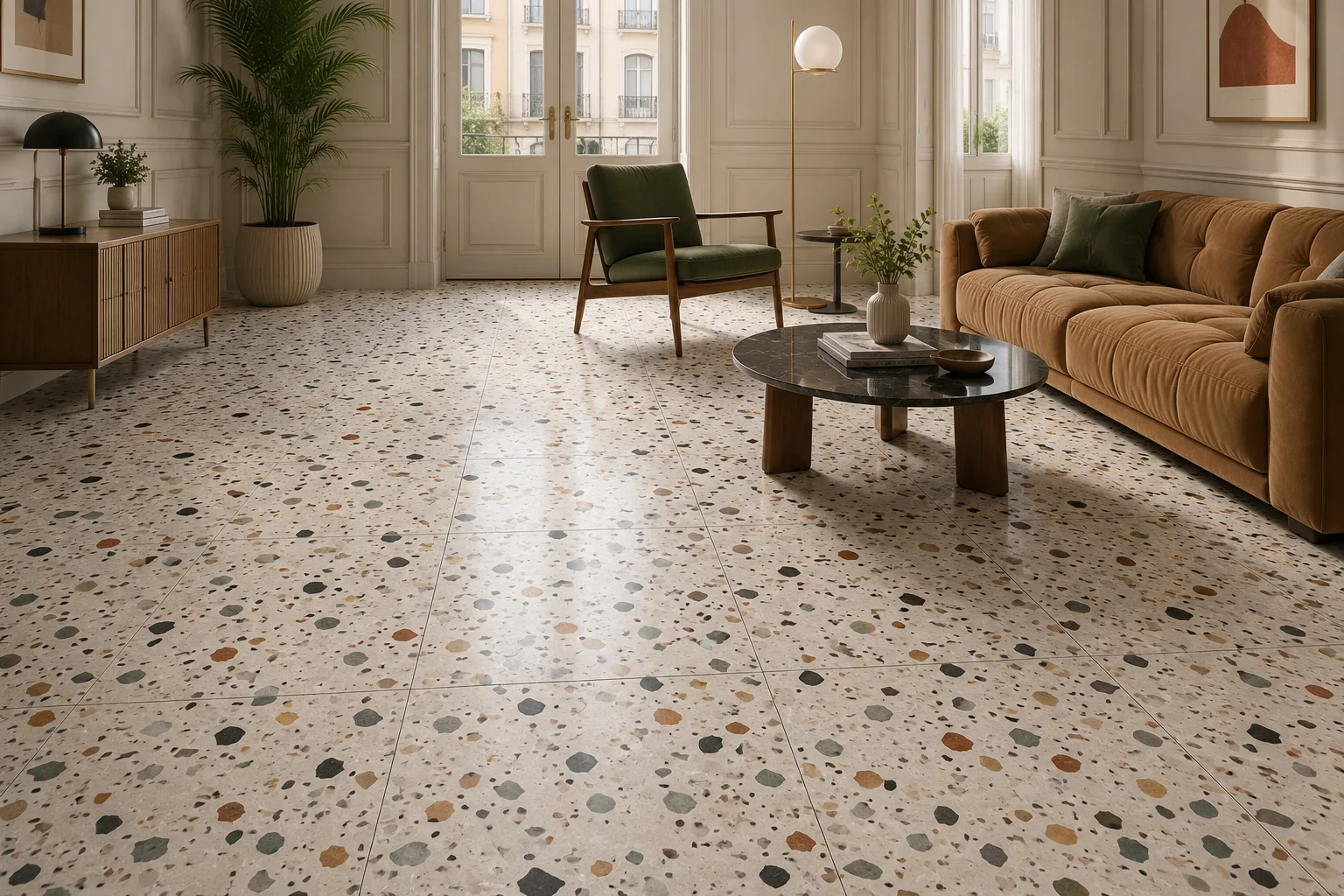
Digital printing technology has made it possible to replicate terrazzo's distinctive speckled aggregate pattern on porcelain tile with impressive visual accuracy, at a significantly lower installation cost and complexity than either poured-in-place or manufactured composite terrazzo. Terrazzo-look porcelain offers the same design character - customisable in scale, density, and colour palette to mimic marble-chip, glass-chip, or granite-chip terrazzo styles - combined with porcelain's inherent advantages: no sealing requirement, strong stain and scratch resistance, and straightforward standard tile installation without specialist grinding and polishing equipment.

The trade-off, as with any manufactured replica, is material authenticity - genuine terrazzo's embedded aggregate has a tactile, dimensional quality that a printed surface, however well executed, doesn't fully replicate up close. For most residential and many commercial applications, however, terrazzo-look porcelain delivers the visual impact people are drawn to at a fraction of the cost and maintenance commitment.

11. How to Choose Between Traditional Terrazzo and Porcelain Alternatives

Choose traditional terrazzo if: you want a genuinely seamless poured floor across a large or irregular area, material authenticity and tactile aggregate texture matter to the project, or you're specifying for extreme-durability institutional or high-traffic commercial use.

Choose terrazzo-look porcelain if: you want the aesthetic at standard tile installation cost and speed, you're working within a defined budget for a residential or moderate-traffic commercial project, or low ongoing maintenance is a priority over material authenticity.

12. Working with Probity Ceramic LLP: What Sets Us Apart

Probity Ceramic LLP manufactures terrazzo-look porcelain tiles designed to capture the distinctive speckled character of traditional terrazzo with the durability, consistency, and low maintenance of engineered porcelain.

Our terrazzo-look range includes:

•     High-definition digital printing replicating marble-chip, glass-chip, and granite-chip terrazzo styles, with customisable aggregate scale and density

•     A range of colourways from classic neutral terrazzo tones to bolder, contemporary palettes

•     Standard and large-format sizes, including options suited to minimal-grout, near-seamless installation

•     Matte and lightly polished finish options replicating the look of ground and sealed traditional terrazzo

•     Strong stain and scratch resistance with no sealing requirement, for genuinely low ongoing maintenance

What designers and distributors consistently ask us for:

Accurate aggregate scale and colour matching to reference terrazzo samples, batch consistency for larger commercial floor orders, and full-size physical samples to evaluate the pattern's realism before committing to a project.

We work with:

Interior designers and architects specifying terrazzo-look finishes for residential, hospitality, and commercial projects, distributors building a differentiated decorative product line, and construction companies sourcing consistent terrazzo-style flooring at scale.

Conclusion

Terrazzo's distinctive speckled character has earned it a lasting place in both commercial and residential design, and for projects that call for genuine seamlessness or extreme institutional durability, traditional poured or manufactured terrazzo remains a strong choice. But for buyers drawn to the look without the installation complexity, cost, and maintenance commitment of traditional terrazzo, modern terrazzo-look porcelain offers a genuinely compelling alternative.

Understanding the real differences between the two — in cost, installation, maintenance, and material authenticity — is what makes it possible to choose the right option for your specific project, rather than defaulting to one without weighing the trade-offs.