Porcelain vs Ceramic Tiles: Which Is Better?
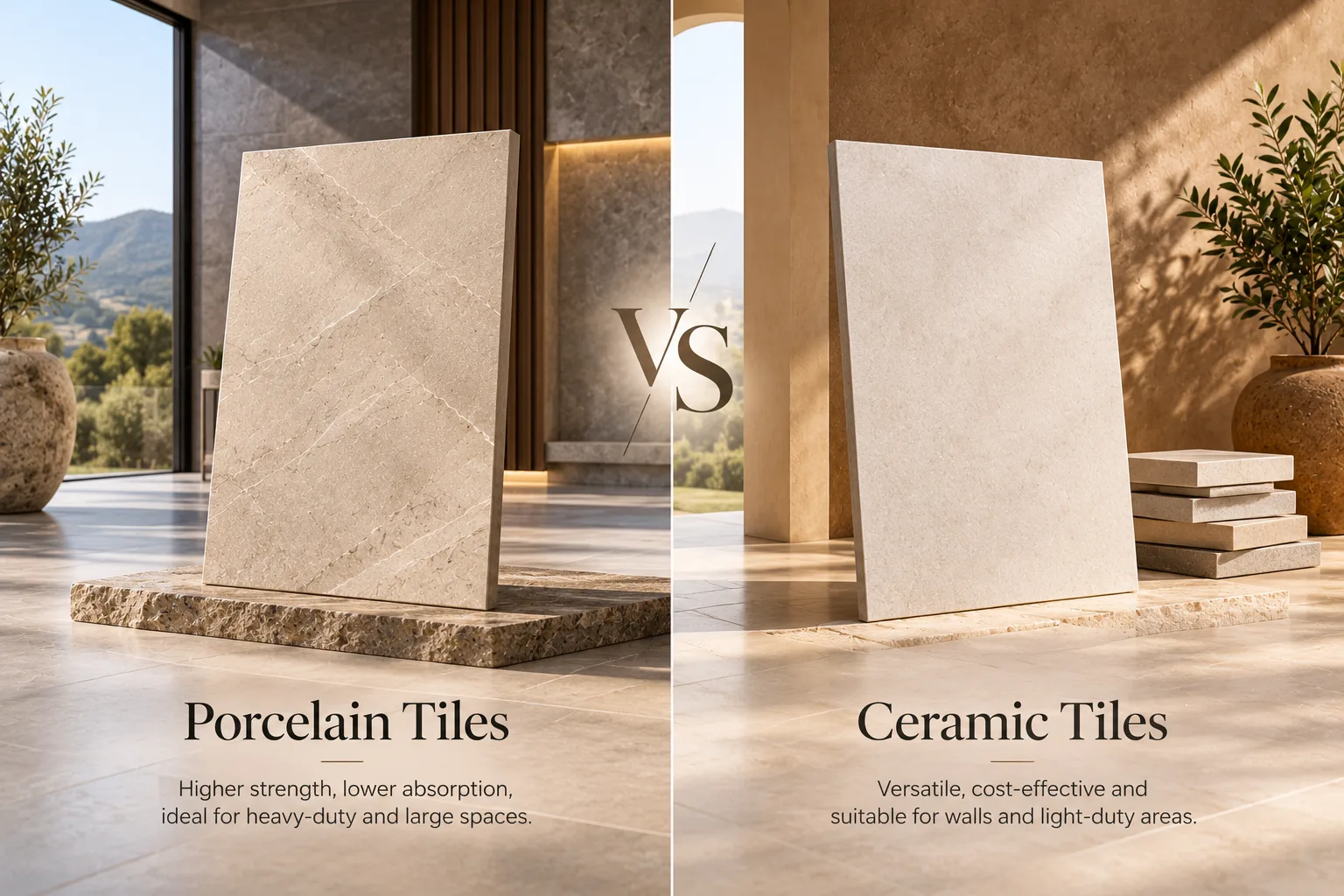
Porcelain vs Ceramic Tiles: Which Is Better for Your Project?
Choosing between porcelain and ceramic tiles is not simply a matter of selecting the stronger or more expensive material. The right choice depends on where the tile will be installed, traffic, moisture and weather exposure, design goals, installation requirements and total project budget.
Porcelain is often a practical option for floors and demanding applications because of its very low water absorption. Ceramic tiles can be an excellent, cost-effective choice for many interior walls and for floor applications when the specific product is rated for that use. Neither category is automatically right for every space.
For importers, distributors, architects, contractors, developers and homeowners, the most reliable approach is to compare the specification of the actual product—not just the label on the carton. This guide explains the differences, applications, buying checks and decision process.
1. What Are Ceramic Tiles?
Ceramic tile is a broad category of fired clay-based surfacing products. Raw materials, body composition, forming method, firing conditions and surface treatment influence the finished tile’s properties. Ceramic tiles may be glazed or unglazed and come in many sizes, colours, patterns and finishes.
Glazed ceramic wall tiles are widely used in kitchens, bathrooms and other interior spaces because they offer extensive design options and are often relatively economical. Some ceramic products are also suitable for floors; suitability should be confirmed from the product’s technical data and intended-use guidance.
The word “ceramic” does not, by itself, establish whether a tile is suitable for a wet floor, heavy traffic or outdoor use. Check the actual product’s absorption, strength, wear resistance, slip performance and declared application.
2. What Are Porcelain Tiles?
Porcelain tile is a defined category of ceramic tile characterised by very low water absorption. Under the North American definition used by the Tile Council of North America, porcelain tile has water absorption of 0.5% or less when tested using the applicable method. Other markets may use standards such as EN 14411 and ISO test methods, so buyers should confirm the standard and method stated in the product documentation.
Porcelain tiles are commonly selected for floors, busy residential areas, commercial interiors and certain exterior applications. They are available in glazed and unglazed formats, including polished, matt, textured, stone-look, wood-look and marble-look designs.
Low absorption is an important characteristic, but it does not automatically guarantee that every porcelain tile is frost-resistant, slip-resistant or suitable for every application. Check the manufacturer’s product-specific technical literature.
3. Porcelain vs Ceramic Tiles: Key Differences
| Factor | Porcelain tiles | Ceramic tiles |
|---|---|---|
| Definition | Ceramic tile category with very low absorption; commonly ≤0.5% under the applicable definition and test method | Broad category of fired clay-based tiles with varied properties |
| Water absorption | Typically very low; verify the declared value and test method | Varies by product and category |
| Body | Often dense and hard | Ranges from porous wall tiles to robust floor products |
| Typical uses | Floors, high-use spaces and selected exterior uses when rated | Interior walls and selected floors or specialist uses when rated |
| Design | Many stone-look, marble-look, wood-look, matt and polished options | Many decorative, wall, mosaic and other design options |
| Cutting | Often harder to cut and drill; suitable tools may be needed | Many products are easier to cut, but product properties vary |
| Cost | Can cost more depending on specification, format and finish | Often economical, especially for many wall-tile ranges |
| Best decision basis | Verified product performance for the application | Verified product performance for the application |
These are general tendencies, not guarantees. Actual performance varies with product, thickness, finish, manufacturing specification and applicable standard.
4. Water Absorption: Important, but Not the Only Factor
Water absorption measures how much water a tile body absorbs under a defined test. It helps distinguish porcelain from non-porcelain products in standards that use a 0.5% threshold. Low absorption can be useful where moisture exposure or freeze-thaw conditions matter.
Absorption alone is not a complete quality score. Strength, wear, surface performance, dimensional consistency and slip characteristics also matter. Waterproofing, grout, drainage and workmanship are important parts of a complete tiled assembly.
5. Which Is Better for Flooring?
Porcelain is often a strong starting point for floors, particularly where traffic, moisture or durability demands are higher. It is widely used in living rooms, corridors, kitchens, retail spaces, offices and hospitality projects. A ceramic floor tile specifically designed and rated for the use may also be appropriate.
Do not assume every porcelain tile is suitable for every floor. A highly polished surface, for example, may not be appropriate for a wet public entrance. Request test data relevant to the actual environment.
6. Which Is Better for Bathroom and Kitchen Walls?
Both materials can work well on bathroom and kitchen walls when suitable for the application and correctly installed. Ceramic wall tiles are often economical and design-flexible for backsplashes, shower walls and decorative features. Porcelain can be useful where a project calls for coordinated floor-and-wall surfaces, larger formats or a particular performance profile.
In wet areas, the tile is only one part of the system. Waterproofing behind the tile, correct detailing around penetrations, suitable adhesives and grout, and good workmanship are essential. Do not assume tile and grout replace a properly designed waterproofing system.
For kitchen backsplashes, cleanability, resistance to routine cleaners and desired appearance may matter more than choosing the lowest-absorption body available.
7. Which Is Better for Outdoor Areas?
Porcelain is frequently considered for outdoor applications because many products have low water absorption. But low absorption alone does not prove exterior suitability. Rain, temperature changes, surface contamination, drainage and—in colder climates—freeze-thaw exposure may affect performance.
Some non-porcelain tiles are suitable for particular exterior environments too. Choose based on verified performance and local project requirements, not category alone.
8. Which Offers Better Durability?
Porcelain’s dense body and low absorption can be advantageous, but durability is not a single property. Wear, impact, staining, chemical resistance, thermal performance and surface scratching are different questions.
Glazed porcelain and glazed ceramic products rely partly on the surface glaze. Unglazed products have different surface characteristics. A tile’s suitability depends on the tested properties of the complete product, not merely the word “porcelain”.
For retail, hospitality, office and other commercial projects, match the product to expected traffic and maintenance conditions. Do not rely on vague claims such as “heavy duty” without supporting technical information.
9. Cost: Compare Total Installed Cost
Ceramic tiles are often less expensive than comparable porcelain alternatives, particularly for wall applications. The actual price difference varies by format, finish, design, brand, origin and order volume.
A lower-cost tile can be the best value if it meets the application requirements. Paying more for porcelain makes sense when its verified performance, format or design benefits matter to the project.
10. Design, Finish and Format
Both categories offer contemporary colours, patterns and finishes. Porcelain is common in large-format stone-look, marble-look, concrete-look and wood-look collections, while ceramic tiles offer extensive decorative options for walls, backsplashes and feature areas.
Glossy or polished finishes create a reflective appearance; matt and structured finishes can feel more understated or tactile. Finish must suit both the design and intended use, including cleanability, slip performance and maintenance.
Large-format tiles and slabs require extra attention to handling, substrate flatness, movement through the building, adhesive coverage and installer capability. Check the actual dimensions, thickness, weight and installation guidance.
11. Installation: The Right Product Needs the Right System
Porcelain can be harder to cut and drill than many ceramic tiles, so suitable equipment and experienced installers may be important. Large or heavy formats can require specialist handling. Ceramic installation also depends on substrate preparation, adhesive selection, layout planning and movement joints.
12. Ceramic vs Porcelain: Room-by-Room Guide
| Project area | Likely starting point | What to verify |
|---|---|---|
| Kitchen backsplash | Ceramic or porcelain wall tile | Cleanability, finish, dimensions and wall compatibility |
| Bathroom wall | Ceramic or porcelain | Wet-area detailing and installation system |
| Living-room floor | Porcelain or a suitably rated floor tile | Traffic, wear, slip characteristics and maintenance |
| Retail or office floor | Often porcelain, subject to specification | Traffic, abrasion, strength, slip and cleaning |
| Balcony or terrace | Product explicitly rated for exterior use | Slip performance, frost resistance if relevant, drainage |
| Hotel/hospitality | Choose by area and operating conditions | Safety, maintenance and replacement availability |
| Feature wall | Ceramic or porcelain | Weight, fixing method, size and finish |
| Large-format surface/slab | Often porcelain slab product | Thickness, handling, fabrication and approved use |
This table is a starting point, not a substitute for product-specific technical approval.
13. Buyer’s Checklist Before Ordering
Importers and distributors should also clarify minimum order quantity, lead time, mixed-container options, private-label requirements, export packaging, shipping terms and documentation before confirming the purchase order.
14. Common Mistakes to Avoid
15. How Probity Ceramic LLP Can Support Product Evaluation
Probity Ceramic LLP manufactures and exports ceramic and porcelain tile products from Morbi, India, including products for interior applications, porcelain floors and walls, outdoor/parking uses and porcelain slabs. Buyers should assess the exact specification against the intended project rather than rely on broad category claims.
For a Probity enquiry, request the current catalogue, product code, size and thickness details, finish information, technical data sheet, relevant test documents, packaging specification, minimum order quantity and export lead time. Confirm the product’s availability and suitability for the destination market.
For distributor, project and private-label orders, clarify shade and calibre control, batch identification, packaging artwork, inspection access, shipment arrangements and the process for handling non-conforming goods.
The goal is a well-matched product and a clearly documented buying process that supports design intent, application requirements and reliable supply.
16. Final Verdict: Which Is Better?
Porcelain is often the stronger starting point for floors, busy spaces and applications where very low water absorption is a priority. Ceramic tiles can be an excellent, cost-effective choice for many interior walls and for floor applications when the selected product is appropriately rated.
The best tile is the one that meets the project’s technical requirements, visual goals, installation conditions and budget. Compare the actual product’s technical data, not just its category name. Verify slip performance for wet areas, frost resistance for cold outdoor conditions and suitability for the specific floor or wall application.
Define the use, compare the specification, inspect a sample, verify the documentation and choose a suitable installation system. That is more reliable than assuming one tile category is always better.
Frequently Asked Questions
Are porcelain tiles better than ceramic tiles?
Not in every situation. Porcelain is often preferred for floors and demanding applications because of low water absorption; ceramic can be economical and suitable for many interior walls. The exact product specification determines suitability.
What is the main difference between porcelain and ceramic tiles?
Porcelain is a defined category of ceramic tile with very low water absorption—commonly 0.5% or less under the applicable standard and test method. Ceramic tiles cover a wider range of products.
Can ceramic tiles be used on floors?
Yes. Some ceramic tiles are designed and rated for floors. Check technical data, intended application and relevant performance properties.
Are porcelain tiles waterproof?
Porcelain tile has very low water absorption, but a tiled surface is not the same as a waterproof building assembly. Wet areas still need correct waterproofing, joints and detailing.
Are porcelain tiles suitable for outdoors?
Some are, but suitability depends on the exact product, slip performance, frost resistance where relevant, drainage and installation system.
Which tile is better for bathrooms?
Both can be suitable. Ceramic is common on walls, while porcelain is often selected for floors. Verify performance and install proper waterproofing.
Which is more durable?
Porcelain’s dense body can be advantageous, but durability depends on tested wear, strength, surface and application properties.
Are porcelain tiles harder to install?
They can be harder to cut or drill than many ceramic tiles and may need appropriate tools and experienced installers.
Which is cheaper?
Ceramic is often less expensive in comparable decorative ranges, particularly for wall tiles. Compare total installed cost.
Can glossy tiles be used on a bathroom floor?
Do not decide from appearance alone. Request slip-resistance data appropriate to the wet conditions and follow local requirements.
What should bulk buyers request?
Ask for product-specific technical data, relevant test reports, approved samples, dimensional and shade information, packing details, batch traceability and written acceptance terms.
How should I compare products for commercial projects?
Define traffic, wet/dry conditions, cleaning regime and safety requirements, then match those needs to documented performance of the exact product.
Related Articles
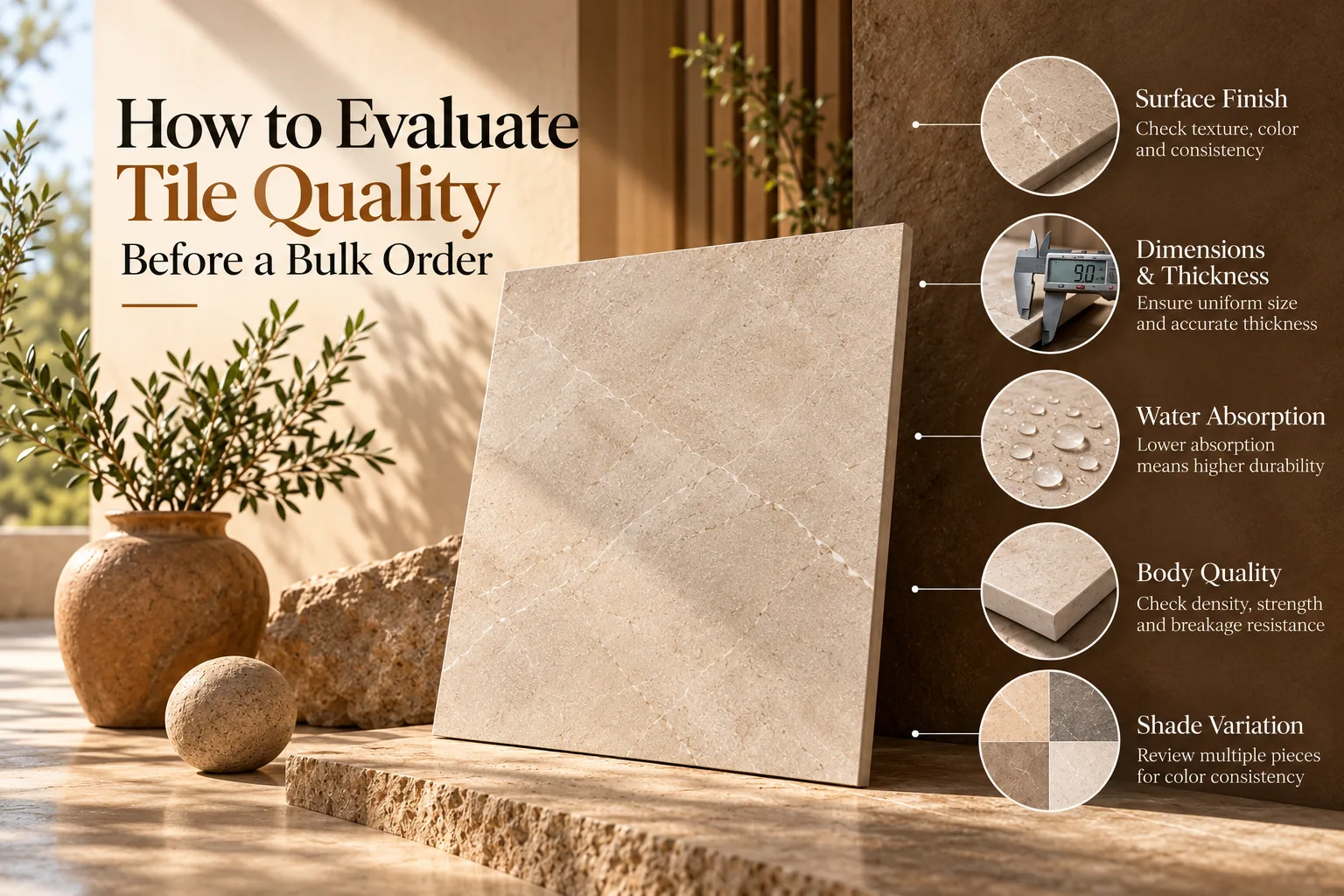
How to Evaluate Tile Quality Before a Bulk Order
Calacatta vs Statuario vs Carrara Porcelain Tiles