Technical
Calacatta vs Statuario vs Carrara Porcelain Tiles

Related Articles
Porcelain vs Ceramic Tiles: Which Is Better?
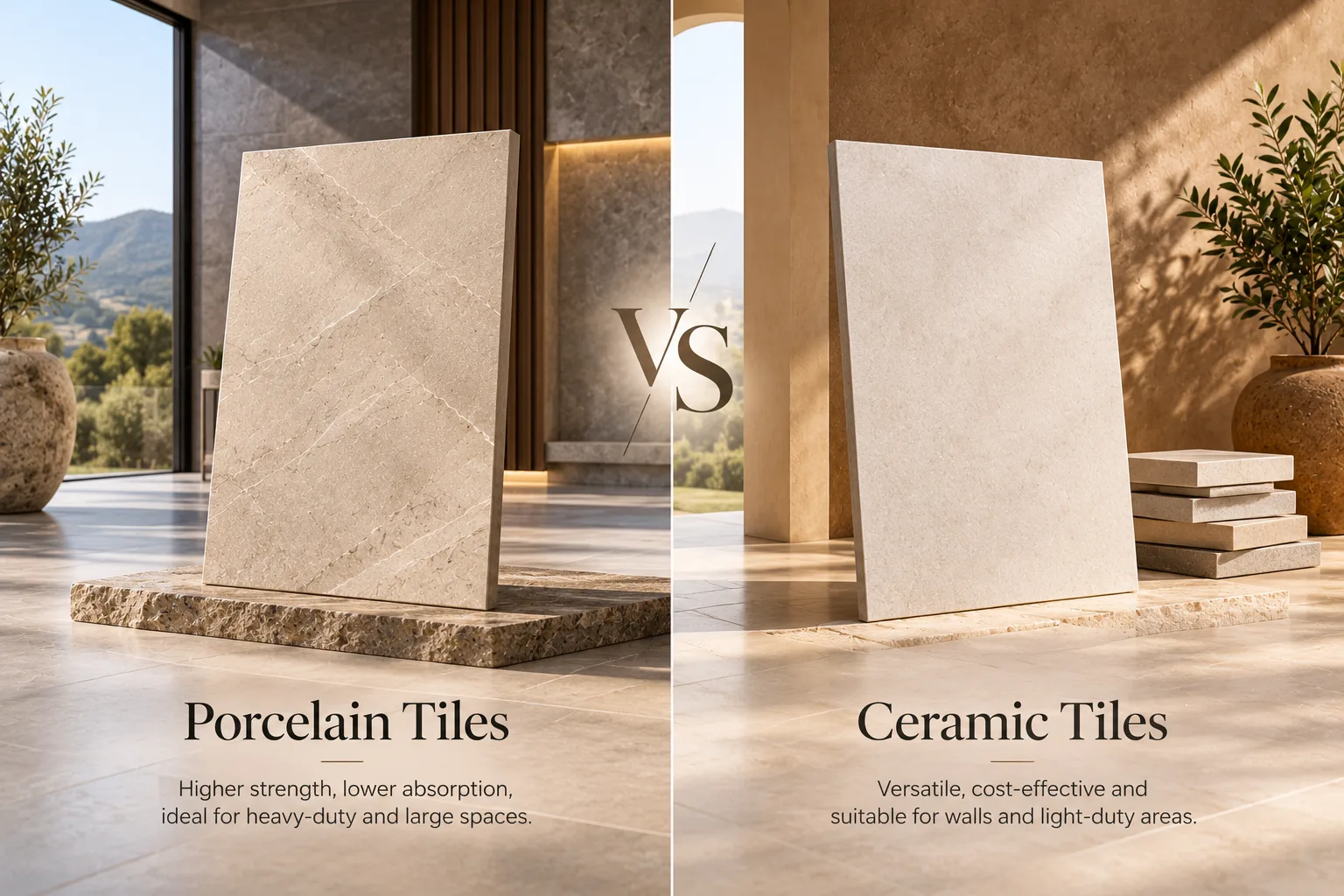
Porcelain vs Ceramic Tiles: Which Is Better for Your Project?Choosing between porcelain and ceramic tiles is not simply a matter of selecting the stronger or more expensive material. The right choice depends on where the tile will be installed, traffic, moisture and weather exposure, design goals, installation requirements and total project budget.Porcelain is often a practical option for floors and demanding applications because of its very low water absorption. Ceramic tiles can be an excellent, cost-effective choice for many interior walls and for floor applications when the specific product is rated for that use. Neither category is automatically right for every space.For importers, distributors, architects, contractors, developers and homeowners, the most reliable approach is to compare the specification of the actual product—not just the label on the carton. This guide explains the differences, applications, buying checks and decision process.1. What Are Ceramic Tiles?Ceramic tile is a broad category of fired clay-based surfacing products. Raw materials, body composition, forming method, firing conditions and surface treatment influence the finished tile’s properties. Ceramic tiles may be glazed or unglazed and come in many sizes, colours, patterns and finishes.Glazed ceramic wall tiles are widely used in kitchens, bathrooms and other interior spaces because they offer extensive design options and are often relatively economical. Some ceramic products are also suitable for floors; suitability should be confirmed from the product’s technical data and intended-use guidance.The word “ceramic” does not, by itself, establish whether a tile is suitable for a wet floor, heavy traffic or outdoor use. Check the actual product’s absorption, strength, wear resistance, slip performance and declared application.2. What Are Porcelain Tiles?Porcelain tile is a defined category of ceramic tile characterised by very low water absorption. Under the North American definition used by the Tile Council of North America, porcelain tile has water absorption of 0.5% or less when tested using the applicable method. Other markets may use standards such as EN 14411 and ISO test methods, so buyers should confirm the standard and method stated in the product documentation.Porcelain tiles are commonly selected for floors, busy residential areas, commercial interiors and certain exterior applications. They are available in glazed and unglazed formats, including polished, matt, textured, stone-look, wood-look and marble-look designs.Low absorption is an important characteristic, but it does not automatically guarantee that every porcelain tile is frost-resistant, slip-resistant or suitable for every application. Check the manufacturer’s product-specific technical literature.3. Porcelain vs Ceramic Tiles: Key DifferencesFactorPorcelain tilesCeramic tilesDefinitionCeramic tile category with very low absorption; commonly ≤0.5% under the applicable definition and test methodBroad category of fired clay-based tiles with varied propertiesWater absorptionTypically very low; verify the declared value and test methodVaries by product and categoryBodyOften dense and hardRanges from porous wall tiles to robust floor productsTypical usesFloors, high-use spaces and selected exterior uses when ratedInterior walls and selected floors or specialist uses when ratedDesignMany stone-look, marble-look, wood-look, matt and polished optionsMany decorative, wall, mosaic and other design optionsCuttingOften harder to cut and drill; suitable tools may be neededMany products are easier to cut, but product properties varyCostCan cost more depending on specification, format and finishOften economical, especially for many wall-tile rangesBest decision basisVerified product performance for the applicationVerified product performance for the applicationThese are general tendencies, not guarantees. Actual performance varies with product, thickness, finish, manufacturing specification and applicable standard.4. Water Absorption: Important, but Not the Only FactorWater absorption measures how much water a tile body absorbs under a defined test. It helps distinguish porcelain from non-porcelain products in standards that use a 0.5% threshold. Low absorption can be useful where moisture exposure or freeze-thaw conditions matter.Absorption alone is not a complete quality score. Strength, wear, surface performance, dimensional consistency and slip characteristics also matter. Waterproofing, grout, drainage and workmanship are important parts of a complete tiled assembly.•Ask for the declared water-absorption value.•Confirm the test method and applicable standard.•Check that the report identifies the product or a representative sample.•Verify all other properties relevant to the intended application.5. Which Is Better for Flooring?Porcelain is often a strong starting point for floors, particularly where traffic, moisture or durability demands are higher. It is widely used in living rooms, corridors, kitchens, retail spaces, offices and hospitality projects. A ceramic floor tile specifically designed and rated for the use may also be appropriate.•Expected traffic and likely loads•Abrasion or wear requirements•Slip-resistance requirements, especially in wet or public areas•Breaking strength and intended-use classification•Surface finish, cleaning regime and contaminants•Substrate condition, adhesive and installation methodDo not assume every porcelain tile is suitable for every floor. A highly polished surface, for example, may not be appropriate for a wet public entrance. Request test data relevant to the actual environment.6. Which Is Better for Bathroom and Kitchen Walls?Both materials can work well on bathroom and kitchen walls when suitable for the application and correctly installed. Ceramic wall tiles are often economical and design-flexible for backsplashes, shower walls and decorative features. Porcelain can be useful where a project calls for coordinated floor-and-wall surfaces, larger formats or a particular performance profile.In wet areas, the tile is only one part of the system. Waterproofing behind the tile, correct detailing around penetrations, suitable adhesives and grout, and good workmanship are essential. Do not assume tile and grout replace a properly designed waterproofing system.For kitchen backsplashes, cleanability, resistance to routine cleaners and desired appearance may matter more than choosing the lowest-absorption body available.7. Which Is Better for Outdoor Areas?Porcelain is frequently considered for outdoor applications because many products have low water absorption. But low absorption alone does not prove exterior suitability. Rain, temperature changes, surface contamination, drainage and—in colder climates—freeze-thaw exposure may affect performance.•Confirm the exact product is approved for the intended exterior use.•Check slip-resistance data for expected wet conditions.•Verify frost resistance where freezing temperatures are possible.•Confirm finish, slope, drainage and cleaning regime.•Use an installation system designed for exterior conditions.Some non-porcelain tiles are suitable for particular exterior environments too. Choose based on verified performance and local project requirements, not category alone.8. Which Offers Better Durability?Porcelain’s dense body and low absorption can be advantageous, but durability is not a single property. Wear, impact, staining, chemical resistance, thermal performance and surface scratching are different questions.Glazed porcelain and glazed ceramic products rely partly on the surface glaze. Unglazed products have different surface characteristics. A tile’s suitability depends on the tested properties of the complete product, not merely the word “porcelain”.For retail, hospitality, office and other commercial projects, match the product to expected traffic and maintenance conditions. Do not rely on vague claims such as “heavy duty” without supporting technical information.9. Cost: Compare Total Installed CostCeramic tiles are often less expensive than comparable porcelain alternatives, particularly for wall applications. The actual price difference varies by format, finish, design, brand, origin and order volume.•Tile price per square metre, including relevant freight and duties•Cutting, drilling, tools and installer skill•Adhesive and installation-system requirements•Breakage during transport, handling and installation•Waste allowance for cuts and complex layouts•Maintenance needs and expected service life•Availability of matching stock for repairs and repeat ordersA lower-cost tile can be the best value if it meets the application requirements. Paying more for porcelain makes sense when its verified performance, format or design benefits matter to the project.10. Design, Finish and FormatBoth categories offer contemporary colours, patterns and finishes. Porcelain is common in large-format stone-look, marble-look, concrete-look and wood-look collections, while ceramic tiles offer extensive decorative options for walls, backsplashes and feature areas.Glossy or polished finishes create a reflective appearance; matt and structured finishes can feel more understated or tactile. Finish must suit both the design and intended use, including cleanability, slip performance and maintenance.Large-format tiles and slabs require extra attention to handling, substrate flatness, movement through the building, adhesive coverage and installer capability. Check the actual dimensions, thickness, weight and installation guidance.11. Installation: The Right Product Needs the Right SystemPorcelain can be harder to cut and drill than many ceramic tiles, so suitable equipment and experienced installers may be important. Large or heavy formats can require specialist handling. Ceramic installation also depends on substrate preparation, adhesive selection, layout planning and movement joints.•Ensure the substrate is sound, clean, flat and suitable for the format.•Select adhesive compatible with tile, substrate and conditions.•Follow the tile and installation-system manufacturers’ instructions.•Include suitable grout joints and movement joints.•Use proper waterproofing and drainage in wet areas.•Plan safe handling and installation for large-format products.12. Ceramic vs Porcelain: Room-by-Room GuideProject areaLikely starting pointWhat to verifyKitchen backsplashCeramic or porcelain wall tileCleanability, finish, dimensions and wall compatibilityBathroom wallCeramic or porcelainWet-area detailing and installation systemLiving-room floorPorcelain or a suitably rated floor tileTraffic, wear, slip characteristics and maintenanceRetail or office floorOften porcelain, subject to specificationTraffic, abrasion, strength, slip and cleaningBalcony or terraceProduct explicitly rated for exterior useSlip performance, frost resistance if relevant, drainageHotel/hospitalityChoose by area and operating conditionsSafety, maintenance and replacement availabilityFeature wallCeramic or porcelainWeight, fixing method, size and finishLarge-format surface/slabOften porcelain slab productThickness, handling, fabrication and approved useThis table is a starting point, not a substitute for product-specific technical approval.13. Buyer’s Checklist Before Ordering•Define the installation area and environmental conditions.•Confirm product category, SKU, size, thickness and finish.•Request the current technical data sheet.•Verify absorption and relevant test methods.•Check wear, strength, slip and other application-specific properties.•Review the sample under suitable lighting.•Confirm shade, calibre and visual variation.•Check packaging, batch identification and repeat-order availability.•For bulk orders, agree on inspection, acceptance criteria and claims procedure.•Confirm local regulations and project specifications are met.Importers and distributors should also clarify minimum order quantity, lead time, mixed-container options, private-label requirements, export packaging, shipping terms and documentation before confirming the purchase order.14. Common Mistakes to Avoid1.Assuming all porcelain tiles are automatically better than all ceramic tiles.1.Treating low absorption as proof of slip resistance or frost resistance.1.Selecting a wet-floor tile based only on appearance.1.Comparing prices without matching size, thickness, finish and specification.1.Assuming every ceramic tile is suitable only for walls.1.Ignoring installer capability, substrate flatness and adhesive compatibility.1.Relying on generic descriptions instead of SKU-specific documentation.1.Failing to account for cutting waste, breakage and replacement stock.15. How Probity Ceramic LLP Can Support Product EvaluationProbity Ceramic LLP manufactures and exports ceramic and porcelain tile products from Morbi, India, including products for interior applications, porcelain floors and walls, outdoor/parking uses and porcelain slabs. Buyers should assess the exact specification against the intended project rather than rely on broad category claims.For a Probity enquiry, request the current catalogue, product code, size and thickness details, finish information, technical data sheet, relevant test documents, packaging specification, minimum order quantity and export lead time. Confirm the product’s availability and suitability for the destination market.For distributor, project and private-label orders, clarify shade and calibre control, batch identification, packaging artwork, inspection access, shipment arrangements and the process for handling non-conforming goods.The goal is a well-matched product and a clearly documented buying process that supports design intent, application requirements and reliable supply.16. Final Verdict: Which Is Better?Porcelain is often the stronger starting point for floors, busy spaces and applications where very low water absorption is a priority. Ceramic tiles can be an excellent, cost-effective choice for many interior walls and for floor applications when the selected product is appropriately rated.The best tile is the one that meets the project’s technical requirements, visual goals, installation conditions and budget. Compare the actual product’s technical data, not just its category name. Verify slip performance for wet areas, frost resistance for cold outdoor conditions and suitability for the specific floor or wall application.Define the use, compare the specification, inspect a sample, verify the documentation and choose a suitable installation system. That is more reliable than assuming one tile category is always better.Frequently Asked QuestionsAre porcelain tiles better than ceramic tiles?Not in every situation. Porcelain is often preferred for floors and demanding applications because of low water absorption; ceramic can be economical and suitable for many interior walls. The exact product specification determines suitability.What is the main difference between porcelain and ceramic tiles?Porcelain is a defined category of ceramic tile with very low water absorption—commonly 0.5% or less under the applicable standard and test method. Ceramic tiles cover a wider range of products.Can ceramic tiles be used on floors?Yes. Some ceramic tiles are designed and rated for floors. Check technical data, intended application and relevant performance properties.Are porcelain tiles waterproof?Porcelain tile has very low water absorption, but a tiled surface is not the same as a waterproof building assembly. Wet areas still need correct waterproofing, joints and detailing.Are porcelain tiles suitable for outdoors?Some are, but suitability depends on the exact product, slip performance, frost resistance where relevant, drainage and installation system.Which tile is better for bathrooms?Both can be suitable. Ceramic is common on walls, while porcelain is often selected for floors. Verify performance and install proper waterproofing.Which is more durable?Porcelain’s dense body can be advantageous, but durability depends on tested wear, strength, surface and application properties.Are porcelain tiles harder to install?They can be harder to cut or drill than many ceramic tiles and may need appropriate tools and experienced installers.Which is cheaper?Ceramic is often less expensive in comparable decorative ranges, particularly for wall tiles. Compare total installed cost.Can glossy tiles be used on a bathroom floor?Do not decide from appearance alone. Request slip-resistance data appropriate to the wet conditions and follow local requirements.What should bulk buyers request?Ask for product-specific technical data, relevant test reports, approved samples, dimensional and shade information, packing details, batch traceability and written acceptance terms.How should I compare products for commercial projects?Define traffic, wet/dry conditions, cleaning regime and safety requirements, then match those needs to documented performance of the exact product.
How to Evaluate Tile Quality Before a Bulk Order
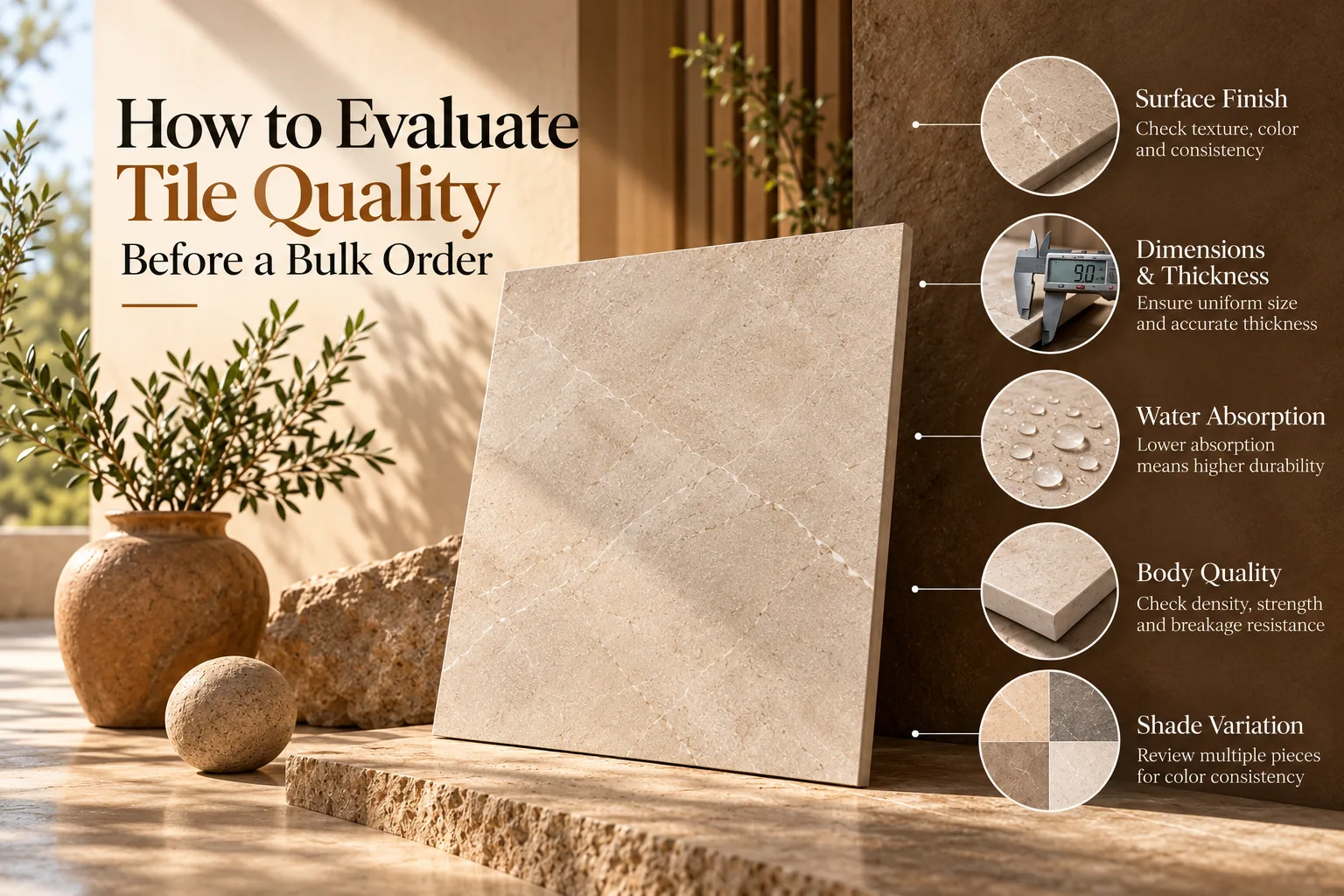
How to Evaluate the Quality of Tiles Before Placing a Bulk Order
A tile sample can look excellent in a showroom and still fail to represent the consistency or performance of a full container. For importers, distributors, wholesalers, retailers, builders and project buyers, evaluating tile quality before placing a bulk order is a procurement control—not just a visual check.
Shade variation, inconsistent dimensions, damaged edges, unsuitable slip performance, weak packaging or missing technical documents can lead to complaints, installation delays, replacement costs and reputational damage. A disciplined process combines a clear specification, representative samples, technical evidence, inspection, packaging checks and written acceptance criteria.
This guide provides a practical framework for ceramic tiles, vitrified tiles, porcelain tiles and large-format surfaces. Testing requirements vary by product and destination market; always verify the exact SKU and applicable standards.
1. Define the Product Specification First
Terms such as “premium quality”, “first choice” or “export quality” are not complete specifications. Before requesting quotes, document:
• Product category and exact SKU
• Intended application: wall, floor, wet area, exterior or commercial use
• Nominal size, thickness and declared tolerances
• Finish: polished/glossy, matt, structured or other
• Edge type: rectified or non-rectified
• Required technical performance for the application
• Applicable standards and test methods
• Shade, calibre and acceptable visual variation
• Packaging, labelling and batch identification
• Quantity, destination market and delivery schedule
A good specification allows multiple suppliers to quote comparable products and gives an inspector measurable acceptance criteria.
2. Do Not Rely on One Attractive Sample
One sample helps assess design and finish but cannot establish consistency across an entire order. Use a repeatable approval process:
• Request samples from the exact SKU, size and finish being quoted.
• Confirm product code, thickness, shade and finish.
• Inspect several pieces, not only one.
• Review under different lighting conditions and from normal viewing distance.
• For marble-look, wood-look or textured designs, ask about the number of faces and intentional variation.
• Keep a labelled, dated reference sample.
• Record the approved specification and agreed tolerances.
• Confirm that production will match the approved sample and documents.
For large projects, arrange a mock-up made from multiple pieces. This can reveal pattern repetition, shade differences and joint appearance that a single tile cannot show.
3. Visual Inspection: What to Look For
Area
Check
Why it matters
Surface
Pinholes, scratches, stains, glaze or print defects
Appearance and saleability
Colour/shade
Consistency with approved sample and between pieces
Prevents patchy installed surfaces
Pattern
Vein distribution, face variation, print alignment
Important for decorative designs
Edges/corners
Chips, cracks, uneven edges
Affects installation and usable yield
Finish
Gloss, texture and surface uniformity
Confirms the ordered look
Flatness
Visible bowing or distortion; measure where required
Can affect lippage and installation
Contamination
Unwanted residue or marks
May indicate handling or production issues
Inspect pieces together and sample across packs or pallets where possible. Visual inspection is useful, but it does not replace dimensional measurement or laboratory testing.
4. Check Dimensions, Thickness and Calibration
Nominal dimensions do not mean every tile measures exactly the nominal size. Use appropriate calibrated tools and compare results with the manufacturer's declared tolerances and applicable standard.
• Measure length and width using the relevant method.
• Measure thickness at suitable points.
• Check squareness and edge consistency where relevant.
• Assess flatness and warpage using the correct method.
• Confirm rectified/non-rectified status and the calibre system.
• Compare multiple pieces from the sample set and, during inspection, across the batch.
Dimensional inconsistency can create uneven joints, lippage, cutting waste and slower installation. Large-format products need particular attention to flatness, edge protection and installation tolerances. Do not apply a universal pass/fail tolerance: use the agreed specification and applicable standard.
5. Understand Water Absorption and Product Category
Water absorption is an important technical property, particularly when identifying product categories and assessing intended use. Request the declared value and supporting test information for the exact product.
Low water absorption alone is not a complete quality score. Strength, surface performance, dimensional characteristics and application suitability also matter.
• What product category is being supplied?
• What water-absorption value is declared?
• Which standard and test method were used?
• Does the report identify the same SKU or a genuinely comparable sample?
• Can the laboratory report be verified?
Ceramic wall tiles, floor tiles, porcelain products and large-format slabs can have different properties and uses. Do not assume they are interchangeable.
6. Verify Performance for the Intended Application
Property
When it matters
What to request
Breaking strength
Flooring, handling and application-specific demands
Relevant test results and standard
Abrasion/wear
Floor applications subject to wear
Applicable classification or test result
Slip resistance
Wet areas, entrances and public spaces
Test method, result and intended-use guidance
Chemical resistance
Commercial or cleaning-intensive settings
Relevant report or declared classification
Stain resistance
Kitchens and stain-prone settings
Product-specific test information
Frost resistance
Exterior or freezing environments
Applicable test result
Other specialist properties
Projects with specific environmental demands
Application-relevant documentation
Test classifications may not be directly comparable across methods. Ask which standard was used and confirm that it meets the destination market and project specification.
7. Check Slip Resistance—Do Not Guess by Touch
Slip resistance is safety-related. It cannot be reliably judged from a photograph or by rubbing a hand across the tile. Glossy is not automatically unsuitable for every floor, and matt is not automatically safe in every wet environment.
Specify the intended conditions—wet or dry, barefoot or shod, slope, contamination and cleaning regime—and request a test method appropriate to that use. Confirm local rules and project requirements. Never compare slip-resistance numbers without checking that the methods and conditions are comparable.
8. Assess Shade, Batch and Design Consistency
Some designs intentionally vary from piece to piece. The objective is to ensure the delivered variation matches the approved design and declared range, rather than demanding identical patterns where variation is intentional.
• Clarify how shade and calibre are identified.
• Ask whether the order will be produced in one batch or multiple batches.
• Confirm the number of faces or patterns.
• Agree on acceptable variation and how it will be assessed.
• Ask how replacement material will be matched to the original batch.
• Approve a multi-piece mock-up for prominent projects.
Batch and shade controls are particularly important when the tiles will be installed across large continuous areas or sold through distributors as a consistent collection.
9. Inspect Rectification and Edge Quality
Rectified tiles have mechanically finished edges intended to provide more consistent dimensions within the product specification. Rectification does not eliminate grout joints or guarantee perfect installation.
Inspect edge straightness, corner damage, chips and consistency. If the product is sold as rectified, confirm declared dimensional tolerances. For large-format tiles and slabs, a damaged edge can make a costly piece unusable.
10. Packaging Is Part of Product Quality
A good tile can arrive damaged if packaging and loading are inadequate. Agree on a written packing specification before shipment.
• Carton strength and internal protection
• Number of pieces and square metres per box
• Labels showing SKU, size, shade, calibre and batch
• Pallet/crate stability and edge protection
• Slab-specific racks or crates where required
• Container securing and weight distribution
• Gross weight, dimensions and safe unloading requirements
• Photographs of packing and loading during inspection
Requirements differ for standard tiles, polished surfaces, fragile edges and large-format slabs. Confirm packaging is suitable for the actual product and transport route.
11. Arrange Pre-Shipment Inspection for Significant Orders
For a substantial or high-risk order, consider an independent pre-shipment inspection. Agree on the scope before production or shipment.
• Verify product identity against the purchase order.
• Check quantity, size, thickness, finish and shade/calibre.
• Sample across cartons, pallets or production lots.
• Perform agreed visual and dimensional checks.
• Check packaging, labels, batch identification and traceability.
• Verify agreed documents.
• Capture photographs and issue a written report.
Sampling should reflect order size and risk. It cannot guarantee every unit is defect-free, but a documented plan is stronger than informal spot-checking.
12. What a Useful Test Report Should Contain
• Clear product name, code, type or sample identification
• Manufacturer or responsible party
• Test standard and method
• Test date, result and units
• Laboratory identity and relevant accreditation information, where applicable
• Scope notes, limitations or conditioning details
• A clear link between the tested sample and ordered product
A certificate logo or generic claim such as “international quality” is not a substitute for a verifiable report. Confirm destination-market conformity requirements with the relevant authority or a qualified compliance professional.
13. Agree on Acceptance Criteria Before Ordering
One preventable mistake is leaving “acceptable quality” undefined. The purchase order should refer to the approved specification and state how conformity will be assessed.
• Approved sample and exact SKU
• Applicable standards and test methods
• Dimensional and thickness tolerances
• Shade/calibre and visual acceptance criteria
• Defect categories and sampling approach
• Packaging and labelling requirements
• Inspection timing and access
• Claim notification period and required evidence
• Replacement, credit or other agreed remedy
Put important requirements in writing. Commercial and legal terms should be reviewed for the transaction and destination market.
14. Common Tile Quality Evaluation Mistakes
• Approving a bulk order from one attractive sample alone.
• Comparing products with different sizes, thicknesses, finishes or uses.
• Treating “first quality” or “export quality” as a complete specification.
• Ignoring dimensional tolerance and flatness.
• Assuming appearance proves technical performance.
• Relying on a generic test report that may not represent the ordered SKU.
• Failing to agree on shade and calibre variation.
• Inspecting only the first carton or easiest pallet.
• Ignoring packaging, loading and unloading.
• Leaving claims and remedies undefined until after shipment.
• Not retaining an approved reference sample.
• Failing to check destination-market requirements.
15. Supplier Evaluation Checklist for Importers and Distributors
Area
Questions for the manufacturer
Product identity
Does the quotation state the exact SKU, size, thickness and finish?
Sample approval
Can we retain a labelled reference sample?
Technical data
Are current product-specific data and reports available?
Consistency
How are shade, calibre and batches controlled?
Inspection
Can we appoint an inspector before shipment?
Packaging
Can you provide the packing specification and loading evidence?
Traceability
Will cartons show product, shade/calibre and batch information?
Compliance
Which documents are relevant to the destination market?
Claims
What is the process and deadline for reporting defects or damage?
Repeat orders
How will future batches match the approved specification?
A reliable supplier should answer clearly and provide evidence where relevant. Inconsistent descriptions or evasive answers are reasons to pause and investigate.
16. A Practical Quality Scorecard
Score each factor from 1 (weak evidence or poor fit) to 5 (strong evidence and good fit). Adjust weights to the product and market.
Factor
Suggested weight
Evidence
Visual quality and sample match
15%
Approved samples and inspection
Dimensions, thickness and flatness
15%
Measurements and applicable tests
Technical performance
20%
Product-specific reports
Shade and batch consistency
15%
Batch controls, samples, mock-up
Packaging and logistics
10%
Packing specification and loading evidence
Compliance documentation
10%
Relevant certificates and test documents
Inspection and traceability
5%
Inspection plan and batch labels
Claims and after-sales
10%
Written policy and contract terms
This scorecard is a decision aid, not a substitute for mandatory testing. A product that fails a critical safety, regulatory or project requirement should not pass because it scores well elsewhere.
17. Extra Checks for Large-Format Tiles and Porcelain Slabs
• Confirm exact dimensions and thickness for every format.
• Check flatness and tolerances using the appropriate method.
• Inspect edges and corners carefully.
• Confirm intended application and installation system.
• Plan movement through doors, corridors, lifts and stairs.
• Verify lifting, storage and unloading requirements.
• Confirm packaging is designed for the specific slab size.
• Review fabrication requirements where cutting is planned.
• Approve a multi-piece mock-up for prominent marble-look designs.
• Plan material for cutting, breakage and future repairs.
A slab suitable for a wall is not automatically suitable for flooring, worktops or exterior use. Obtain written application guidance for the exact product.
18. How Probity Fits into a Bulk-Sourcing Evaluation
Probity Ceramic LLP is an India-based ceramic and porcelain tile manufacturer/exporter whose portfolio includes ceramic tiles, porcelain tiles and large-format slab products. The same disciplined evaluation process should apply to Probity as to any shortlisted supplier.
Request the current catalogue, exact SKU details, physical samples, technical data sheets, relevant test documents, packaging specifications, MOQ, production lead time and written export quotation. Confirm all information against the selected product and destination market.
For export or private-label orders, also clarify carton artwork, barcode and label requirements, batch traceability, mixed-container rules, inspection access and the process for non-conforming goods.
The objective is not simply to find a supplier who says its tiles are high quality. It is to select a supplier whose specification, evidence, process and contractual commitments make quality verifiable.
19. Bulk Tile Quality Checklist Before Purchase Order Approval
• ☐ Intended application and destination market defined
• ☐ Exact product type, SKU, size, thickness and finish confirmed
• ☐ Physical sample approved and labelled
• ☐ Multiple pieces checked for visual consistency
• ☐ Shade, calibre and face variation discussed
• ☐ Dimensional and flatness tolerances documented
• ☐ Relevant technical data and reports reviewed
• ☐ Slip resistance checked where applicable
• ☐ Packaging and carton/crate markings approved
• ☐ Destination-market compliance checked
• ☐ Pre-shipment inspection plan agreed
• ☐ Sampling and acceptance criteria documented
• ☐ Claim window and remedies written into contract
• ☐ Quantity, MOQ, lead time and shipment terms confirmed
• ☐ Reference sample and product records retained
20. Final Verdict: Quality Must Be Verifiable
The safest way to evaluate tile quality before a bulk order is to combine visual inspection, dimensional checks, technical evidence, packaging review, batch controls and a written acceptance process.
No single test, certificate or attractive sample answers every quality question. The correct checks depend on product type, application, destination market and commercial risk.
For importers and distributors, the goal is repeatable quality: a product that matches the approved specification in the delivered shipment and in future repeat orders. Define the specification, approve a representative sample, verify the data, inspect the shipment and document acceptance criteria. This turns quality from a sales promise into a procurement standard.
Frequently Asked Questions
How can I check tile quality before placing a bulk order?
Define the specification, approve representative samples, inspect multiple pieces, verify dimensions and technical data, check packaging, and agree on pre-shipment inspection and acceptance criteria.
Is visual inspection enough to judge tile quality?
No. It can identify visible defects, but properties such as water absorption, strength and slip resistance may require appropriate tests and documentation.
What documents should I request from a tile manufacturer?
Request a product-specific technical data sheet, relevant test reports, applicable conformity documents, declared tolerances, packing details and product identification. Requirements depend on the product and market.
Why are shade and calibre important?
Differences can become visible across installations and affect joint consistency, installation time and saleable yield.
Should I hire a third-party inspector?
For substantial or high-risk orders, independent inspection can document product identity, condition, dimensions, packaging and agreed checks.
How do ceramic and porcelain tile quality checks differ?
Some checks overlap, but requirements depend on product category, applicable standards and intended use. Request data for the exact SKU.
How do I check slip resistance?
Request results using a method appropriate to the intended environment and confirm they meet local rules and project requirements.
How should large-format tiles or slabs be inspected?
Pay extra attention to dimensions, flatness, edges, handling, packaging, lifting and application suitability.
What if the shipment does not match the approved sample?
Document the issue promptly with photographs, labels, batch information and inspection evidence, then follow the contract's claim process and notification period.
Can a good test report still be followed by quality problems?
Yes. A report covers specific properties of the tested sample; it does not guarantee every delivered piece is defect-free or that packaging and batch consistency are adequate.
What does “export quality” mean?
The phrase alone is not a complete technical specification. Define measurable requirements, applicable standards, acceptance criteria and packaging expectations.
How can I compare two suppliers fairly?
Use the same specification, test methods, sample process, inspection criteria and packaging requirements, then compare documented results and commercial terms.

Protect Tile Import Margins from Rising Freight Costs | Probity Ceramic
Freight cost volatility has become one of the defining risks in the tile import business. A container rate that was stable for eighteen months can move 30-60% within a single quarter in response to fuel prices, port congestion, capacity shortages, or geopolitical disruption on major shipping lanes. For an importer working on a fixed retail or project price, a freight spike that lands mid-shipment can erase the entire margin on that order.Unlike raw material cost or currency movement, freight cost is often treated as a fixed pass-through - booked late, negotiated reactively, and absorbed rather than planned for. That reactive approach is precisely what erodes profitability fastest when rates move against you.This guide sets out a practical framework for tile importers, distributors, and project buyers to protect margins when freight costs rise - covering container optimisation, sourcing structure, Incoterm selection, packaging efficiency, contract design, and the role your manufacturing partner plays in absorbing volatility rather than passing it straight through to you.1. Why Freight Costs Are Rising for Tile ImportersOcean freight rates on the lanes that matter most to tile importers - India to the GCC, Europe, Africa, Southeast Asia, and the Americas - have become structurally less predictable over the past several years. Several factors compound to drive this:• Bunker fuel price volatility, which feeds directly into base freight and surcharge structures• Port congestion and equipment imbalances that create container shortages on specific lanes• Rerouting around chokepoints (such as the Red Sea and Suez corridor), adding transit days and cost• Carrier alliance capacity management, which can tighten space on tile-heavy lanes during peak shipping seasons• Seasonal demand spikes ahead of major construction and retail cycles in destination marketsBecause porcelain tile is a heavy, high-density product shipped almost exclusively by FCL sea freight, importers feel freight rate movement more acutely than importers of lighter goods - freight can represent 15-30% of landed cost on a standard container, compared to a low single-digit percentage for many other product categories.2. How Freight Volatility Erodes Margin - and Why It's Often Invisible Until Too LateThe core problem is timing. Tile orders are typically quoted to the end customer or project weeks or months before the container is booked and loaded. If freight rates move upward between quotation and booking, that increase lands entirely on the importer's margin unless it was contractually passed through.This shows up in three specific ways:Margin compression on committed pricing. Fixed-price quotes to distributors, retailers, or project clients leave no room to recover a freight increase after the fact.Cash flow strain from advance payment structures. A 30% advance paid against a proforma invoice locks in product cost, but freight - often booked separately and later - can still move before the container sails.Erosion that compounds across a multi-shipment programme. A distributor with quarterly container orders can see a freight increase repeat and compound across every subsequent shipment if it isn't addressed structurally.The importers who protect margin most effectively are the ones who treat freight as a planned, actively managed cost line - not a number that gets confirmed the week before loading.3. Maximising Container Utilisation: The First Line of DefenceFreight cost is charged per container, not per tile. This means the single most direct lever an importer controls is how much usable product value is loaded into every FCL.Optimise product mix by weight and volume. A container loaded purely to maximise carton count without considering weight distribution can leave usable capacity on the table. Work with your manufacturer's export team to model different size and product combinations against your container's weight and volume limits.Confirm actual tonnage per container for your specific product. Large-format slabs, full-body porcelain, and standard 600×600mm tiles all load differently. A manufacturer experienced in export loading will know the real achievable tonnage for each product category, not just a generic FCL estimate.Avoid partial or under-loaded containers. An LCL or part-loaded FCL shipment carries a materially higher freight cost per tonne than a fully loaded container. Where order volume allows, always prioritise full container loads.Reassess palletisation efficiency. Pallet configuration and stacking height directly affect how much product fits per container within safe load limits. This is a packaging engineering question worth raising directly with your manufacturer.4. Choosing the Right Incoterm for a Volatile Freight MarketThe Incoterm you buy under determines who carries freight risk between factory and destination, and this becomes especially important when rates are moving unpredictably.FOB (Free on Board). You arrange and pay for ocean freight directly. This gives you full visibility and control over freight booking, allowing you to shop rates, book early, or lock in contracts - but it also means you carry the full exposure to rate movement.CIF (Cost, Insurance, Freight). The manufacturer arranges and quotes freight as part of the landed price. This can simplify budgeting, but the quoted freight component may include a margin buffer, and you have less direct control over carrier selection or booking timing.CFR (Cost and Freight). Similar to CIF but without the insurance component bundled - worth considering if you already hold your own marine cargo insurance.In a rising freight environment, importers with strong freight-forwarder relationships and enough volume to negotiate directly often do better under FOB, since they can lock in rates independently of the manufacturer's quote cycle. Importers without established forwarder relationships may find CIF more predictable, provided the manufacturer's export team has strong carrier relationships and books in advance rather than at spot rate.5. Packaging and Weight Efficiency: An Underused Margin LeverPackaging weight is a frequently overlooked contributor to freight cost. Since ocean freight for tile is generally constrained by container weight limits before it is constrained by volume, every kilogram of unnecessary packaging weight is a kilogram of tile that isn't shipped.• Ask your manufacturer whether carton and pallet specifications have been engineered for weight efficiency without compromising breakage protection• Compare corrugated board grade and pallet type across suppliers - heavier, over-specified packaging on a low-risk product category adds cost without adding protection• Balance this carefully against breakage risk: under-packaging to save weight is a false economy if it increases damage claimsA manufacturer who can show you the actual weight breakdown of packaging versus product per container is demonstrating a level of export sophistication that pays off directly in your landed cost.6. Cutting Out Margin Layers: Direct Manufacturer SourcingWhen freight costs rise, every additional margin layer in your supply chain becomes proportionally more expensive to carry. Sourcing through a trading company or agent means absorbing both their margin and the freight increase, whereas a direct manufacturer relationship exposes you to freight movement alone.Direct manufacturer relationships also tend to give importers more room to negotiate on FOB pricing or shared freight risk during volatile periods, since the manufacturer has direct visibility into their own cost structure and more flexibility to adjust than a trader working off someone else's quote.7. Consolidation and Order Planning to Reduce Freight FrequencyEvery container shipped carries fixed cost components - documentation, port handling, customs processing - independent of freight rate itself. Consolidating smaller, frequent orders into fewer, larger shipments reduces how many times these fixed costs are incurred.Forecast further ahead. Moving from reactive, as-needed ordering to a quarterly or seasonal forecast allows you to plan container volumes rather than shipping partial loads under time pressure.Coordinate multi-product consolidation. If you buy multiple tile categories from the same manufacturer, consolidating them into single containers reduces total shipment count without reducing product range.Align order timing with your manufacturer's production schedule. Orders placed to align with existing production runs can sometimes access better freight booking windows than urgent, out-of-cycle orders.8. Contract and Pricing Structures That Absorb Freight ShocksThe most resilient importers build freight volatility into their commercial structure rather than absorbing it silently.Freight escalation clauses. For multi-shipment annual agreements, negotiate a clause that adjusts pricing if freight indices move beyond an agreed threshold - protecting both sides from extreme swings.Rate validity windows on quotations. Ensure any FOB or CIF quotation states clearly how long the freight component remains valid, so you aren't caught by a stale quote in a moving market.Pass-through clauses to your own customers. Where you sell on fixed pricing to distributors or project clients, consider building your own freight escalation language into those contracts, mirroring what you negotiate upstream.Advance freight booking. Where volume justifies it, booking freight capacity ahead of container readiness - even provisionally - can lock in rates before further increases.9. Currency Risk: The Freight Cost Multiplier Importers Often MissFreight is typically quoted and settled in USD, and tile product pricing is usually USD-denominated as well. When your local currency weakens against the USD at the same time freight rates rise, the two effects compound rather than simply add - a 10% freight increase combined with a 10% currency depreciation does not produce a 20% landed cost increase, it produces a larger one, since freight is calculated on top of a product cost that has also become more expensive in local currency terms.Hedging tools such as forward contracts, and timing large orders around favourable currency windows where feasible, are worth discussing with your finance team alongside your freight strategy - the two risks should be managed together, not separately.10. Building a Freight Contingency Into Your Landed Cost ModelRather than pricing projects and inventory on the freight rate available at quotation time, build a contingency band into your landed cost model - commonly 8-15% above the current quoted rate for orders with a long lead time between quotation and shipment.This protects your margin on the individual order and removes the pressure to either absorb a late-stage increase or attempt a difficult renegotiation with a customer after a price has already been committed.11. What to Look for in a Manufacturing Partner During High-Freight PeriodsNot every manufacturer manages freight volatility the same way. During periods of rising freight cost, the difference between a reactive supplier and an experienced export partner becomes very visible.• An export team that books freight proactively and communicates rate movement ahead of time, rather than surprising you at invoicing• Willingness to model container loading options that maximise your tonnage-to-freight ratio• Packaging that has been engineered for weight efficiency without increasing breakage risk• Flexibility on Incoterms, allowing you to choose the structure that best fits your freight risk appetite• Transparent, itemised quotations that separate product cost, packaging, and freight, so you can see exactly where a rate movement is coming fromA manufacturer with deep, established freight-forwarder relationships on your specific trade lane is often able to absorb short-term volatility more effectively than a smaller operation booking at spot rate for every shipment.ConclusionRising freight costs are a structural feature of international trade, not a temporary anomaly - and importers who treat freight as a passive, unmanaged cost line will see it erode margin repeatedly. Importers who actively manage container utilisation, sourcing structure, Incoterms, packaging efficiency, and contract design consistently protect profitability even when rates move sharply against them.The manufacturer relationship sits at the centre of nearly every lever in this guide. A manufacturing partner with genuine export sophistication - proactive freight booking, engineered packaging, transparent pricing, and flexible commercial terms - is one of the most effective tools an importer has for staying resilient through freight cycles, not just an upstream cost.