How to Evaluate Tile Quality Before a Bulk Order
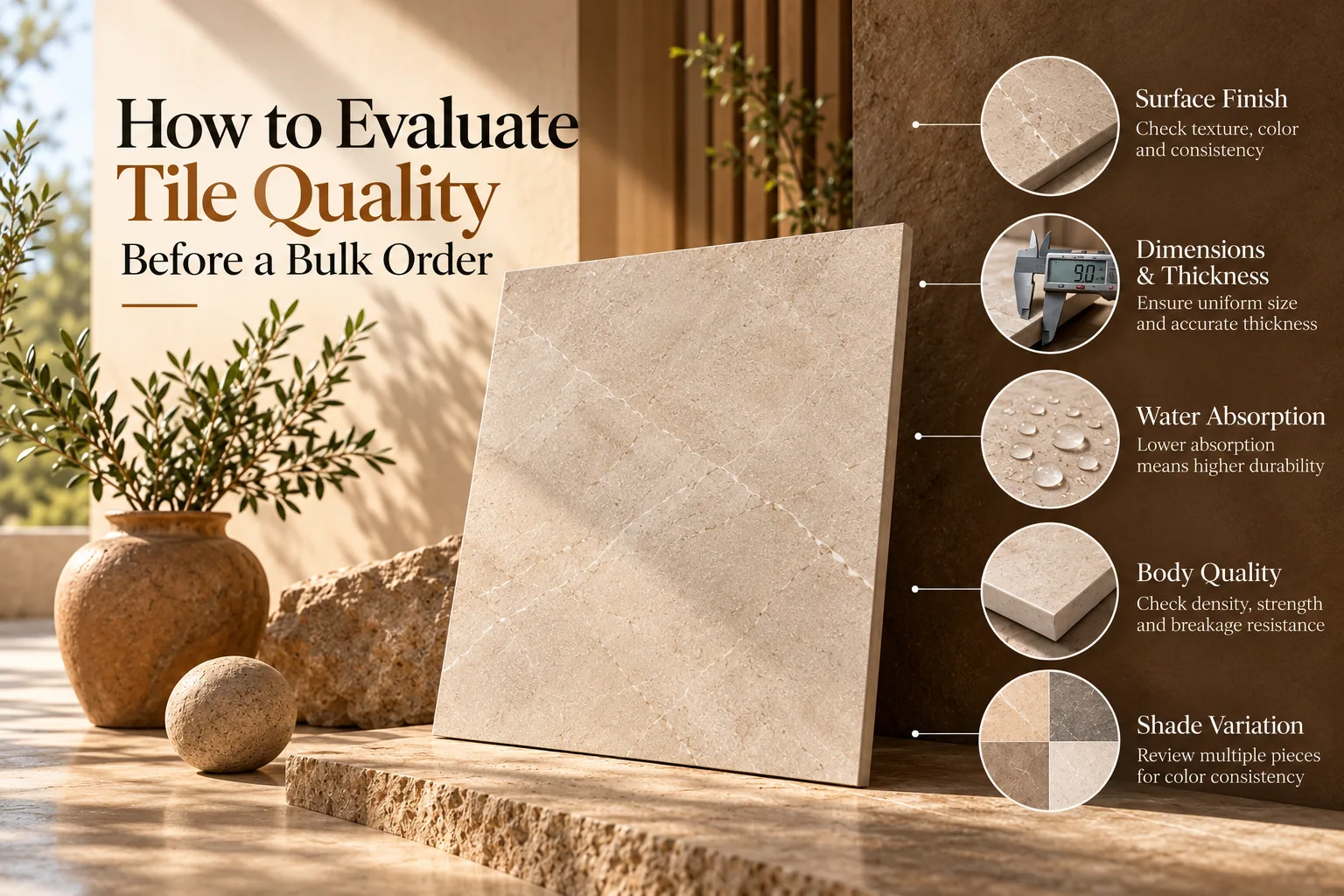
How to Evaluate the Quality of Tiles Before Placing a Bulk Order
A tile sample can look excellent in a showroom and still fail to represent the consistency or performance of a full container. For importers, distributors, wholesalers, retailers, builders and project buyers, evaluating tile quality before placing a bulk order is a procurement control—not just a visual check.
Shade variation, inconsistent dimensions, damaged edges, unsuitable slip performance, weak packaging or missing technical documents can lead to complaints, installation delays, replacement costs and reputational damage. A disciplined process combines a clear specification, representative samples, technical evidence, inspection, packaging checks and written acceptance criteria.
This guide provides a practical framework for ceramic tiles, vitrified tiles, porcelain tiles and large-format surfaces. Testing requirements vary by product and destination market; always verify the exact SKU and applicable standards.
1. Define the Product Specification First
Terms such as “premium quality”, “first choice” or “export quality” are not complete specifications. Before requesting quotes, document:
A good specification allows multiple suppliers to quote comparable products and gives an inspector measurable acceptance criteria.
2. Do Not Rely on One Attractive Sample
One sample helps assess design and finish but cannot establish consistency across an entire order. Use a repeatable approval process:
For large projects, arrange a mock-up made from multiple pieces. This can reveal pattern repetition, shade differences and joint appearance that a single tile cannot show.
3. Visual Inspection: What to Look For
| Area | Check | Why it matters |
| Surface | Pinholes, scratches, stains, glaze or print defects | Appearance and saleability |
| Colour/shade | Consistency with approved sample and between pieces | Prevents patchy installed surfaces |
| Pattern | Vein distribution, face variation, print alignment | Important for decorative designs |
| Edges/corners | Chips, cracks, uneven edges | Affects installation and usable yield |
| Finish | Gloss, texture and surface uniformity | Confirms the ordered look |
| Flatness | Visible bowing or distortion; measure where required | Can affect lippage and installation |
| Contamination | Unwanted residue or marks | May indicate handling or production issues |
Inspect pieces together and sample across packs or pallets where possible. Visual inspection is useful, but it does not replace dimensional measurement or laboratory testing.
4. Check Dimensions, Thickness and Calibration
Nominal dimensions do not mean every tile measures exactly the nominal size. Use appropriate calibrated tools and compare results with the manufacturer's declared tolerances and applicable standard.
Dimensional inconsistency can create uneven joints, lippage, cutting waste and slower installation. Large-format products need particular attention to flatness, edge protection and installation tolerances. Do not apply a universal pass/fail tolerance: use the agreed specification and applicable standard.
5. Understand Water Absorption and Product Category
Water absorption is an important technical property, particularly when identifying product categories and assessing intended use. Request the declared value and supporting test information for the exact product.
Low water absorption alone is not a complete quality score. Strength, surface performance, dimensional characteristics and application suitability also matter.
Ceramic wall tiles, floor tiles, porcelain products and large-format slabs can have different properties and uses. Do not assume they are interchangeable.
6. Verify Performance for the Intended Application
| Property | When it matters | What to request |
| Breaking strength | Flooring, handling and application-specific demands | Relevant test results and standard |
| Abrasion/wear | Floor applications subject to wear | Applicable classification or test result |
| Slip resistance | Wet areas, entrances and public spaces | Test method, result and intended-use guidance |
| Chemical resistance | Commercial or cleaning-intensive settings | Relevant report or declared classification |
| Stain resistance | Kitchens and stain-prone settings | Product-specific test information |
| Frost resistance | Exterior or freezing environments | Applicable test result |
| Other specialist properties | Projects with specific environmental demands | Application-relevant documentation |
Test classifications may not be directly comparable across methods. Ask which standard was used and confirm that it meets the destination market and project specification.
7. Check Slip Resistance—Do Not Guess by Touch
Slip resistance is safety-related. It cannot be reliably judged from a photograph or by rubbing a hand across the tile. Glossy is not automatically unsuitable for every floor, and matt is not automatically safe in every wet environment.
Specify the intended conditions—wet or dry, barefoot or shod, slope, contamination and cleaning regime—and request a test method appropriate to that use. Confirm local rules and project requirements. Never compare slip-resistance numbers without checking that the methods and conditions are comparable.
8. Assess Shade, Batch and Design Consistency
Some designs intentionally vary from piece to piece. The objective is to ensure the delivered variation matches the approved design and declared range, rather than demanding identical patterns where variation is intentional.
Batch and shade controls are particularly important when the tiles will be installed across large continuous areas or sold through distributors as a consistent collection.
9. Inspect Rectification and Edge Quality
Rectified tiles have mechanically finished edges intended to provide more consistent dimensions within the product specification. Rectification does not eliminate grout joints or guarantee perfect installation.
Inspect edge straightness, corner damage, chips and consistency. If the product is sold as rectified, confirm declared dimensional tolerances. For large-format tiles and slabs, a damaged edge can make a costly piece unusable.
10. Packaging Is Part of Product Quality
A good tile can arrive damaged if packaging and loading are inadequate. Agree on a written packing specification before shipment.
Requirements differ for standard tiles, polished surfaces, fragile edges and large-format slabs. Confirm packaging is suitable for the actual product and transport route.
11. Arrange Pre-Shipment Inspection for Significant Orders
For a substantial or high-risk order, consider an independent pre-shipment inspection. Agree on the scope before production or shipment.
Sampling should reflect order size and risk. It cannot guarantee every unit is defect-free, but a documented plan is stronger than informal spot-checking.
12. What a Useful Test Report Should Contain
A certificate logo or generic claim such as “international quality” is not a substitute for a verifiable report. Confirm destination-market conformity requirements with the relevant authority or a qualified compliance professional.
13. Agree on Acceptance Criteria Before Ordering
One preventable mistake is leaving “acceptable quality” undefined. The purchase order should refer to the approved specification and state how conformity will be assessed.
Put important requirements in writing. Commercial and legal terms should be reviewed for the transaction and destination market.
14. Common Tile Quality Evaluation Mistakes
15. Supplier Evaluation Checklist for Importers and Distributors
| Area | Questions for the manufacturer |
| Product identity | Does the quotation state the exact SKU, size, thickness and finish? |
| Sample approval | Can we retain a labelled reference sample? |
| Technical data | Are current product-specific data and reports available? |
| Consistency | How are shade, calibre and batches controlled? |
| Inspection | Can we appoint an inspector before shipment? |
| Packaging | Can you provide the packing specification and loading evidence? |
| Traceability | Will cartons show product, shade/calibre and batch information? |
| Compliance | Which documents are relevant to the destination market? |
| Claims | What is the process and deadline for reporting defects or damage? |
| Repeat orders | How will future batches match the approved specification? |
A reliable supplier should answer clearly and provide evidence where relevant. Inconsistent descriptions or evasive answers are reasons to pause and investigate.
16. A Practical Quality Scorecard
Score each factor from 1 (weak evidence or poor fit) to 5 (strong evidence and good fit). Adjust weights to the product and market.
| Factor | Suggested weight | Evidence |
| Visual quality and sample match | 15% | Approved samples and inspection |
| Dimensions, thickness and flatness | 15% | Measurements and applicable tests |
| Technical performance | 20% | Product-specific reports |
| Shade and batch consistency | 15% | Batch controls, samples, mock-up |
| Packaging and logistics | 10% | Packing specification and loading evidence |
| Compliance documentation | 10% | Relevant certificates and test documents |
| Inspection and traceability | 5% | Inspection plan and batch labels |
| Claims and after-sales | 10% | Written policy and contract terms |
This scorecard is a decision aid, not a substitute for mandatory testing. A product that fails a critical safety, regulatory or project requirement should not pass because it scores well elsewhere.
17. Extra Checks for Large-Format Tiles and Porcelain Slabs
A slab suitable for a wall is not automatically suitable for flooring, worktops or exterior use. Obtain written application guidance for the exact product.
18. How Probity Fits into a Bulk-Sourcing Evaluation
Probity Ceramic LLP is an India-based ceramic and porcelain tile manufacturer/exporter whose portfolio includes ceramic tiles, porcelain tiles and large-format slab products. The same disciplined evaluation process should apply to Probity as to any shortlisted supplier.
Request the current catalogue, exact SKU details, physical samples, technical data sheets, relevant test documents, packaging specifications, MOQ, production lead time and written export quotation. Confirm all information against the selected product and destination market.
For export or private-label orders, also clarify carton artwork, barcode and label requirements, batch traceability, mixed-container rules, inspection access and the process for non-conforming goods.
The objective is not simply to find a supplier who says its tiles are high quality. It is to select a supplier whose specification, evidence, process and contractual commitments make quality verifiable.
19. Bulk Tile Quality Checklist Before Purchase Order Approval
20. Final Verdict: Quality Must Be Verifiable
The safest way to evaluate tile quality before a bulk order is to combine visual inspection, dimensional checks, technical evidence, packaging review, batch controls and a written acceptance process.
No single test, certificate or attractive sample answers every quality question. The correct checks depend on product type, application, destination market and commercial risk.
For importers and distributors, the goal is repeatable quality: a product that matches the approved specification in the delivered shipment and in future repeat orders. Define the specification, approve a representative sample, verify the data, inspect the shipment and document acceptance criteria. This turns quality from a sales promise into a procurement standard.
Frequently Asked Questions
How can I check tile quality before placing a bulk order?
Define the specification, approve representative samples, inspect multiple pieces, verify dimensions and technical data, check packaging, and agree on pre-shipment inspection and acceptance criteria.
Is visual inspection enough to judge tile quality?
No. It can identify visible defects, but properties such as water absorption, strength and slip resistance may require appropriate tests and documentation.
What documents should I request from a tile manufacturer?
Request a product-specific technical data sheet, relevant test reports, applicable conformity documents, declared tolerances, packing details and product identification. Requirements depend on the product and market.
Why are shade and calibre important?
Differences can become visible across installations and affect joint consistency, installation time and saleable yield.
Should I hire a third-party inspector?
For substantial or high-risk orders, independent inspection can document product identity, condition, dimensions, packaging and agreed checks.
How do ceramic and porcelain tile quality checks differ?
Some checks overlap, but requirements depend on product category, applicable standards and intended use. Request data for the exact SKU.
How do I check slip resistance?
Request results using a method appropriate to the intended environment and confirm they meet local rules and project requirements.
How should large-format tiles or slabs be inspected?
Pay extra attention to dimensions, flatness, edges, handling, packaging, lifting and application suitability.
What if the shipment does not match the approved sample?
Document the issue promptly with photographs, labels, batch information and inspection evidence, then follow the contract's claim process and notification period.
Can a good test report still be followed by quality problems?
Yes. A report covers specific properties of the tested sample; it does not guarantee every delivered piece is defect-free or that packaging and batch consistency are adequate.
What does “export quality” mean?
The phrase alone is not a complete technical specification. Define measurable requirements, applicable standards, acceptance criteria and packaging expectations.
How can I compare two suppliers fairly?
Use the same specification, test methods, sample process, inspection criteria and packaging requirements, then compare documented results and commercial terms.
Related Articles

Calacatta vs Statuario vs Carrara Porcelain Tiles

Protect Tile Import Margins from Rising Freight Costs | Probity Ceramic