Protect Tile Import Margins from Rising Freight Costs | Probity Ceramic
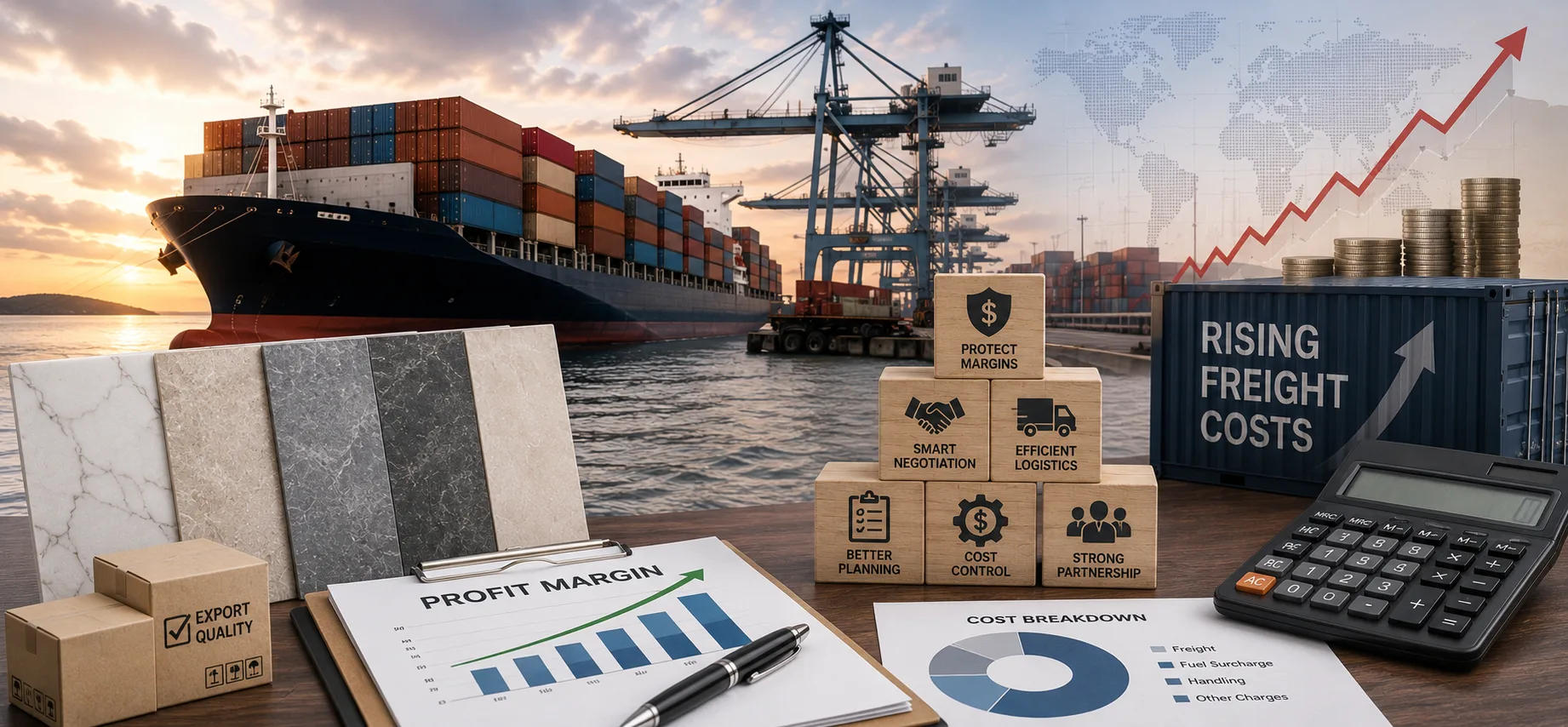
Freight cost volatility has become one of the defining risks in the tile import business. A container rate that was stable for eighteen months can move 30-60% within a single quarter in response to fuel prices, port congestion, capacity shortages, or geopolitical disruption on major shipping lanes. For an importer working on a fixed retail or project price, a freight spike that lands mid-shipment can erase the entire margin on that order.
Unlike raw material cost or currency movement, freight cost is often treated as a fixed pass-through - booked late, negotiated reactively, and absorbed rather than planned for. That reactive approach is precisely what erodes profitability fastest when rates move against you.
This guide sets out a practical framework for tile importers, distributors, and project buyers to protect margins when freight costs rise - covering container optimisation, sourcing structure, Incoterm selection, packaging efficiency, contract design, and the role your manufacturing partner plays in absorbing volatility rather than passing it straight through to you.
1. Why Freight Costs Are Rising for Tile Importers
Ocean freight rates on the lanes that matter most to tile importers - India to the GCC, Europe, Africa, Southeast Asia, and the Americas - have become structurally less predictable over the past several years. Several factors compound to drive this:
• Bunker fuel price volatility, which feeds directly into base freight and surcharge structures
• Port congestion and equipment imbalances that create container shortages on specific lanes
• Rerouting around chokepoints (such as the Red Sea and Suez corridor), adding transit days and cost
• Carrier alliance capacity management, which can tighten space on tile-heavy lanes during peak shipping seasons
• Seasonal demand spikes ahead of major construction and retail cycles in destination markets
Because porcelain tile is a heavy, high-density product shipped almost exclusively by FCL sea freight, importers feel freight rate movement more acutely than importers of lighter goods - freight can represent 15-30% of landed cost on a standard container, compared to a low single-digit percentage for many other product categories.
2. How Freight Volatility Erodes Margin - and Why It's Often Invisible Until Too Late
The core problem is timing. Tile orders are typically quoted to the end customer or project weeks or months before the container is booked and loaded. If freight rates move upward between quotation and booking, that increase lands entirely on the importer's margin unless it was contractually passed through.
This shows up in three specific ways:
Margin compression on committed pricing. Fixed-price quotes to distributors, retailers, or project clients leave no room to recover a freight increase after the fact.
Cash flow strain from advance payment structures. A 30% advance paid against a proforma invoice locks in product cost, but freight - often booked separately and later - can still move before the container sails.
Erosion that compounds across a multi-shipment programme. A distributor with quarterly container orders can see a freight increase repeat and compound across every subsequent shipment if it isn't addressed structurally.
The importers who protect margin most effectively are the ones who treat freight as a planned, actively managed cost line - not a number that gets confirmed the week before loading.
3. Maximising Container Utilisation: The First Line of Defence
Freight cost is charged per container, not per tile. This means the single most direct lever an importer controls is how much usable product value is loaded into every FCL.
Optimise product mix by weight and volume. A container loaded purely to maximise carton count without considering weight distribution can leave usable capacity on the table. Work with your manufacturer's export team to model different size and product combinations against your container's weight and volume limits.
Confirm actual tonnage per container for your specific product. Large-format slabs, full-body porcelain, and standard 600×600mm tiles all load differently. A manufacturer experienced in export loading will know the real achievable tonnage for each product category, not just a generic FCL estimate.
Avoid partial or under-loaded containers. An LCL or part-loaded FCL shipment carries a materially higher freight cost per tonne than a fully loaded container. Where order volume allows, always prioritise full container loads.
Reassess palletisation efficiency. Pallet configuration and stacking height directly affect how much product fits per container within safe load limits. This is a packaging engineering question worth raising directly with your manufacturer.
4. Choosing the Right Incoterm for a Volatile Freight Market
The Incoterm you buy under determines who carries freight risk between factory and destination, and this becomes especially important when rates are moving unpredictably.
FOB (Free on Board). You arrange and pay for ocean freight directly. This gives you full visibility and control over freight booking, allowing you to shop rates, book early, or lock in contracts - but it also means you carry the full exposure to rate movement.
CIF (Cost, Insurance, Freight). The manufacturer arranges and quotes freight as part of the landed price. This can simplify budgeting, but the quoted freight component may include a margin buffer, and you have less direct control over carrier selection or booking timing.
CFR (Cost and Freight). Similar to CIF but without the insurance component bundled - worth considering if you already hold your own marine cargo insurance.
In a rising freight environment, importers with strong freight-forwarder relationships and enough volume to negotiate directly often do better under FOB, since they can lock in rates independently of the manufacturer's quote cycle. Importers without established forwarder relationships may find CIF more predictable, provided the manufacturer's export team has strong carrier relationships and books in advance rather than at spot rate.
5. Packaging and Weight Efficiency: An Underused Margin Lever
Packaging weight is a frequently overlooked contributor to freight cost. Since ocean freight for tile is generally constrained by container weight limits before it is constrained by volume, every kilogram of unnecessary packaging weight is a kilogram of tile that isn't shipped.
• Ask your manufacturer whether carton and pallet specifications have been engineered for weight efficiency without compromising breakage protection
• Compare corrugated board grade and pallet type across suppliers - heavier, over-specified packaging on a low-risk product category adds cost without adding protection
• Balance this carefully against breakage risk: under-packaging to save weight is a false economy if it increases damage claims
A manufacturer who can show you the actual weight breakdown of packaging versus product per container is demonstrating a level of export sophistication that pays off directly in your landed cost.
6. Cutting Out Margin Layers: Direct Manufacturer Sourcing
When freight costs rise, every additional margin layer in your supply chain becomes proportionally more expensive to carry. Sourcing through a trading company or agent means absorbing both their margin and the freight increase, whereas a direct manufacturer relationship exposes you to freight movement alone.
Direct manufacturer relationships also tend to give importers more room to negotiate on FOB pricing or shared freight risk during volatile periods, since the manufacturer has direct visibility into their own cost structure and more flexibility to adjust than a trader working off someone else's quote.
7. Consolidation and Order Planning to Reduce Freight Frequency
Every container shipped carries fixed cost components - documentation, port handling, customs processing - independent of freight rate itself. Consolidating smaller, frequent orders into fewer, larger shipments reduces how many times these fixed costs are incurred.
Forecast further ahead. Moving from reactive, as-needed ordering to a quarterly or seasonal forecast allows you to plan container volumes rather than shipping partial loads under time pressure.
Coordinate multi-product consolidation. If you buy multiple tile categories from the same manufacturer, consolidating them into single containers reduces total shipment count without reducing product range.
Align order timing with your manufacturer's production schedule. Orders placed to align with existing production runs can sometimes access better freight booking windows than urgent, out-of-cycle orders.
8. Contract and Pricing Structures That Absorb Freight Shocks
The most resilient importers build freight volatility into their commercial structure rather than absorbing it silently.
Freight escalation clauses. For multi-shipment annual agreements, negotiate a clause that adjusts pricing if freight indices move beyond an agreed threshold - protecting both sides from extreme swings.
Rate validity windows on quotations. Ensure any FOB or CIF quotation states clearly how long the freight component remains valid, so you aren't caught by a stale quote in a moving market.
Pass-through clauses to your own customers. Where you sell on fixed pricing to distributors or project clients, consider building your own freight escalation language into those contracts, mirroring what you negotiate upstream.
Advance freight booking. Where volume justifies it, booking freight capacity ahead of container readiness - even provisionally - can lock in rates before further increases.
9. Currency Risk: The Freight Cost Multiplier Importers Often Miss
Freight is typically quoted and settled in USD, and tile product pricing is usually USD-denominated as well. When your local currency weakens against the USD at the same time freight rates rise, the two effects compound rather than simply add - a 10% freight increase combined with a 10% currency depreciation does not produce a 20% landed cost increase, it produces a larger one, since freight is calculated on top of a product cost that has also become more expensive in local currency terms.
Hedging tools such as forward contracts, and timing large orders around favourable currency windows where feasible, are worth discussing with your finance team alongside your freight strategy - the two risks should be managed together, not separately.
10. Building a Freight Contingency Into Your Landed Cost Model
Rather than pricing projects and inventory on the freight rate available at quotation time, build a contingency band into your landed cost model - commonly 8-15% above the current quoted rate for orders with a long lead time between quotation and shipment.
This protects your margin on the individual order and removes the pressure to either absorb a late-stage increase or attempt a difficult renegotiation with a customer after a price has already been committed.
11. What to Look for in a Manufacturing Partner During High-Freight Periods
Not every manufacturer manages freight volatility the same way. During periods of rising freight cost, the difference between a reactive supplier and an experienced export partner becomes very visible.
• An export team that books freight proactively and communicates rate movement ahead of time, rather than surprising you at invoicing
• Willingness to model container loading options that maximise your tonnage-to-freight ratio
• Packaging that has been engineered for weight efficiency without increasing breakage risk
• Flexibility on Incoterms, allowing you to choose the structure that best fits your freight risk appetite
• Transparent, itemised quotations that separate product cost, packaging, and freight, so you can see exactly where a rate movement is coming from
A manufacturer with deep, established freight-forwarder relationships on your specific trade lane is often able to absorb short-term volatility more effectively than a smaller operation booking at spot rate for every shipment.
Conclusion
Rising freight costs are a structural feature of international trade, not a temporary anomaly - and importers who treat freight as a passive, unmanaged cost line will see it erode margin repeatedly. Importers who actively manage container utilisation, sourcing structure, Incoterms, packaging efficiency, and contract design consistently protect profitability even when rates move sharply against them.
The manufacturer relationship sits at the centre of nearly every lever in this guide. A manufacturing partner with genuine export sophistication - proactive freight booking, engineered packaging, transparent pricing, and flexible commercial terms - is one of the most effective tools an importer has for staying resilient through freight cycles, not just an upstream cost.
Related Articles

Calacatta vs Statuario vs Carrara Porcelain Tiles

Elevation Tiles for Modern House Exteriors