Tile Container Loading Guide: How Importers Plan Bulk Shipments
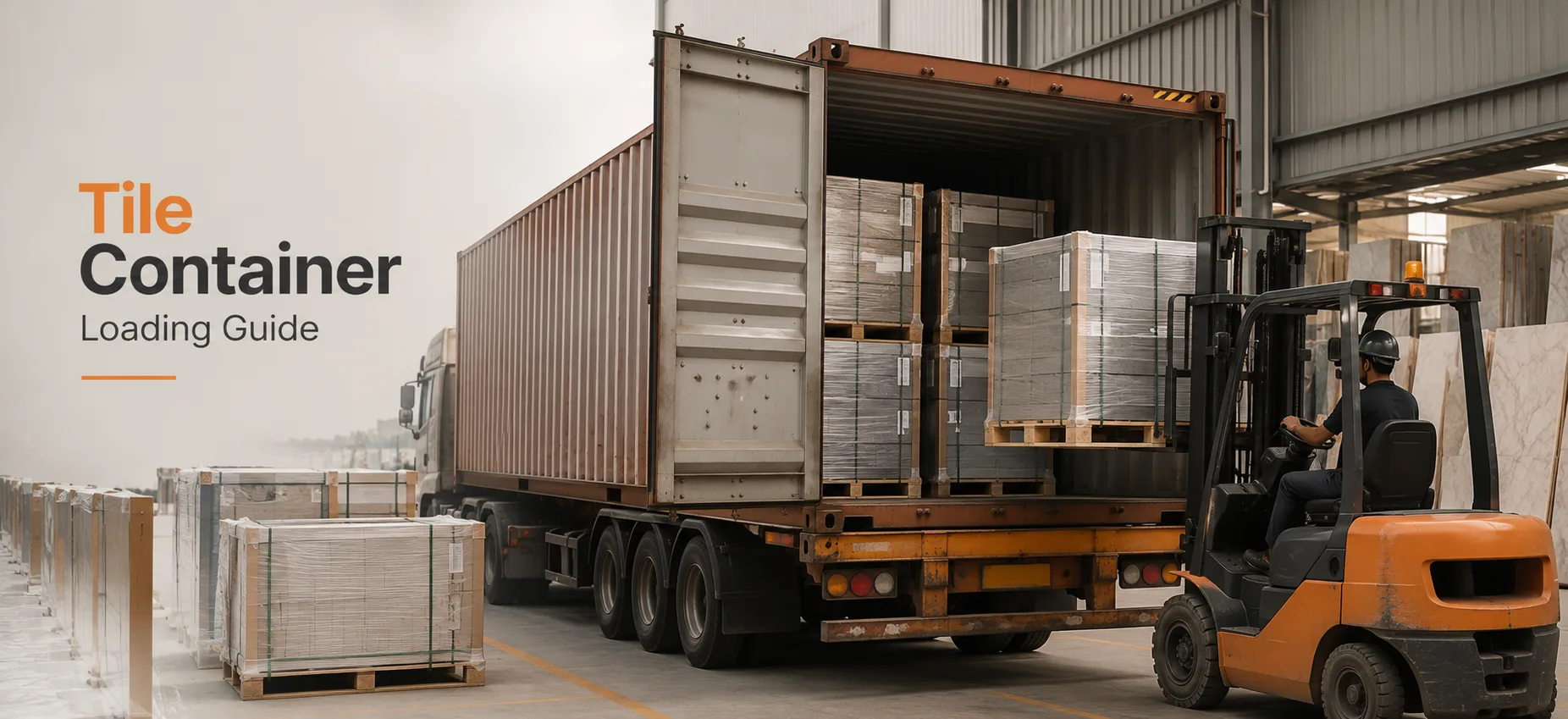
A tile order can be specified perfectly — right size, right finish, right certification — and still arrive damaged, short-counted, or unusable if the container loading was done poorly. Loading is where the commercial order becomes a physical shipment, and it is one of the least visible parts of the import process to a buyer who is not physically present at the factory.
This guide is written for importers and distributors planning their first or next FCL tile shipment, and for procurement and logistics teams who need to sanity-check a manufacturer's loading plan, packaging specification, and container utilisation. It covers how container capacity is actually calculated, what proper tile packaging looks like, how loading is carried out and supervised at the factory, and the mistakes that most commonly lead to breakage claims or short shipments.
By the end, you will know what to specify, what to inspect, and what a well-loaded tile container should look like before the doors close.
1. Why Container Loading Matters for Tile Importers
Tiles are dense, rigid, and brittle under point-load pressure — a combination that makes them straightforward to overpack by weight but easy to damage through poor stacking, inadequate cushioning, or shifting during transit. Loading quality affects an importer directly in three ways:
Breakage rate. Poorly loaded containers routinely produce breakage claims well above the industry-standard contingency allowance, eating directly into margin.
Container utilisation. Inefficient loading wastes payable container space, pushing your effective per-square-metre freight cost higher than it needs to be.
Dispute risk. Shortages or damage discovered on arrival, without clear loading documentation from the factory, can turn into a lengthy and unproductive claims process between buyer, seller, and freight forwarder.
Understanding loading fundamentals lets you specify requirements clearly, evaluate a manufacturer's process before you commit to a large order, and know what to check when the container is opened.
2. Understanding Container Types Used for Tile Shipments
Tile shipments are almost always moved in standard dry containers, most commonly:
20-foot container (20' GP): holds roughly 18–22 tonnes of tile depending on size and packaging, and is the most common choice for tile shipments given the product's density — volume space typically runs out well before the container's weight limit does.
40-foot container (40' GP / 40' HC): offers roughly double the floor length but is used less often for tile alone, since tiles reach the container's maximum payload weight before filling the available volume, leaving unused space. It becomes efficient when combined with lighter cargo or for large-format, lower-density product.
Confirm with your manufacturer and freight forwarder which container size makes commercial sense for your specific tile size and order volume — defaulting to a 40-foot container for a standard porcelain tile order often means paying for space you cannot use.
3. How Many Tiles Fit in a Container: Calculating Load Capacity
Capacity is governed by two constraints, and whichever is reached first determines your effective load: the container's maximum payload weight, and the available internal volume once packaging and bracing are accounted for.
15.Calculate carton weight: box quantity per carton × tile weight (based on size and thickness) + packaging weight.
16.Divide the container's maximum payload weight by the carton weight to estimate a weight-based carton count.
17.Cross-check against volume: carton dimensions × available container floor and stacking space, allowing for bracing and access clearance.
18.Apply the lower of the two figures as your realistic loading capacity, then reduce by a small margin to account for even, secure stacking rather than a theoretical maximum.
As a general guide, standard 600×600mm porcelain tiles at 9–10mm thickness typically load at approximately 1,600–1,900 square metres per 20-foot container, while larger-format or thicker tiles reduce that figure. Always request the manufacturer's specific loading calculation for your exact product rather than relying on generic industry figures, since thickness, box configuration, and packaging all shift the number.
4. Packaging Standards That Protect Tiles in Transit
Packaging is the primary defence against breakage, and it is worth specifying rather than leaving to default factory practice. Key elements to confirm:
• Corrugated carton strength: double-wall or triple-wall corrugated board for export shipments, rated to withstand stacking pressure across a full container height.
• Inner protection: foam sheets, honeycomb paper, or corner protectors between tiles, particularly for polished or high-gloss surfaces prone to edge chipping and surface scratching.
• Edge and corner reinforcement: cartons with reinforced edges resist crushing when stacked multiple boxes high.
• Moisture protection: shrink wrap or moisture-resistant lining, especially relevant for shipments crossing humid climates or long transit routes.
• Carton labelling: product code, size, shade/batch number, and quantity clearly marked on every carton, enabling verification without opening every box.
• Palletisation: shrink-wrapped or strapped pallets for added stability, particularly valuable for large-format tiles and slabs.
5. Palletised vs Loose-Loaded Cartons: Which Is Better
Both approaches are used across the industry, and the right choice depends on tile format and priorities.
Loose-loaded cartons (stacked directly on the container floor without pallets) maximise usable volume, since pallets themselves consume space and add dead weight. This is the standard approach for most standard-size porcelain and ceramic tiles and gives the highest square-metre yield per container.
Palletised loading trades some volume efficiency for stability and easier handling at destination, particularly for large-format slabs, fragile finishes, or where the destination warehouse is set up for forklift unloading rather than manual carton handling. It also generally reduces handling-related breakage during unloading.
For large or repeat orders, discuss both options with your manufacturer and factor in your destination warehouse's unloading capability, not just the loading efficiency at origin.
6. Step-by-Step: How a Tile Container Is Loaded at the Factory
19.Container is inspected for cleanliness, structural integrity, and absence of moisture or odour before loading begins.
20.Flooring or dunnage material is laid where required to protect the lowest layer of cartons.
21.Cartons are loaded from the rear of the container forward, typically in a criss-cross or interlocking stack pattern for stability.
22.Weight is distributed evenly across the container floor, with heavier cartons generally positioned lower.
23.Bracing material — airbags, timber battens, or void-fill — is installed to prevent shifting during transit.
24.A final tally count is taken against the packing list before the doors are closed and sealed.
25.A container seal number is recorded and shared with the buyer for verification against the Bill of Lading.
7. Weight Distribution and Container Balance
Uneven weight distribution is a safety issue as well as a damage risk — an imbalanced container can shift dangerously during ocean transit and road handling, and concentrated weight in one section increases the crushing pressure on cartons at the base of that stack. A properly loaded container distributes weight evenly across the floor area and keeps the centre of gravity low and centred, with heavier cartons never stacked directly on top of lighter, more fragile ones.
8. Common Loading Mistakes That Cause Breakage or Rejected Shipments
Overstacking beyond carton-rated height. Exceeding the corrugated board's rated stacking strength crushes cartons at the bottom of the stack, even when the container itself is not overloaded by weight.
Inadequate bracing. Without proper void-fill or bracing, cartons shift during transit, and repeated micro-movement over a multi-week voyage causes edge chipping even in well-packaged product.
Mixing incompatible products without separation. Loading polished and matte finishes, or different sizes, without clear separation and correct stacking order increases handling errors at destination.
Loading without a final count against the packing list. Skipping this step is a common source of shortage disputes that are difficult to resolve after the container has sailed.
No photographic or video record of loading. Without documentation, a damage or shortage dispute has no independent reference point to fall back on.
9. Pre-Shipment Inspection and Loading Supervision
For first orders, large-volume shipments, or high-value product, arranging pre-shipment inspection and loading supervision is a standard, cost-effective safeguard. This typically covers:
• Verification of product specification, quantity, and shade/batch consistency before loading begins
• Photographic or video documentation of the loading process
• Confirmation of correct packaging and bracing standards
• An independent final tally count against the purchase order and packing list
• Container seal verification and recording
This can be arranged directly with the manufacturer's export team or through an independent third-party inspection agency, and is generally a small cost relative to the value of the shipment and the disputes it can prevent.
10. Documentation Generated During Container Loading
A well-run loading process produces a documented paper trail that supports both customs clearance and any post-shipment claims process:
• Loading photographs or video, dated and matched to the container/seal number
• Final packing list, confirmed against the physical loaded count
• Container seal number, recorded and shared with the buyer
• Weight and measurement (W/M) certificate, where required for freight billing
• Pre-shipment inspection report, where independent inspection was arranged
Request this documentation as a standard part of your order process rather than only after a problem arises — most established exporters will provide it without difficulty.
11. How Morbi Manufacturers Optimise Container Loading
Morbi's concentration of export-focused tile manufacturers has produced a mature, specialised loading discipline: dedicated loading bays, trained loading crews familiar with tile-specific stacking patterns, and established relationships with freight forwarders operating regular FCL lanes to Mundra and Kandla ports. Many manufacturers now use standardised carton and pallet configurations calculated specifically for common export tile sizes, allowing accurate capacity quotes before an order is even confirmed.
For importers, this means a well-established Morbi manufacturer should be able to provide a precise, size-specific loading calculation, not a rough estimate, as part of the initial quotation process.
12. Working with Probity Ceramic LLP: What Sets Us Apart
Probity Ceramic LLP manages container loading as a controlled, documented process, built around the specific needs of importers, distributors, and construction companies moving bulk and repeat volumes.
Our loading process covers:
• Product-specific capacity calculations provided at the quotation stage, based on your exact tile size and thickness
• Double-wall corrugated cartons with foam or honeycomb inner protection as standard for export shipments
• Trained loading crews following standardised, tile-specific stacking and bracing protocols
• Photographic documentation of every loaded container, matched to seal number
• Final tally verification against the packing list before container sealing
• Support for third-party pre-shipment inspection on request
What our buyers consistently tell us matters most:
A precise loading count they can plan around, packaging that survives long-transit routes without a rise in breakage claims, and full documentation available proactively rather than only when something goes wrong.
We work with:
Importers placing their first FCL order who want a transparent loading process before committing, distributors managing recurring container shipments, and construction companies coordinating phased deliveries where consistent packaging and documentation across shipments genuinely matters.
Conclusion
Container loading is where a well-negotiated tile order either holds together or falls apart — quite literally. Understanding how capacity is calculated, what packaging standard to insist on, and what a properly supervised loading process looks like gives you the ability to specify it clearly upfront and verify it when the container is opened at destination.
A manufacturer that can produce a precise, product-specific loading calculation and documented loading process at the quotation stage is telling you something real about how seriously they take the physical side of export — not just the commercial side.
Related Articles

The Complete Guide to Import Tiles from India

Best Anti-Slip Outdoor Tiles for Patios, Balconies & Pool Areas