CE Certification for Tiles: What Importers Need to Know
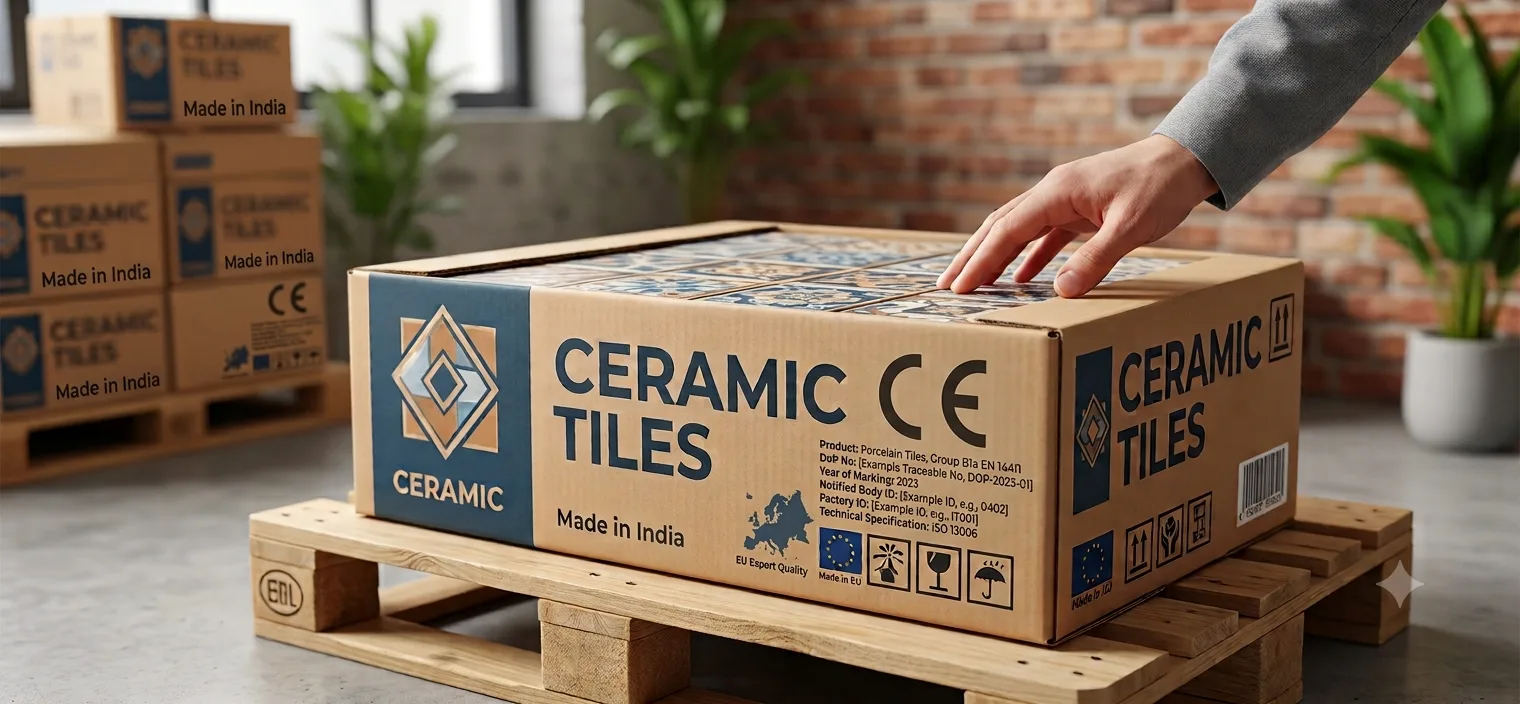
If you are importing or distributing tiles into the European Union — or into any market that recognises CE marking as a benchmark — you will run into the term "CE certified" on almost every manufacturer's product sheet. Yet it is one of the most misunderstood certifications in the tile trade. It is not a quality award, not optional paperwork, and not something a manufacturer can simply claim without a documented process behind it.
This guide is written for importers preparing to sell into the EU market, distributors auditing their supplier's compliance documentation, and construction companies specifying tiles for projects where CE marking is a contractual or regulatory requirement. It explains what CE certification actually covers, the regulatory framework behind it, how to read a Declaration of Performance, and how to verify that a supplier's CE claim is genuine rather than printed on a catalogue for effect.
By the end, you will know exactly what to ask for — and what a real CE-compliant tile supplier should be able to hand you without hesitation.
1. What Is CE Certification for Tiles
CE marking on a tile is a manufacturer's declaration that the product has been assessed against the harmonised European standard for ceramic tiles — EN 14411 — and that its performance characteristics (dimensional tolerance, water absorption, breaking strength, slip resistance, frost resistance, and chemical resistance, among others) have been tested and documented.
CE stands for "Conformité Européenne." It is not a quality grade — a CE-marked tile is not automatically "better" than a non-CE-marked one — it is a regulatory statement that the product's declared performance has been verified through a defined assessment process and that the manufacturer takes legal responsibility for the accuracy of that declaration.
For tiles specifically, CE marking is mandatory for products placed on the market within the European Economic Area under the EU's Construction Products Regulation (CPR). Outside the EEA, many markets (including the GCC, parts of Africa, and Latin America) accept or increasingly request CE marking as a recognised proxy for verified product performance, even where it is not a legal requirement.
2. Why CE Certification Matters for Importers and Distributors
For any business bringing tiles into the EU, CE marking is not optional paperwork — it is a legal precondition for placing the product on the market. Beyond legal compliance, it matters commercially for several reasons:
Customs clearance risk. EU customs authorities and market surveillance bodies can and do request CE documentation. Product without a valid Declaration of Performance can be held, rejected, or subject to a market withdrawal order.
Contractual requirement. Architects, specifiers, and main contractors on commercial and infrastructure projects routinely require CE documentation as a condition of product approval, regardless of the tile's origin.
Liability protection. A verified Declaration of Performance gives the importer a documented basis to demonstrate due diligence if a product performance dispute arises after installation.
Buyer confidence. For distributors selling to retailers or contractors, being able to produce genuine CE documentation on request is a straightforward trust signal in a market where certification fraud does occur.
3. The Legal Framework: EN 14411 and the Construction Products Regulation
CE marking for tiles sits within a specific legal structure, and understanding it helps you ask the right questions of a supplier.
EN 14411 is the harmonised European product standard for ceramic tiles. It defines classification (by manufacturing method and water absorption), dimensional and surface quality tolerances, and the physical, chemical, and mechanical properties that must be declared — including breaking strength, water absorption, slip resistance, frost resistance, and resistance to staining and chemicals.
The Construction Products Regulation (CPR, EU No. 305/2011) is the overarching EU regulation that makes CE marking mandatory for construction products — including tiles — covered by a harmonised standard. It sets out the manufacturer's legal obligations: testing, documentation, ongoing production control, and issuing a Declaration of Performance for every product placed on the EU market.
Together, EN 14411 defines what must be tested and declared, and the CPR defines the legal process a manufacturer must follow to affix the CE mark honestly.
4. Which Tiles Fall Under CE Marking
CE marking under EN 14411 applies broadly across ceramic and porcelain tile categories intended for wall and floor covering, including:
• Porcelain (fully vitrified) tiles
• Glazed and unglazed ceramic floor and wall tiles
• Extruded and pressed tiles
• Large-format porcelain slabs
• Outdoor and frost-resistant tiles intended for exterior or freeze-exposed applications
The specific performance requirements and test thresholds vary by tile classification group under EN 14411 (based on manufacturing method and water absorption category), so the applicable Declaration of Performance should always reference the correct classification for the exact product being purchased.
5. How CE Certification Works: The AVCP System Explained
CE marking is issued through a defined Assessment and Verification of Constancy of Performance (AVCP) process, not a one-time test. For ceramic tiles, this typically follows System 4, under which:
15.The manufacturer determines the product type through initial type testing (ITT), carried out by an accredited laboratory.
16.The manufacturer implements and maintains Factory Production Control (FPC) — a documented, ongoing internal quality system that ensures every subsequent batch continues to meet the declared performance.
17.The manufacturer issues a Declaration of Performance (DoP) for the product and affixes the CE mark.
Because System 4 relies on manufacturer self-declaration backed by accredited initial testing (rather than mandatory third-party certification body oversight, as required for some other construction products), the integrity of the Factory Production Control system — and the manufacturer's willingness to share genuine ITT reports — is the real indicator of whether a CE claim can be trusted.
6. What's Included in a Declaration of Performance (DoP)
A genuine Declaration of Performance is a specific legal document, not a generic certificate. A valid DoP for tiles should include:
• A unique identification number for the product type
• The intended use of the product
• The manufacturer's name and registered address
• The applicable harmonised standard (EN 14411) and classification
• The declared performance values for each essential characteristic (water absorption, breaking strength, slip resistance, frost resistance, etc.), or "NPD" (No Performance Determined) where a characteristic does not apply
• The name and signature of the person responsible for the declaration, on behalf of the manufacturer
If a supplier provides only a CE logo on packaging or a marketing brochure without a product-specific DoP referencing actual tested values, that is not valid CE documentation.
7. How to Verify a Supplier's CE Certification Is Genuine
CE marking is a self-declaration system, which unfortunately makes it possible for the mark to be applied without genuine testing behind it. Before accepting a supplier's CE claim, take these verification steps:
Request the actual Declaration of Performance for the specific product code you are ordering — not a generic company-level certificate.
Request the Initial Type Testing (ITT) report and confirm it was issued by an accredited, recognised testing laboratory, with test methods referencing EN ISO 10545 (the test method series underlying EN 14411).
Cross-check the declared values against the DoP — a legitimate DoP will show specific, plausible test figures, not round or suspiciously uniform numbers across an entire catalogue.
Ask about Factory Production Control documentation — a manufacturer with a genuine FPC system should be able to describe their internal batch testing and calibration checks without hesitation.
Commission an independent test on production samples for large or first-time orders, particularly where CE compliance is contractually critical to your project.
8. CE Marking vs Other International Standards (ISO, ASTM, BIS)
Buyers sourcing globally often need to map between certification systems, since different destination markets recognise different standards:
ISO 13006 is the international reference standard for ceramic tiles and forms the technical basis that EN 14411 is closely aligned with — many manufacturers test to both simultaneously.
ASTM standards (C373, C485, C648, C1026) are the equivalent test methods used in North America and are not interchangeable with a CE DoP, even where underlying performance is similar.
BIS is India's domestic standard and does not substitute for CE marking in EU-bound shipments, though many Indian manufacturers now test to BIS, ISO, and EN standards concurrently to serve multiple export markets from a single production run.
ISO 9001:2015 is a quality management system certification, not a product performance certification — it says the manufacturer runs a consistent process, but does not itself substitute for a product-specific CE DoP.
For any shipment destined for the EU, CE marking under EN 14411 is the specific requirement — equivalent-sounding certifications from other regions do not satisfy it.
9. Common Mistakes Importers Make with CE Compliance
Accepting a company-level certificate instead of a product-specific DoP. CE compliance is declared per product type, not as a blanket claim covering an entire catalogue.
Not checking the classification group. A DoP issued for one EN 14411 classification (e.g., a different water absorption group) does not cover a different product line.
Assuming ISO 9001 covers CE requirements. A quality management certificate is not a substitute for product performance testing and declaration.
Not retaining documentation. Importers should keep the DoP on file for every shipment, as EU market surveillance authorities can request it after the product has already been sold.
Relying solely on a printed CE logo on the box. The logo itself carries no verification value without the underlying declaration and test reports behind it.
10. What to Request from Your Tile Manufacturer: A Checklist
• Declaration of Performance (DoP) specific to the product code being ordered
• Initial Type Testing (ITT) report from an accredited laboratory
• Confirmation of the EN 14411 classification group for the product
• A summary of the manufacturer's Factory Production Control process
• Test method references (EN ISO 10545 series)
• Willingness to support an independent third-party test on production samples, for large or first orders
11. Why Morbi Manufacturers Are Increasingly CE-Compliant
As European demand for Indian porcelain and ceramic tile has grown, established manufacturers in Morbi have invested in accredited testing relationships and Factory Production Control systems specifically to serve the EU market on equal footing with European and other Asian competitors. This has meant upgrading calibration equipment, formalising batch documentation, and building export teams capable of issuing accurate, product-specific Declarations of Performance rather than generic paperwork.
For importers, this means a well-audited Morbi manufacturer is now a realistic, cost-competitive route to CE-compliant product — provided the verification steps outlined above are actually carried out before the order is placed, rather than assumed from a catalogue claim.
12. Working with Probity Ceramic LLP: What Sets Us Apart
Probity Ceramic LLP is a premium porcelain tile manufacturer and exporter based in Morbi, Gujarat, with production and documentation processes built to serve CE-compliant markets alongside GCC, African, and Southeast Asian requirements.
Our compliance capability covers:
• Product-specific Declarations of Performance issued for our export product lines under EN 14411
• Initial Type Testing carried out through accredited, recognised laboratories
• Documented Factory Production Control covering raw material intake, pressing, firing, and final batch inspection
• Concurrent testing to ISO 13006, EN 14411, and BIS standards to support multi-market shipments
• Export documentation support for CE-requiring markets, prepared alongside standard shipping paperwork
What CE-focused buyers consistently ask us for:
A product-specific DoP before order confirmation, transparency on which classification group a product falls under, and, for larger or first orders, willingness to support independent verification testing. Our export team handles all three as a standard part of the order process, not an exception.
We work with:
EU-based importers and distributors requiring verified CE documentation, construction and project companies specifying CE compliance contractually, and retail and wholesale distributors who need to stand behind their supplier's paperwork when a customer or auditor asks for it.
Conclusion
CE certification for tiles is a legal and technical framework, not a marketing badge — and treating it as the latter is exactly how importers end up with product they cannot legally place on the EU market, or documentation that falls apart under a customer's or auditor's scrutiny. Understanding the EN 14411 standard, the Construction Products Regulation, and the specific structure of a genuine Declaration of Performance gives you the ability to tell real compliance from a printed logo.
As more manufacturers — including a growing number in Morbi — invest in accredited testing and documented production control, verified CE-compliant sourcing from India is increasingly realistic. The task, as with any certification claim, is verifying it directly rather than taking it on faith.
Related Articles

The Complete Guide to Import Tiles from India

Best Anti-Slip Outdoor Tiles for Patios, Balconies & Pool Areas