Porcelain Tiles Manufacturer in India: A Practical Guide for Importers
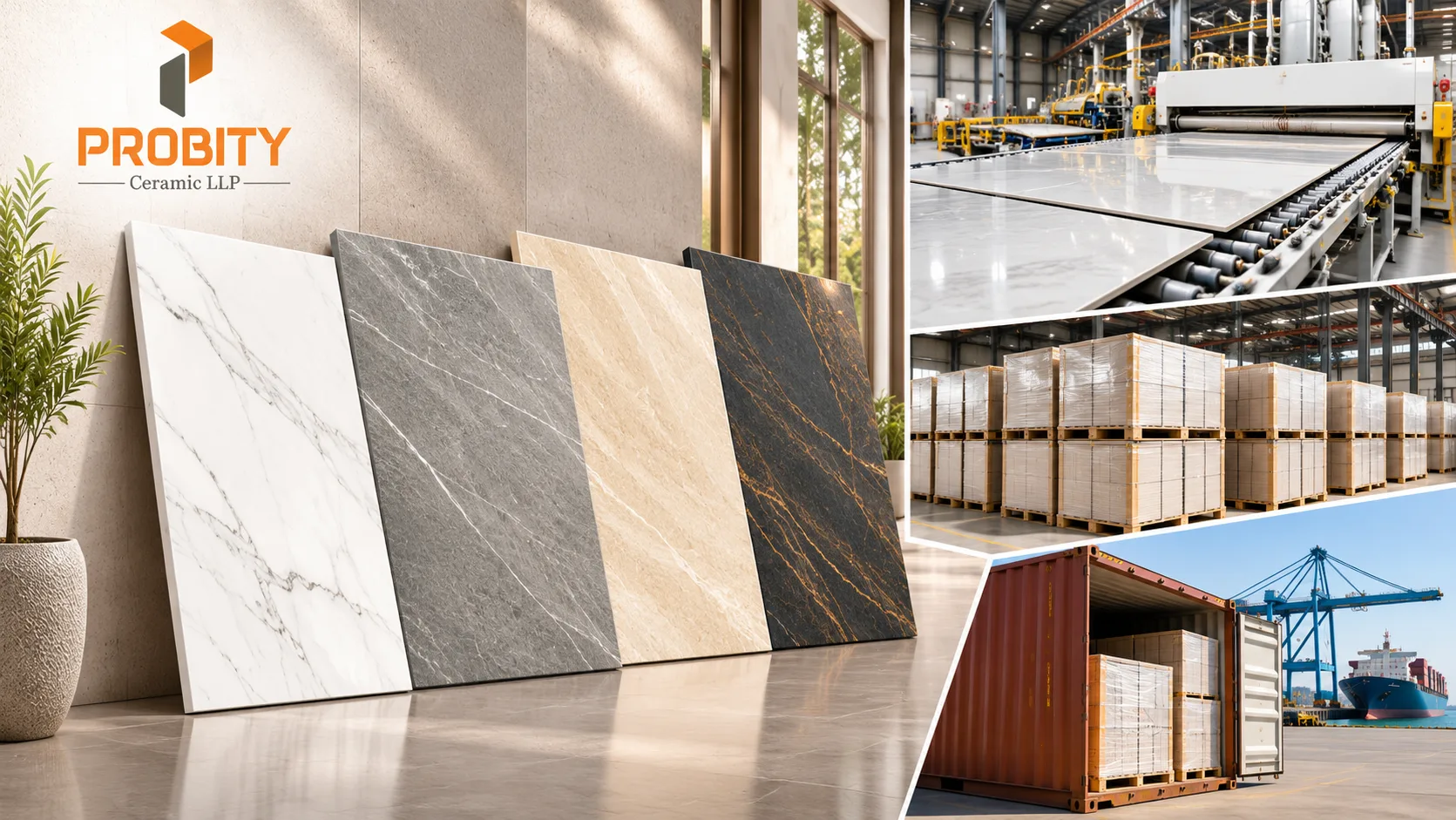
How to Choose a Porcelain Tile Manufacturer in India
Introduction: A Sourcing Decision, Not Just a Product Decision
India is widely described as one of the world’s largest porcelain and ceramic tile manufacturing and exporting bases, and Gujarat’s Morbi cluster is commonly cited as the centre of that industry. Gujarat government statements reported in national media have put Morbi’s share of India’s ceramic exports as high as roughly 80–90%, alongside a large share of domestic production. These are industry-level figures reported at a point in time; an importer evaluating a specific supplier should treat them as context, not as a substitute for verifying that one factory.
The practical difficulty for an importer is not finding “a porcelain tile manufacturer in India.” There are hundreds of factories of very different scale, equipment and quality discipline operating in the same cluster, alongside trading houses and export agents who resell factory production under their own name. The question that actually protects a buyer is narrower: can this specific supplier demonstrate consistent production, product-specific test evidence and export documentation to the standard your destination market requires?
This guide sets out how to evaluate a porcelain tile manufacturer in India before committing to an order — what to ask for, what a credible answer looks like, and where importers most often get this wrong.
Quick Answer: What Separates a Credible Manufacturer From a Reseller?
In short: the label “manufacturer” on a website or trade listing is not, by itself, proof of anything. Confirm it against documentation and, where practical, direct verification.
1. Why India, and Why Morbi, for Porcelain Tile Sourcing
Morbi’s position as India’s principal ceramic tile cluster is well documented in industry and government sources, and the concentration of raw material suppliers, machinery, digital printing technology, packaging and export logistics in one region has supported large-scale porcelain, GVT, PGVT and large-format porcelain slabs production. This scale is a genuine advantage for buyers seeking competitive factory pricing and a wide design range from a small number of sourcing trips. Depending on the application, buyers may also assess ceramic wall tiles, subway tiles and mosaic tiles.
However, a cluster’s reputation describes the region, not any individual factory within it. The same geography that produces export-grade porcelain tiles to recognised international classifications also contains factories at very different levels of equipment, quality control and export experience. Cluster reputation is a reason to shortlist India as a sourcing region; it is not a substitute for verifying the specific manufacturer.
2. Manufacturer vs Trading House vs Export Agent
Before evaluating any specific supplier, it helps to be clear which of these three an importer is actually dealing with, since each carries a different risk profile.
None of these three is automatically the wrong choice — a well-established trading house can offer real value through consolidated sourcing and language or logistics support. The risk is in not knowing which one you are dealing with, and assuming manufacturer-level accountability from an entity that does not control production.
3. What “Porcelain” Should Mean Before You Evaluate a Manufacturer
Under ISO 13006, porcelain tiles are classified by very low water absorption, conventionally no more than 0.5% by mass, determined using the ISO 10545-3 test method. This classification is a property of the specific product, tested and reported — not an attribute that transfers automatically from a manufacturer’s general description of its range.
Before assessing a manufacturer’s capability, confirm what you actually need: the exact product classification, the applicable standard and edition for your destination market, and whether that classification has been demonstrated with a product-specific test report rather than asserted in a catalogue.
4. Production Capability to Check
5. Certifications and Standards an Importer Should Request
6. Quality Control and Batch Consistency
A manufacturer can produce an excellent sample and still ship a bulk order with visible shade or calibre variation, particularly across multiple production runs. This is one of the most common sources of dispute between importers and Indian manufacturers, and it is rarely resolved after the container has shipped.
Ask how shade and calibre are grouped and labelled, and whether that information is marked on the carton or pallet.Request that a full bulk order, or at minimum each production run within it, come from a single identified batch.Retain an approved physical reference sample, with the SKU, shade and calibre recorded, against which the bulk shipment can be checked.For larger or repeat orders, consider a pre-shipment inspection before the goods leave the factory.7. MOQ, Lead Time and Repeat-Order Capability
Minimum order quantities, production lead time and the ability to repeat an order reliably vary significantly between manufacturers and are rarely stated accurately in a general catalogue. Confirm these in writing for the specific product and quantity you need, and ask separately what happens if you need to reorder the same design after the current production run has ended — some designs are produced in limited runs and may not be identically available later.
8. Packaging, Container Loading and Export Documentation
Confirm the carton, pallet or slab-crate protection used for your specific product, and who is responsible for loading and securing the container.Agree labelling requirements, including batch identification visible on the outer packaging.Confirm Incoterms, shipment responsibilities, insurance arrangements and required documentation with your own logistics or customs adviser — these vary by destination country and should not be assumed from a general quotation.Define, in writing, the process for shortages, breakage or non-conforming goods discovered on arrival.9. A Practical Due-Diligence Framework
Define the exact product requirement: classification, size, finish, thickness and the technical properties your project or market requires. For application-specific sourcing, compare porcelain floor tiles and porcelain wall tiles.Identify whether the supplier is a manufacturer, a trading house or an agent, and confirm which factory will actually produce your order.Request product-specific test reports and current certification documents, not general company literature.Order physical samples and assess them under realistic lighting and installation conditions, including more than one piece to check for variation.Ask how shade and calibre batching is managed, and how that will be communicated for your specific order.Confirm MOQ, lead time, packaging and loading arrangements in writing before placing a trial order.Place a trial order sized to validate consistency before committing to a larger or recurring programme.Inspect the trial order on arrival against the approved sample and retained specification before scaling up.10. What Importers and Distributors Should Check Before Buying
Product selection is only one part of sourcing. A tile that meets the design brief can still create problems if the supplier cannot maintain consistency, pack it correctly for the transport route, or provide the documentation your destination market requires.
Ask whether the supplier manufactures the product or sources it from another facility.Confirm exact product classification, technical specification and the test method used.Review how shade and calibre controls work and how production batches are identified.Clarify MOQ, production lead time and repeat-order availability in writing.Approve a physical sample and retain an identified reference sample for comparison against the bulk shipment.Agree carton, pallet or slab-crate protection, labelling and loading requirements.Confirm Incoterms, shipment responsibilities, insurance and documentation with your logistics or customs adviser.Define pre-shipment inspection arrangements and the process for shortages, breakage or non-conforming goods.11. Common Mistakes Importers Make When Selecting a Manufacturer
Treating a trading house’s catalogue as proof of one factory’s manufacturing capability.Assuming a cluster’s reputation applies equally to every factory operating within it.Approving a single small sample without checking variation across multiple pieces or production runs.Comparing factory quotations without matching size, thickness, finish, classification and packaging specification.Accepting a general certificate as proof of compliance for every product and every batch.Skipping a trial order and moving straight to full container volumes with an unverified supplier.Not confirming, in writing, who is responsible for packaging damage, shortages or non-conforming goods.Overlooking destination-market documentation requirements until the shipment is already in transit.12. Frequently Asked Questions
How do I know if a supplier in India is an actual manufacturer?
Ask for the factory address and production details, and where practical verify them through a visit, a video factory tour or an independent inspection. A manufacturer should also be able to provide product-specific test reports tied to its own production, not only general marketing material.
Is Morbi the only place to source porcelain tiles from India?
No. Morbi is widely cited as India’s largest ceramic tile cluster and a major share of national exports, but porcelain tile manufacturing also takes place in other regions. Cluster location is one factor among several, not a guarantee of quality on its own.
What is the difference between a manufacturer and an export trading house?
A manufacturer owns and operates its own production. A trading house sources from one or more factories and exports or resells under its own name. Both can be legitimate partners, but the accountability for consistency and quality differs, so confirm which one you are dealing with.
What certifications should I ask an Indian porcelain tile manufacturer for?
At minimum, ask for the product’s classification evidence under ISO 13006, a water-absorption test report under ISO 10545-3, and the manufacturer’s ISO 9001 certificate. Confirm any additional destination-market requirements, such as CE marking for the EU, separately.
Does a low water absorption figure alone confirm a tile is good quality?
No. Water absorption is one useful classification property, but it does not by itself determine strength, surface wear performance, slip suitability or shade consistency. Review the full set of relevant technical properties for your application.
How much variation in shade or calibre is normal between batches?
Some variation is a normal feature of ceramic manufacturing, which is why shade and calibre batching exists. The key is whether the manufacturer documents and labels these batches clearly, and whether your order is sourced from a consistent, identified batch.
Should I place a large order on my first transaction with a new manufacturer?
A smaller trial order, sized to validate consistency, documentation and packaging, is generally lower risk than moving straight to a full container volume with an unverified supplier.
Who is responsible for breakage or shortages discovered after shipping?
This depends on the agreed Incoterms, the packaging specification and what was agreed in writing before shipment. Define this process, including any pre-shipment inspection, before the order is placed, not after a problem occurs.
Can a trading house guarantee the same quality as the original factory?
Only if it has a direct, verifiable relationship with that specific factory and controls how batches are sourced. Ask which factory produces the order and whether that will remain consistent across repeat purchases.
What should I request before placing a bulk order with an Indian manufacturer?
Request detailed product specifications, product-specific test reports, physical samples, shade and calibre information, packaging details, lead time, commercial terms and destination-market documentation support, all confirmed in writing.
Is a manufacturer’s export experience important?
Yes. Export-specific requirements — documentation, packaging for long transit, destination compliance — differ from domestic supply. A manufacturer with established export experience to your destination market is generally better placed to avoid documentation and packaging issues.
How do I verify a factory's claims without visiting India in person?
Request a live video factory tour, ask for product-specific test reports from an identifiable laboratory, request references from other export buyers where available, and consider a third-party pre-shipment inspection for the trial order.
Related Articles
How to Choose the Right Tile Manufacturer in India: Buyer’s Guide

The Complete Guide to Import Tiles from India