Best Ceramic & Porcelain Tiles in Ukraine: The Complete Buyer's Guide
Ukraine's tile market has changed considerably in recent years, shaped by a mix of established domestic production, a long-standing reliance on European imports, and growing interest in cost-competitive alternatives from Asian manufacturers as renovation and reconstruction demand continues across residential and commercial projects. For anyone buying tile in Ukraine today - a homeowner renovating an apartment, a contractor sourcing for a project, or a distributor building out a retail range - the number of available options can be difficult to navigate without a clear framework.
This guide is written to help exactly that audience find their way through the Ukrainian tile market: what's actually available, how to tell genuine quality from marketing claims, what certifications and standards matter, and how sourcing decisions differ depending on whether you're buying a few boxes for a bathroom or importing a full container for a project or retail catalogue.
By the end, you will have a practical framework for evaluating ceramic and porcelain tile options in Ukraine, regardless of whether the product on the shelf in front of you is domestic, European, or imported from further afield.
1. The Ukrainian Tile Market Today
Ukraine has its own established ceramic tile production base, historically concentrated in regions with strong industrial and clay-processing heritage, alongside a long tradition of importing tile from European manufacturers, particularly Poland, Spain, and Italy. In recent years, reconstruction and renovation activity across residential and commercial buildings has kept demand for tile - from budget ceramic through premium porcelain - consistently strong, while also increasing price sensitivity and interest in a wider range of sourcing options, including cost-competitive Asian manufacturers.
For today's buyer, this means a genuinely broader set of choices than a decade ago, but also a market where quality, certification, and supplier reliability vary considerably between domestic production, European imports, and newer Asian import channels - making an informed buying framework more useful than ever.
2. Ceramic vs Porcelain: Understanding the Difference Before You Buy
The two terms are often used loosely in retail settings, but the distinction matters for durability and application:
Ceramic tile is typically made from red or white clay, fired at lower temperatures, and generally has higher water absorption. It is well-suited to interior walls and light-to-moderate traffic floors, and is usually the more budget-friendly option.
Porcelain tile is made from denser, more refined clay (often including kaolin) fired at higher temperatures, producing a harder, less porous tile with significantly lower water absorption. This makes it better suited to heavy-traffic floors, wet areas, and exterior or frost-exposed applications — an especially relevant distinction in Ukraine's climate, discussed further below.
As a general buying rule: for exterior use, unheated spaces, or any application exposed to freeze-thaw cycles, porcelain with a low water absorption rating is the safer choice; standard ceramic is genuinely well suited to most interior wall applications where cost efficiency matters more than frost resistance.
3. Where Tiles Sold in Ukraine Come From
Tile available in the Ukrainian market today generally falls into three broad sourcing categories, each with a different quality and price profile:
Domestic Ukrainian production. Local manufacturers offer competitive pricing and shorter logistics chains, and are often a practical choice for standard ceramic wall and floor tile in budget and mid-market categories.
European imports (Poland, Spain, Italy, and others). These typically carry strong design reputation and consistent EU-standard certification, generally at a premium price point reflecting higher production costs and shorter shipping distances to the Ukrainian market.
Asian imports, including India and Turkey. A growing share of the mid-to-premium market, offering a combination of design range, improving certification standards, and a meaningfully lower price point than comparable European product, at the cost of a longer shipping lead time.
None of these categories is inherently "best" - the right choice depends on the specific project's budget, timeline, and technical requirements, which is why the evaluation criteria in the next section matter more than country of origin alone.
4. What to Look for When Buying Tiles in Ukraine
• Water absorption rating: critical for any exterior, balcony, or unheated space application given Ukraine's winter climate.
• PEI rating (surface abrasion resistance): higher ratings for higher-traffic floors, particularly in commercial or high-footfall residential areas.
• Slip resistance (R-rating or equivalent): especially relevant for bathroom floors, entryways, and any exterior walking surface exposed to rain or snow.
• Certification documentation: EN 14411 / CE marking is the standard reference point for European-aligned quality verification (see Section 7).
• Batch and shade consistency: particularly important for larger projects where tile from the same order needs to match across an entire floor or room.
• Supplier transparency: a supplier willing to provide technical data sheets, certification documents, and physical samples on request is a reliable positive signal regardless of country of origin.
5. Best Tile Categories for Ukrainian Homes and Climate
Frost-resistant porcelain for exterior and balcony use: essential given Ukraine's cold winters; look specifically for a documented low water absorption rating and frost-resistance testing rather than assuming all porcelain qualifies.
Large-format porcelain for open-plan interiors: increasingly popular in renovated apartments and new-build projects for a clean, seamless floor appearance with minimal grout lines.
Wood-look and stone-look porcelain: a practical, durable alternative to natural materials for underfloor-heated apartments, a common heating setup in Ukrainian residential buildings.
Anti-slip tiles for bathrooms and entryways: particularly relevant given wet, snowy, or muddy conditions tracked indoors for much of the year.
6. Price Ranges and What Affects Cost
Tile pricing in Ukraine varies significantly by category, origin, and finish, and buyers should expect a wide spread between basic ceramic wall tile and premium large-format porcelain slabs. Beyond the base product price, buyers should factor in:
• Import duties and applicable taxes on imported product, which vary by country of origin and product classification
• Transportation and logistics costs, which differ meaningfully between short-haul European imports and longer-transit Asian imports
• Installation costs, which can vary based on tile format (large-format slabs generally require more specialised, and therefore costlier, installation)
• Wastage allowance, typically 8–10% above the measured area to account for cuts, breakage, and pattern matching
Buyers should always request a landed, all-in price comparison rather than comparing base product prices alone, since duty, freight, and format-driven installation cost differences can meaningfully change which option is actually most cost-effective for a given project.
7. Certifications and Standards to Check
EN 14411 - the European harmonised standard for ceramic tiles - is the most widely recognised quality reference point in the Ukrainian market, given the country's deepening alignment with EU technical standards. CE marking, and the underlying Declaration of Performance behind it, indicates a manufacturer has tested the product's water absorption, breaking strength, slip resistance, and other performance characteristics against this standard, regardless of whether the manufacturer is based in the EU or exporting into it.
ISO 13006 is the closely related international reference standard, commonly used by manufacturers testing for multiple export markets simultaneously, including manufacturers based in India and other non-EU exporting countries.
For any significant purchase, ask the supplier for the specific product's Declaration of Performance or equivalent test documentation rather than relying on a general "certified" claim on packaging or in a showroom.
8. Buying Through a Local Retailer vs Importing Directly
For homeowners and small contractors, buying through an established local retailer or distributor remains the most practical route - it avoids the complexity of customs clearance and freight logistics, and provides local recourse if a quality issue arises after purchase.
For distributors, larger contractors, and construction companies working at project or catalogue scale, importing directly from a manufacturer can offer meaningfully better pricing and greater control over specification, certification verification, and OEM/private label options - but requires managing freight, customs documentation, and quality verification directly, or through a trusted logistics and customs partner.
9. Popular Styles and Design Trends in Ukraine
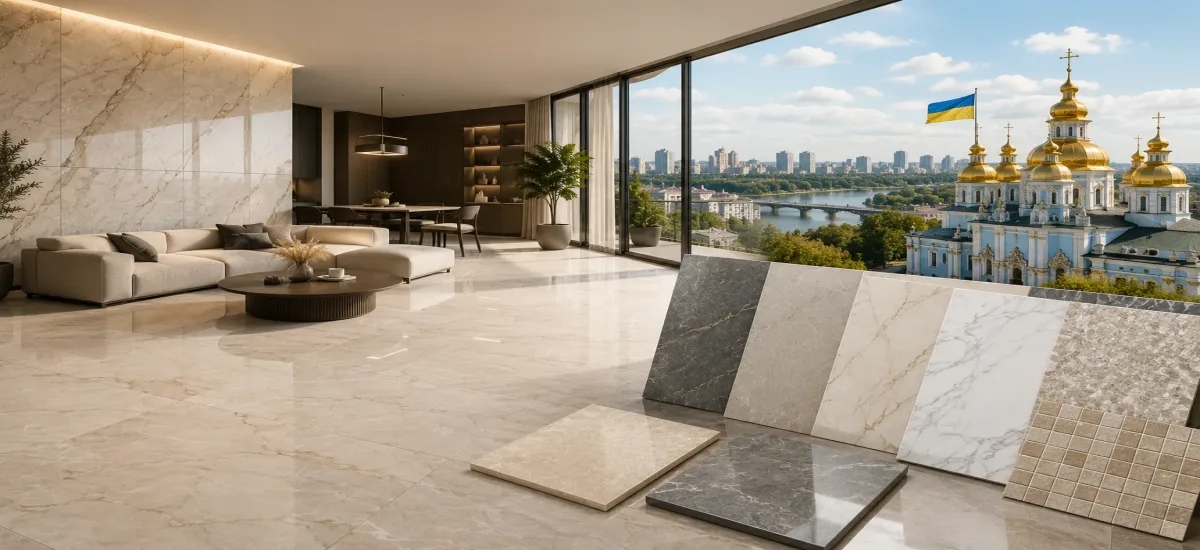
Current demand in the Ukrainian residential market leans toward large-format, minimal-grout porcelain floors, warm and light neutral tones that suit both renovated Soviet-era apartments and new-build projects, marble-look and concrete-look finishes for a contemporary aesthetic, and wood-look porcelain as a durable, underfloor-heating-compatible alternative to natural wood flooring - a particularly relevant consideration given how common underfloor heating is in the Ukrainian residential market.
10. Common Mistakes Ukrainian Buyers Make
Choosing standard ceramic for an exterior or balcony application. Without adequate frost resistance, standard ceramic can crack or spall after repeated freeze-thaw cycles.
Comparing base prices without accounting for duty, freight, and installation cost differences. A lower shelf price on an imported tile can end up costing more once landed cost and installation format are factored in.
Not ordering enough wastage allowance, particularly for large-format tile or patterns requiring careful alignment, leading to a mismatched batch on reorder.
Skipping certification verification, especially for larger project purchases where a quality dispute later can be costly to resolve without proper documentation.
Selecting tile from a small sample or digital image alone, without viewing a full-size sample under the actual installation lighting - see our companion guide on how lighting changes tile appearance for more detail.
11. Why Indian Porcelain Tiles Are a Strong Option for Ukraine
Indian porcelain manufacturers, particularly established producers based in Morbi, Gujarat, have become an increasingly practical sourcing option for the Ukrainian market for several concrete reasons: a genuine cost advantage over European product even after freight and duty are factored in; growing EN 14411 (CE) and ISO 13006 certification maturity that aligns with the same standards Ukrainian buyers already reference for European product; a broad design range spanning large-format porcelain, marble-look, wood-look, and frost-resistant exterior tile; and OEM/private label capability for Ukrainian distributors and retailers looking to build a differentiated catalogue.
The main practical trade-off versus a European supplier is lead time - sea freight from India takes materially longer than trucking from Poland or Spain - which makes Indian sourcing best suited to planned project and catalogue purchasing rather than urgent, short-lead-time individual orders.
12. Working with Probity Ceramic LLP: What Sets Us Apart
Probity Ceramic LLP is a premium porcelain tile manufacturer and exporter based in Morbi, Gujarat, supplying distributors, contractors, and construction companies across international markets, including Ukraine and the wider Eastern European region.
What we offer buyers evaluating Ukraine-bound sourcing:
• Porcelain tiles and large-format slabs from 300×600mm to 1200×2400mm, including frost-resistant options suited to exterior and balcony applications
• Concurrent testing to ISO 13006 and EN 14411 (CE), with product-specific Declarations of Performance available on request
• Marble-look, wood-look, stone-look, and concrete-look collections aligned with current Ukrainian design demand
• OEM and private label manufacturing for Ukrainian distributors and retailers building a differentiated range
• An export team experienced in preparing documentation for European-aligned and Eastern European customs and compliance requirements
We work with:
Ukrainian distributors and retailers sourcing catalogue-scale volume, contractors and construction companies supplying reconstruction and renovation projects, and buyers evaluating Indian sourcing for the first time who want factory-verified certification and physical samples before committing to a container order.
Conclusion
Finding the best ceramic and porcelain tile in Ukraine today means navigating a genuinely wider set of options than a decade ago - domestic production, European imports, and a growing, increasingly credible range of Asian sourcing, particularly from India. The right choice depends less on country of origin and more on matching the tile's technical specification (water absorption, PEI rating, slip resistance) to the application, verifying certification directly, and comparing true landed cost rather than shelf price alone.
For buyers planning ahead - whether a single renovation project or a full distributor catalogue - that broader set of options, evaluated with the right framework, generally means better quality and value than relying on a single traditional source out of habit.
Related Articles
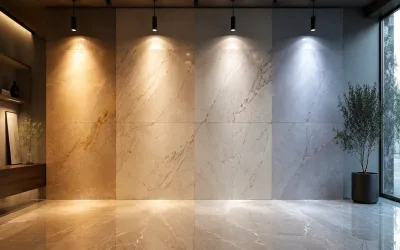
How Lighting Changes the Appearance of Tiles

How Tile Color Influences Mood in Interior Design