Technical
600×1200 vs 800×1600 vs 1200×2400 Tiles: Which Size Is Right?
Related Articles
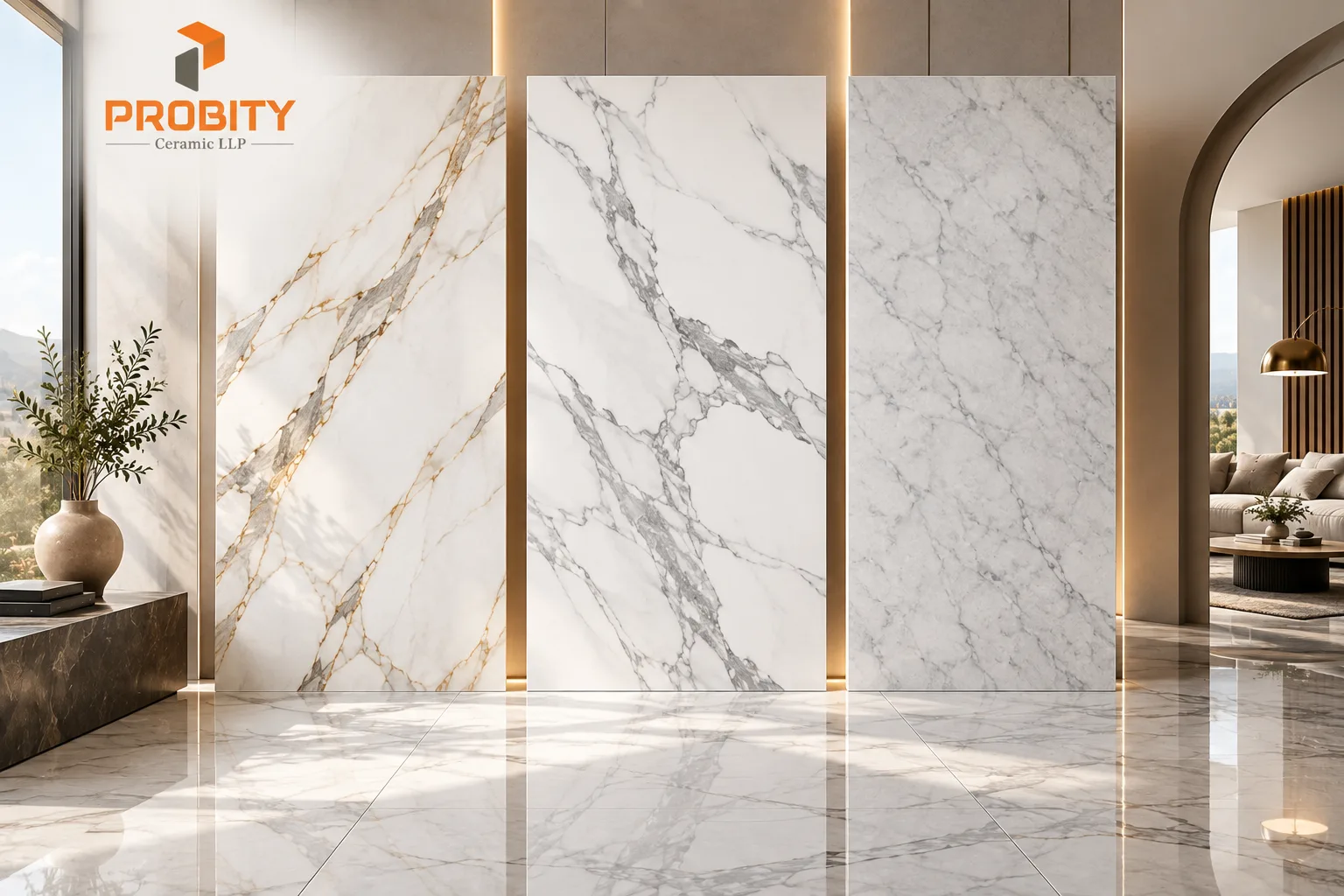
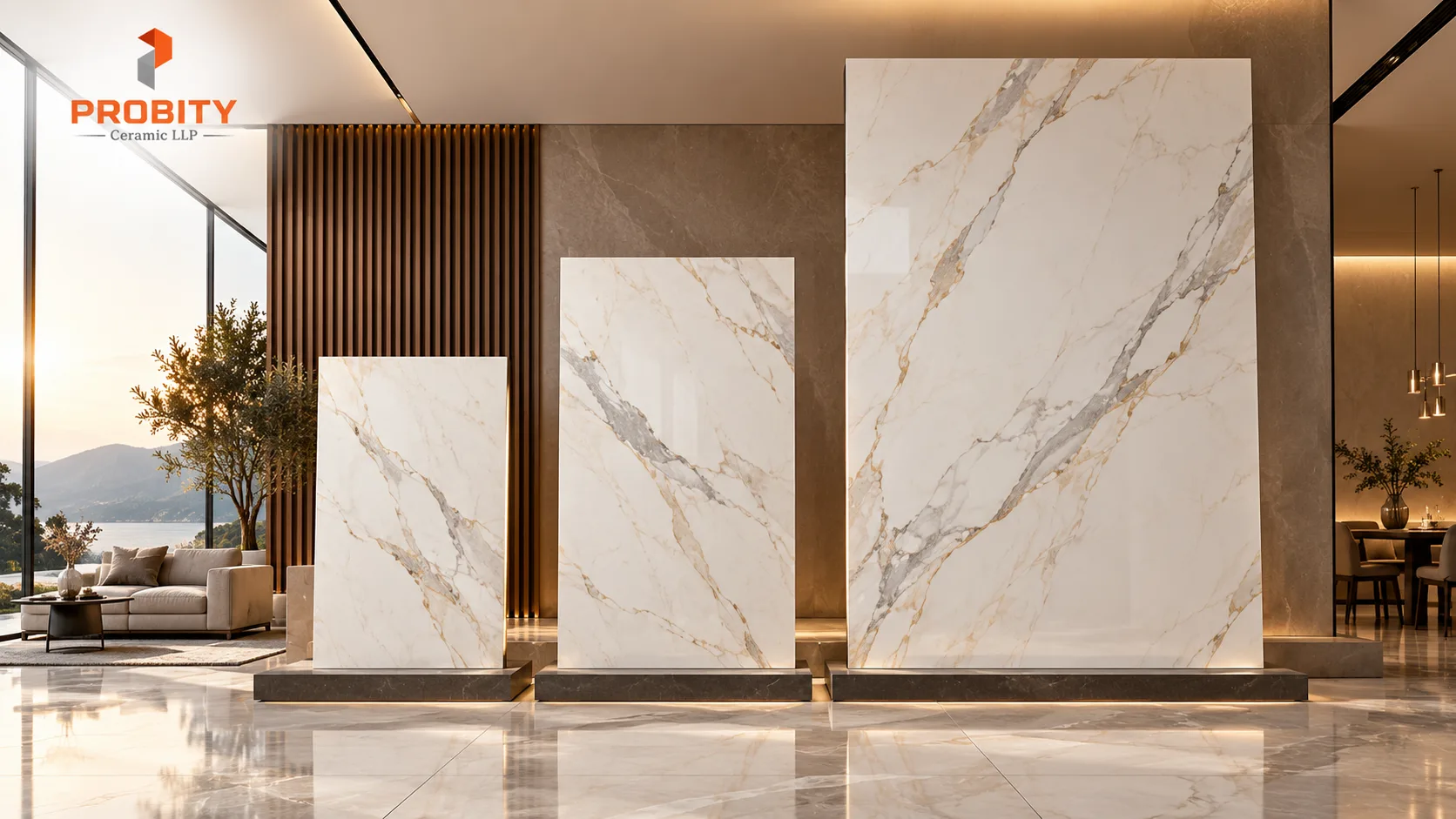
Calacatta vs Statuario vs Carrara Porcelain Tiles
White marble-look surfaces remain one of the most versatile ways to create a premium architectural interior. But once you compare Calacatta, Statuario and Carrara-inspired porcelain tiles, the decision becomes less straightforward. All three names suggest white Italian marble, yet the visual effect can be dramatically different.Calacatta generally signals stronger movement and more expressive veining. Statuario is commonly associated with a bright white ground and defined grey veining. Carrara tends toward a softer white-to-grey background and quieter, finer veining. In porcelain collections, however, these names describe design directions rather than guaranteeing one identical natural-stone pattern.That distinction matters. A buyer should not select a tile simply because the box says Calacatta or Statuario. The actual design, vein scale, colour temperature, format, finish, lighting, application and technical specification all matter.This guide gives architects, designers, importers and project buyers a practical framework for comparing the three marble-look directions.1. The Quick DifferenceStyleTypical Visual DirectionDesign CharacterTypical RoleCalacattaBright white with bold grey and/or warm gold movementDramatic and expressiveFeature surfaces and statement interiorsStatuarioBright/luminous white with defined grey veiningCrisp and architecturalRefined focal surfaces and premium interiorsCarraraSofter white/grey with finer grey movementCalm and understatedLarger areas and balanced interiorsThese are general visual directions. Natural marble varies, and porcelain manufacturers interpret marble references differently. Always evaluate the actual collection and approved sample.2. Calacatta Marble-Look PorcelainCalacatta-inspired porcelain is generally selected when the design needs visible movement. The visual language often combines a light background with pronounced grey veining and, in some collections, warm gold or beige accents.•Strong focal-point potential.•Pairs well with brass, beige, taupe and warm wood.•Works particularly well when surrounding finishes are restrained.•Large-format applications can emphasise vein movement.Common applications•Feature walls•Luxury bathroom walls and vanity backdrops•Hotel and restaurant interiors•Premium living areas•Selected kitchen backsplashes•Reception and statement commercial spacesProbity's CALACATTA GOLD 600×1200 mm product is described as a glossy marble-look glazed porcelain tile with a white background and grey/gold veining, 9 mm thickness and rectified edges.3. Statuario Marble-Look PorcelainStatuario-inspired porcelain usually aims for a bright, clean marble field with more defined grey movement. It is often selected when the designer wants visual luxury without necessarily introducing warm gold tones.•Bright visual base for contemporary interiors.•Defined veining creates character without extra decorative pattern.•Works with white, grey, black, chrome, brass and wood palettes.•Large formats can emphasise continuity.Probity currently lists Satuvario in 600×1200 mm glossy porcelain and STATUARIO collections in larger formats with matt structured finishes.Commercial spelling varies: Probity uses both Satuvario and Statuario in product names. For procurement, use the exact SKU and approved sample rather than relying on the collection name alone.4. Carrara Marble-Look PorcelainCarrara-inspired porcelain generally takes a quieter approach: softer white or grey-white backgrounds, finer grey movement and a less dramatic overall pattern.•Useful for calm, timeless interiors.•Works when other materials already provide visual interest.•Suitable for bathrooms, walls and floors when the technical specification fits.•Pairs naturally with white, light grey, wood and neutral cabinetry.A Carrara name is not a guarantee of one exact pattern in porcelain. Manufacturers can offer several Carrara-inspired designs with different tones and vein density. Review the actual collection.5. Head-to-Head ComparisonFactorCalacattaStatuarioCarraraBackgroundBright white; some warmer designsBright/luminous whiteSofter white to light greyVeiningBold, broad, dramatic; may include goldDefined grey, often crispFiner, softer, dispersedVisual impactHighMedium-highLow-mediumTemperatureCan be warm with gold/beigeUsually cool/neutralOften cool/softDesign roleStatement surfaceRefined focal surfaceCalm backgroundLarge-format useExcellent with planned vein layoutExcellent for continuityGood for calmer continuous surfacesThere is no universal winner. The appropriate choice depends on the project's visual hierarchy and the specific tile collection.6. Choose by Design PersonalityIf you want a statement: CalacattaUse stronger Calacatta movement when the surface itself should become a major visual element. Keep adjacent finishes relatively quiet.If you want crisp luxury: StatuarioStatuario-inspired designs can provide a bright, architectural look with defined grey movement and a controlled palette.If you want understated elegance: CarraraCarrara-inspired designs are often easier to extend across larger areas because softer patterns can sit behind furniture and other finishes.7. Choose by Room and ApplicationApplicationCalacattaStatuarioCarraraLiving-room feature wallStrong statementRefined statementQuiet backdropBathroom feature wallExcellentExcellentExcellentGeneral bathroom wallGood if controlledExcellentExcellentLarge floor areasUse where movement is acceptableGood with balanced patternOften well suitedHotel lobbyStrong focal zonesPremium architectural lookCalmer backdropRetailPremium feature zonesRefined brand environmentsNeutral schemesKitchen backsplashStrong statementClean luxurySubtle eleganceVisual style alone should never determine technical suitability. Check the exact product's slip, wear, surface and installation requirements.8. Choose by Format and Vein MovementFormat changes how marble veining is perceived. A dramatic pattern on a small tile can look fragmented; the same design on a larger panel can read as a continuous architectural surface.•600×1200 mm: popular large-format tile with fewer grout lines.•800×1600 mm and similar formats: useful for larger walls and floors.•800×2400, 800×3000 and other slabs: useful where fewer joints and stronger continuity are desired, subject to handling and installation requirements.Probity currently lists 600×1200 marble-look products and STATUARIO collections in 800×2400, 800×3000 and 800×3200 mm formats.For bold Calacatta or Statuario patterns, review multiple tiles together or request a layout image before final approval.9. Glossy vs Matt FinishFinishVisual EffectConsiderationGlossy/polishedBrighter and more reflectiveCan amplify colour and vein contrast; lighting matters.MattSofter and more contemporaryReduces reflections and can make strong patterns feel calmer.Matt structuredTactile, grounded appearanceMay support functional/slip requirements depending on product.Probity's Calacatta Alpine and Calacatta Gold examples are glossy, while STATUARIO_SCALA and STATUARIO_GREY are listed with matt structured surfaces.10. Porcelain vs Natural MarbleConsiderationMarble-Look PorcelainNatural MarblePatternManufactured and reproducible within a collectionNatural variation is intrinsicMaintenanceGenerally straightforward; follow product guidanceOften requires more specialised careAcid sensitivityGenerally more resistant; verify product dataCan etch from acidic substancesLarge-format planningManufactured dimensions and repeatabilityNatural slab size/pattern varyDesign matchingCan reproduce a selected aestheticEach slab is uniqueSupply planningRepeat production may be possibleMatching later lots can be difficultThis is a directional comparison. Use technical documentation for the exact porcelain product and care guidance for natural stone.11. Buyer Checklist1.Review the actual product, not only the collection name.2.Request physical samples or high-resolution production images.3.Check the background tone under project lighting.4.Review vein scale and direction across several tiles.5.Confirm whether the pattern is random, continuous or bookmatched.6.Select format based on the intended elevation.7.Confirm finish and application suitability.8.Check water absorption, slip, wear/scratch and chemical-resistance data where relevant.9.Confirm rectification, dimensions and calibration.10.Approve packaging and batch/shade identification for commercial orders.Probity's product pages publish SKU-level information such as 9 mm thickness, rectification and, for listed products, water absorption below 0.50%, selected slip ratings and logistics details. Always verify the exact SKU before specification.12. Commercial and Hospitality ProjectsFor commercial projects, selection should balance visual impact with repeatability, procurement scale and maintenance expectations.•Use dramatic Calacatta movement strategically in reception, feature walls, lift lobbies or selected hospitality zones.•Use Statuario-inspired designs where bright, refined continuity is important.•Use Carrara-inspired patterns where a calmer surface is needed across larger areas.•Standardise product codes and approved samples across procurement packages.•For multi-country projects, confirm technical and compliance requirements for each destination.•Coordinate large-format selection with installers early.A hotel, retail chain or residential developer does not need every surface to be dramatic. Strong projects often use a hero marble look in selected zones and quieter materials elsewhere.13. Probity's Marble-Look Porcelain CollectionProbity Ceramic currently presents marble-look products spanning Calacatta-inspired designs, Statuario/Satuvario designs and other marble-inspired collections.Probity ExamplePublished Format / FinishDesign DirectionCALACATTA GOLD600×1200 mm, glossyWhite marble with grey and gold veiningCalacatta Alpine600×1200 mm, glossySoft mineral streaks and marble depthSatuvario Smart600×1200 mm, glossyStatuario/Calacatta-inspired nuancesSTATUARIO_SCALA800×2400 / 800×3000 / 800×3200 mm, matt structuredStatuario-inspired with delicate veiningSTATUARIO_GREY800×2400 / 800×3000 / 800×3200 mm, matt structuredLuminous Statuario-inspired surfaceProbity's listed products also state FCL ordering, typical 15–20 day production schedules for several products, OEM/private-label packaging support and Mundra loading. Exact availability, MOQ, capacity and technical specification should be confirmed for the chosen SKU.14. FAQsWhat is the difference between Calacatta, Statuario and Carrara porcelain tiles?Calacatta-inspired designs generally feature stronger movement, Statuario-inspired designs tend toward bright backgrounds with defined grey veining, while Carrara-inspired designs are usually softer and more understated. Actual patterns vary by collection.Which is better for a luxury interior: Calacatta or Statuario?Both can create a luxury look. Calacatta is commonly used for stronger visual movement, while Statuario often provides a cleaner and more architectural appearance.Is Carrara porcelain less luxurious than Calacatta?No. Carrara creates a different visual effect. Its softer pattern can be highly effective across larger areas and calmer interiors.Which marble-look tile is suitable for a feature wall?All three can work. Calacatta often creates the strongest statement, Statuario a refined focal effect, and Carrara a quieter backdrop.What size is best for marble-look porcelain?It depends on the room, pattern and installation. 600×1200 is a popular large format, while larger slabs can improve vein continuity.Does glossy or matt finish work better?Glossy can make marble patterns brighter and more dramatic; matt can create a softer contemporary appearance. Select according to lighting, application and performance.Are marble-look porcelain tiles easier to maintain than natural marble?Porcelain generally requires less specialised maintenance, while natural marble can be more sensitive to acids and may require sealing depending on stone and use.Can Calacatta porcelain be used on floors?Some Calacatta-look porcelain products are designed for floors. Verify the exact product's slip, wear and application specifications.Can Statuario porcelain be used in bathrooms?Suitable porcelain products can be used on bathroom walls and floors when their technical specification and installation system support the application.How should a hotel choose between the three?Start with the desired visual hierarchy: dramatic patterns for hero zones, refined patterns for premium continuity, and quieter patterns for broad coverage.Can I request samples before importing?Yes. International buyers should request physical samples and approve the actual product before bulk procurement.Can Probity provide private-label marble-look porcelain?Probity's current product pages state OEM/private-label packaging support for listed products. Confirm design, packaging, MOQ and exclusivity terms with the export team.15. Conclusion and CTACalacatta, Statuario and Carrara should not be treated as three interchangeable tile names. They represent three different visual approaches: expressive movement, crisp refinement and understated marble character.The strongest selection process starts with the project rather than the name. Decide how much visual movement the room can handle, how bright or warm the palette should feel, how large the surface is, which format creates the right vein continuity and what technical performance the application requires.Then compare actual samples. Look at multiple tiles together, place them beside cabinetry and paint, review them under project lighting and confirm the technical specification. For international buyers, also evaluate batch consistency, packaging, MOQ, lead time and export support.Probity Ceramic's current portfolio includes Calacatta, Statuario/Satuvario and other marble-look porcelain collections in tile and large-format formats. For distributors, architects, developers and project buyers, its export team can help match the desired visual direction to an appropriate product specification.

Protect Tile Import Margins from Rising Freight Costs | Probity Ceramic
Freight cost volatility has become one of the defining risks in the tile import business. A container rate that was stable for eighteen months can move 30-60% within a single quarter in response to fuel prices, port congestion, capacity shortages, or geopolitical disruption on major shipping lanes. For an importer working on a fixed retail or project price, a freight spike that lands mid-shipment can erase the entire margin on that order.Unlike raw material cost or currency movement, freight cost is often treated as a fixed pass-through - booked late, negotiated reactively, and absorbed rather than planned for. That reactive approach is precisely what erodes profitability fastest when rates move against you.This guide sets out a practical framework for tile importers, distributors, and project buyers to protect margins when freight costs rise - covering container optimisation, sourcing structure, Incoterm selection, packaging efficiency, contract design, and the role your manufacturing partner plays in absorbing volatility rather than passing it straight through to you.1. Why Freight Costs Are Rising for Tile ImportersOcean freight rates on the lanes that matter most to tile importers - India to the GCC, Europe, Africa, Southeast Asia, and the Americas - have become structurally less predictable over the past several years. Several factors compound to drive this:• Bunker fuel price volatility, which feeds directly into base freight and surcharge structures• Port congestion and equipment imbalances that create container shortages on specific lanes• Rerouting around chokepoints (such as the Red Sea and Suez corridor), adding transit days and cost• Carrier alliance capacity management, which can tighten space on tile-heavy lanes during peak shipping seasons• Seasonal demand spikes ahead of major construction and retail cycles in destination marketsBecause porcelain tile is a heavy, high-density product shipped almost exclusively by FCL sea freight, importers feel freight rate movement more acutely than importers of lighter goods - freight can represent 15-30% of landed cost on a standard container, compared to a low single-digit percentage for many other product categories.2. How Freight Volatility Erodes Margin - and Why It's Often Invisible Until Too LateThe core problem is timing. Tile orders are typically quoted to the end customer or project weeks or months before the container is booked and loaded. If freight rates move upward between quotation and booking, that increase lands entirely on the importer's margin unless it was contractually passed through.This shows up in three specific ways:Margin compression on committed pricing. Fixed-price quotes to distributors, retailers, or project clients leave no room to recover a freight increase after the fact.Cash flow strain from advance payment structures. A 30% advance paid against a proforma invoice locks in product cost, but freight - often booked separately and later - can still move before the container sails.Erosion that compounds across a multi-shipment programme. A distributor with quarterly container orders can see a freight increase repeat and compound across every subsequent shipment if it isn't addressed structurally.The importers who protect margin most effectively are the ones who treat freight as a planned, actively managed cost line - not a number that gets confirmed the week before loading.3. Maximising Container Utilisation: The First Line of DefenceFreight cost is charged per container, not per tile. This means the single most direct lever an importer controls is how much usable product value is loaded into every FCL.Optimise product mix by weight and volume. A container loaded purely to maximise carton count without considering weight distribution can leave usable capacity on the table. Work with your manufacturer's export team to model different size and product combinations against your container's weight and volume limits.Confirm actual tonnage per container for your specific product. Large-format slabs, full-body porcelain, and standard 600×600mm tiles all load differently. A manufacturer experienced in export loading will know the real achievable tonnage for each product category, not just a generic FCL estimate.Avoid partial or under-loaded containers. An LCL or part-loaded FCL shipment carries a materially higher freight cost per tonne than a fully loaded container. Where order volume allows, always prioritise full container loads.Reassess palletisation efficiency. Pallet configuration and stacking height directly affect how much product fits per container within safe load limits. This is a packaging engineering question worth raising directly with your manufacturer.4. Choosing the Right Incoterm for a Volatile Freight MarketThe Incoterm you buy under determines who carries freight risk between factory and destination, and this becomes especially important when rates are moving unpredictably.FOB (Free on Board). You arrange and pay for ocean freight directly. This gives you full visibility and control over freight booking, allowing you to shop rates, book early, or lock in contracts - but it also means you carry the full exposure to rate movement.CIF (Cost, Insurance, Freight). The manufacturer arranges and quotes freight as part of the landed price. This can simplify budgeting, but the quoted freight component may include a margin buffer, and you have less direct control over carrier selection or booking timing.CFR (Cost and Freight). Similar to CIF but without the insurance component bundled - worth considering if you already hold your own marine cargo insurance.In a rising freight environment, importers with strong freight-forwarder relationships and enough volume to negotiate directly often do better under FOB, since they can lock in rates independently of the manufacturer's quote cycle. Importers without established forwarder relationships may find CIF more predictable, provided the manufacturer's export team has strong carrier relationships and books in advance rather than at spot rate.5. Packaging and Weight Efficiency: An Underused Margin LeverPackaging weight is a frequently overlooked contributor to freight cost. Since ocean freight for tile is generally constrained by container weight limits before it is constrained by volume, every kilogram of unnecessary packaging weight is a kilogram of tile that isn't shipped.• Ask your manufacturer whether carton and pallet specifications have been engineered for weight efficiency without compromising breakage protection• Compare corrugated board grade and pallet type across suppliers - heavier, over-specified packaging on a low-risk product category adds cost without adding protection• Balance this carefully against breakage risk: under-packaging to save weight is a false economy if it increases damage claimsA manufacturer who can show you the actual weight breakdown of packaging versus product per container is demonstrating a level of export sophistication that pays off directly in your landed cost.6. Cutting Out Margin Layers: Direct Manufacturer SourcingWhen freight costs rise, every additional margin layer in your supply chain becomes proportionally more expensive to carry. Sourcing through a trading company or agent means absorbing both their margin and the freight increase, whereas a direct manufacturer relationship exposes you to freight movement alone.Direct manufacturer relationships also tend to give importers more room to negotiate on FOB pricing or shared freight risk during volatile periods, since the manufacturer has direct visibility into their own cost structure and more flexibility to adjust than a trader working off someone else's quote.7. Consolidation and Order Planning to Reduce Freight FrequencyEvery container shipped carries fixed cost components - documentation, port handling, customs processing - independent of freight rate itself. Consolidating smaller, frequent orders into fewer, larger shipments reduces how many times these fixed costs are incurred.Forecast further ahead. Moving from reactive, as-needed ordering to a quarterly or seasonal forecast allows you to plan container volumes rather than shipping partial loads under time pressure.Coordinate multi-product consolidation. If you buy multiple tile categories from the same manufacturer, consolidating them into single containers reduces total shipment count without reducing product range.Align order timing with your manufacturer's production schedule. Orders placed to align with existing production runs can sometimes access better freight booking windows than urgent, out-of-cycle orders.8. Contract and Pricing Structures That Absorb Freight ShocksThe most resilient importers build freight volatility into their commercial structure rather than absorbing it silently.Freight escalation clauses. For multi-shipment annual agreements, negotiate a clause that adjusts pricing if freight indices move beyond an agreed threshold - protecting both sides from extreme swings.Rate validity windows on quotations. Ensure any FOB or CIF quotation states clearly how long the freight component remains valid, so you aren't caught by a stale quote in a moving market.Pass-through clauses to your own customers. Where you sell on fixed pricing to distributors or project clients, consider building your own freight escalation language into those contracts, mirroring what you negotiate upstream.Advance freight booking. Where volume justifies it, booking freight capacity ahead of container readiness - even provisionally - can lock in rates before further increases.9. Currency Risk: The Freight Cost Multiplier Importers Often MissFreight is typically quoted and settled in USD, and tile product pricing is usually USD-denominated as well. When your local currency weakens against the USD at the same time freight rates rise, the two effects compound rather than simply add - a 10% freight increase combined with a 10% currency depreciation does not produce a 20% landed cost increase, it produces a larger one, since freight is calculated on top of a product cost that has also become more expensive in local currency terms.Hedging tools such as forward contracts, and timing large orders around favourable currency windows where feasible, are worth discussing with your finance team alongside your freight strategy - the two risks should be managed together, not separately.10. Building a Freight Contingency Into Your Landed Cost ModelRather than pricing projects and inventory on the freight rate available at quotation time, build a contingency band into your landed cost model - commonly 8-15% above the current quoted rate for orders with a long lead time between quotation and shipment.This protects your margin on the individual order and removes the pressure to either absorb a late-stage increase or attempt a difficult renegotiation with a customer after a price has already been committed.11. What to Look for in a Manufacturing Partner During High-Freight PeriodsNot every manufacturer manages freight volatility the same way. During periods of rising freight cost, the difference between a reactive supplier and an experienced export partner becomes very visible.• An export team that books freight proactively and communicates rate movement ahead of time, rather than surprising you at invoicing• Willingness to model container loading options that maximise your tonnage-to-freight ratio• Packaging that has been engineered for weight efficiency without increasing breakage risk• Flexibility on Incoterms, allowing you to choose the structure that best fits your freight risk appetite• Transparent, itemised quotations that separate product cost, packaging, and freight, so you can see exactly where a rate movement is coming fromA manufacturer with deep, established freight-forwarder relationships on your specific trade lane is often able to absorb short-term volatility more effectively than a smaller operation booking at spot rate for every shipment.ConclusionRising freight costs are a structural feature of international trade, not a temporary anomaly - and importers who treat freight as a passive, unmanaged cost line will see it erode margin repeatedly. Importers who actively manage container utilisation, sourcing structure, Incoterms, packaging efficiency, and contract design consistently protect profitability even when rates move sharply against them.The manufacturer relationship sits at the centre of nearly every lever in this guide. A manufacturing partner with genuine export sophistication - proactive freight booking, engineered packaging, transparent pricing, and flexible commercial terms - is one of the most effective tools an importer has for staying resilient through freight cycles, not just an upstream cost.
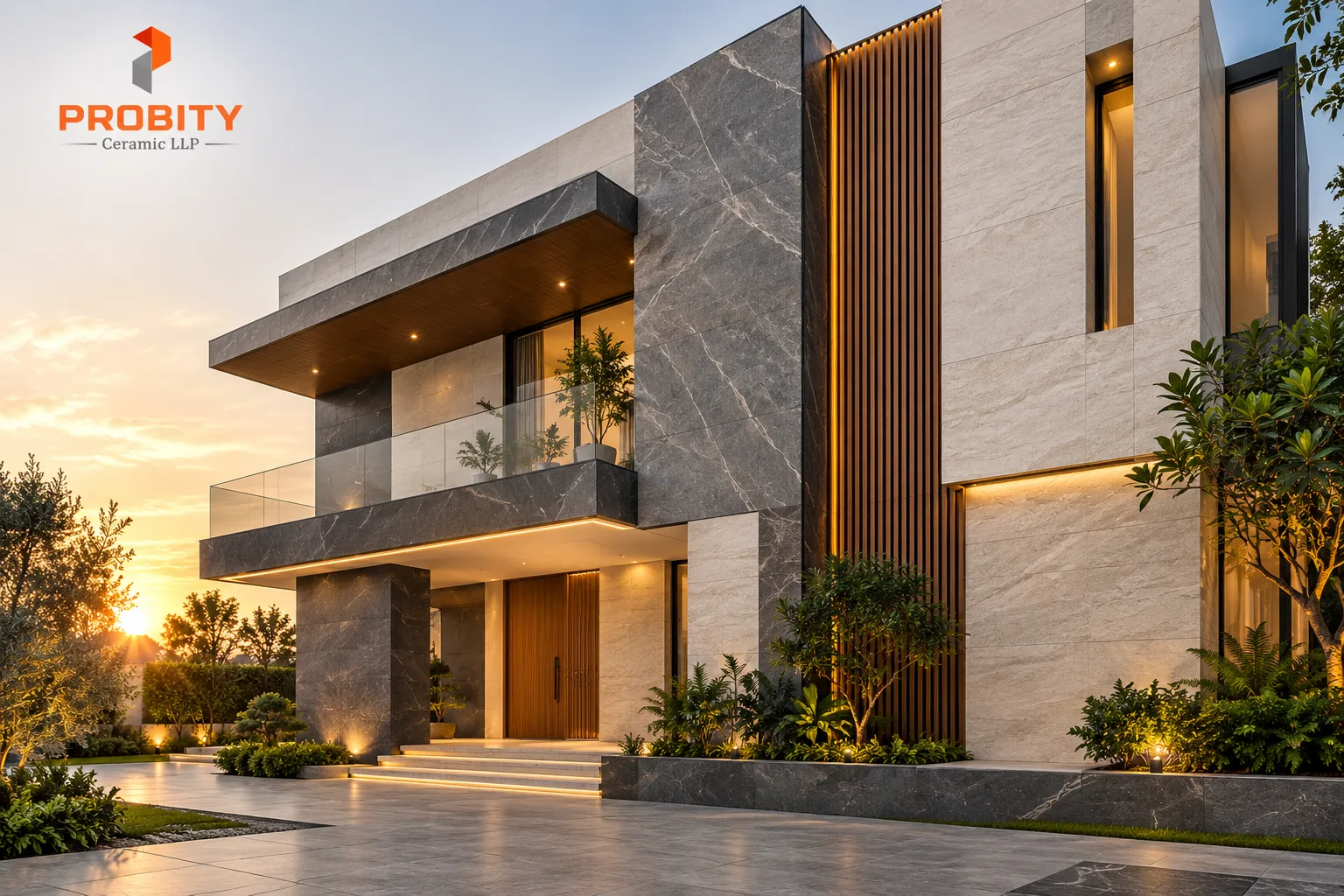
Elevation Tiles for Modern House Exteriors
Every interior finish in a house gets a second chance. A wall colour that looks wrong can be repainted in a weekend. The front facade does not get that forgiveness. It faces direct sun, monsoon rain, dust and temperature swings every single day, and it is also the first thing anyone sees before they step inside. A finish that fades, stains or cracks within a few years is not just a maintenance problem - it is a visible, permanent mark on the building.Elevation tiles exist to solve exactly this problem. Rather than painted plaster or textured cement finishes that need repainting and resealing every few years, a tiled facade is fixed once and, when specified correctly, holds its colour and texture for well over a decade with only routine cleaning.The difficulty is that “elevation tile” is a broad label covering several different tile bodies, sizes and finishes, not all of which are suitable for an open, unsheltered exterior wall. A tile that performs perfectly on an interior feature wall can fail within two monsoons if it is fixed outside without the right water absorption and frost or thermal-cycling performance.This guide sets out what elevation tiles actually are, which body type belongs on which part of a house, how to plan and specify a facade, and how to source, ship and install the tiles correctly.1. What Are Elevation Tiles?Elevation tiles are tiles designed specifically for the exterior vertical surfaces of a building - the front facade, boundary and compound walls, entrance columns, gate pillars, balcony cladding and outer staircases. They are fixed to the structural wall using tile adhesive and grout, in the same general way as an interior wall tile, but the tile itself is engineered to withstand continuous weather exposure rather than a sheltered indoor environment.The category sits apart from ordinary ceramic wall tiles for two reasons. First, elevation tiles are produced with lower water absorption and better weather resistance so they do not crack or discolour when rained on directly. Second, they are supplied in sizes, finishes and surface textures - stone-look, wood-look, brick-look and high-depth 3D patterns - developed specifically for facade design rather than bathroom or kitchen walls.Not every wall tile is an elevation tile, and this distinction matters more outdoors than almost anywhere else in a building.2. Why Elevation Tiles Have Replaced Paint and Textured PlasterColour permanence - digitally printed tile colour does not fade the way exterior paint does under UV exposure.No repainting cycle - a correctly specified tiled facade typically needs only cleaning, not repainting every few years.Weather resistance - low water absorption bodies resist the staining and surface breakdown that textured plaster can show after repeated monsoons.Design range - stone-look, wood-look, brick-look and 3D textured finishes are difficult or expensive to achieve convincingly in paint or plaster.Repairability - tiles are modular; a damaged piece can be replaced without redoing the whole wall, unlike a patched paint or plaster repair that is often visible.Long-term value - a well-installed facade can hold its appearance for fifteen to twenty years with only basic cleaning, which changes the lifetime cost comparison against repeated repainting.None of this removes the need to choose the right tile body for an open, unsheltered wall. The wrong specification simply moves the maintenance problem from paint to tile.3. Ceramic vs GVT vs Full Body Porcelain for Exterior WallsCeramic elevation tilesCeramic is the traditional and most widely available elevation tile body. It is lightweight, easy to cut on site, and available in a wide range of stone-look, brick-look and textured finishes. Ceramic bodies generally have higher water absorption than porcelain, so they suit partially sheltered walls - under overhangs, porches and covered verandahs - better than fully open, unsheltered facades.GVT (glazed vitrified tile) elevation tilesGVT elevation tiles use a denser, vitrified body with very low water absorption, commonly cited in the market at well under 0.5%. This makes GVT the standard choice for open exterior walls that take direct rain and sun with no overhead shelter - the full front facade, boundary walls and gate pillars.Full body porcelainFull body porcelain carries colour through the entire thickness of the tile, not just the surface layer, so a chip or edge knock is far less visible. This makes it a strong choice for high-traffic exterior areas such as gate pillars, boundary wall corners and steps, where minor impact damage is more likely.As a simple rule: if the wall is ever going to be hit directly by rain with no roof or overhang above it, specify GVT or full body porcelain, not standard ceramic.4. Sizes and Formats Used on Modern Facades300×450 mm (12×18 inch) - a widely used elevation size, suited to stone-look and high-depth textured panels.300×600 mm (12×24 inch) - the most commonly specified elevation format, offering a larger, more contemporary panel with fewer joints than smaller sizes.600×600 mm - used for larger stone-look cladding sections and commercial-scale facades.200×1200 mm (8×48 inch) plank format - the standard size for wood-look elevation tiles, imitating timber planking across entrance columns or feature panels.These sizes are wall-cladding products, not floor tiles. Confirm with the manufacturer that the specific size and design you want is offered as an elevation product rather than an interior wall tile, since the underlying body and rating can differ even when two tiles look similar in a catalogue photo.5. Finishes and Textures: Matte, Stone-Look, Wood-Look and High DepthMatte and satin finishesMatte finishes are generally preferred for open exterior walls because they do not show water spotting, dust film and weathering as visibly as a high-gloss polished surface does over time.Stone-look texturesDigitally printed stone-look GVT and porcelain tiles reproduce granite, slate and sandstone textures convincingly, from fine-grain beige and ivory tones for residential fronts to darker slate-look panels for commercial entrances.Wood-look plank tilesWood-look elevation tiles in warm oak, walnut or teak tones hold their colour and grain pattern through repeated monsoon exposure in a way painted or natural timber cladding cannot. They are commonly used on entrance columns or as an accent strip against a plainer main wall.High-depth and 3D textured tilesHigh-depth tiles carry a surface relief of roughly 2.5–5 mm, creating a tactile stone or brick texture with genuine shadow play as sunlight angles change through the day. These are typically used as feature panels - gate columns, the wall flanking the main entrance, or a defined section of the compound wall - rather than across an entire facade.Brick-look finishesBrick-finish cladding tiles reproduce the look of exposed brick architecture without the structural and weatherproofing complexity of real exposed brickwork, and work well as a feature panel against a smoother main wall.6. Where Elevation Tiles Are Used on a HouseFront facade - the primary wall the design is built around, usually GVT or full body porcelain for full weather exposure.Boundary and compound walls - GVT or full body porcelain for durability against impact and continuous weather exposure.Entrance columns and gate pillars - a common location for wood-look plank tiles or high-depth 3D textures as a feature element.Balcony and staircase cladding - exterior-rated tiles used on balcony fronts and outer staircases exposed to weather.Covered porches and verandahs - sheltered areas where ceramic elevation tiles can be used successfully.Feature panels - a defined section - around the main door, a column, or part of the compound wall - where a bolder texture or wood-look finish is used against a plainer main cladding.7. Design Ideas for Modern House ExteriorsStone-look base with a wood-look accent column - grey or beige stone-textured cladding across the main facade, with a warm wood-look plank column flanking the entrance.High-depth feature wall at the entrance - a textured 3D panel behind the main door, framed by plain matte cladding on either side.Dark slate-look boundary wall with a lighter main house facade - creates visual contrast between the compound wall and the house itself.Full-height wood-look plank cladding on a single volume - used on one architectural block of a multi-level house to break up a large plain facade.Brick-look accent panel beside a smooth stone-look wall - combines two textures for a contemporary, layered facade without cladding the entire house in one pattern.Matte charcoal or graphite tone gate pillars - a strong, modern entrance statement that contrasts with a lighter-toned main facade.A general design principle worth keeping in mind: reserve high-depth 3D textures and bold patterns for defined feature panels rather than the entire facade, and let a calmer stone-look or matte tone carry the majority of the wall area.8. Technical Properties to Check Before You SpecifyWater absorption - GVT elevation tiles typically show water absorption well under 0.5%, which is the key property for open, unsheltered walls.Breaking strength - relevant wherever the wall may be knocked - boundary walls, gate pillars and lower sections of a facade.Frost and thermal-cycling resistance - confirm this for any destination market with freezing winters; it is less relevant to consistently warm climates but essential elsewhere.Slip resistance - applies to any horizontal surface finished with the same or a matching tile, such as an entrance step or porch floor.UV and colour stability - digitally printed exterior tiles should be tested for resistance to fading under prolonged direct sun exposure.Surface finish - matte or textured finishes generally weather better visually than high-gloss polished finishes on an open wall.Ask the manufacturer for the technical data sheet for the exact product, not a general category description, before finalising a specification.9. Planning the Facade Before You OrderMeasure every elevation separately - front, side and rear walls, boundary walls, columns and any recessed or projecting sections.Identify sheltered vs open areas - decide where ceramic is acceptable and where GVT or full body porcelain is required.Mark feature zones - decide where a bolder texture, wood-look plank or 3D panel will sit, and where the calmer base cladding will run.Account for openings - windows, doors, meter boxes, drainpipes and light fittings all affect cutting and layout.Decide joint width and grout colour - these affect how visually continuous the facade will look, particularly with large-format panels.Share a layout drawing with the supplier - this lets the manufacturer confirm quantities, including wastage allowance, for each tile type and finish.A facade with several finishes - base cladding, feature panels, plank accents - is essentially several small orders that must be planned together so quantities, batches and delivery timing align.10. What to Specify Before Requesting a QuotationProduct specificationTile body: ceramic, GVT or full body porcelain, matched to sheltered or open wall use.Size and format for each area of the facade.Finish and texture: matte, stone-look, wood-look, brick-look or high depth.Water absorption and any frost/thermal-cycling requirement for the destination climate.Edge type and recommended joint width.Commercial specificationTotal quantity by tile type, including a wastage allowance for cutting around openings.Requirement that each tile type comes from a single production run to avoid shade variation across the facade.Packing method suited to tile size and site handling conditions.Destination country and port, and preferred Incoterm.Standard or private-label packaging.Trial order or a recurring supply programme for multi-unit or repeat projects.A facade specification that separates each wall area, finish and quantity lets the manufacturer quote accurately and confirm true availability rather than a generic estimate.11. Samples and Quality ChecksRequest full-size samples, not swatches - stone-look and high-depth textures read very differently at full tile size compared with a small cut sample.View samples outdoors, in daylight - indoor showroom lighting does not represent how a matte or textured finish will look on an actual facade.Check shade consistency across the batch - particularly important for large facade areas using a single tile type.Confirm texture depth for high-depth tiles - relief depth affects both appearance and how dirt and water sit on the surface.Ask for the technical data sheet - water absorption, breaking strength and, where relevant, frost resistance for the specific product.Check size and squareness - particularly for larger formats where small deviations become visible once installed.For larger residential or multi-unit projects, consider a pre-shipment inspection before the full order is dispatched.12. Packing and Shipping Considerations for Exterior TilesElevation tiles are generally lighter than large-format slabs but still require careful packing, since chipped edges and corners are visible on an installed facade in a way they are not on an interior floor.Edge and corner protection - essential for high-depth and textured tiles, where surface relief is more vulnerable to chipping in transit.Batch labelling - keep each finish and production batch clearly identified, especially where a facade uses several tile types.Container planning - confirm weight and volume against the container plan before production, particularly for large multi-finish orders.Site handling - confirm what equipment is available at the destination to unload and move cartons or pallets safely.Probity’s current porcelain-tile page states that it uses export-standard packaging with wooden pallets, corner protectors and shrink wrapping, and that its export team assists with container planning, customs paperwork and freight coordination. Confirm the specific packing method for the elevation tile sizes and textures in your order.Probity also states a general production lead time of 15–20 days for its porcelain tiles from order confirmation and deposit receipt, depending on design availability. For a multi-finish facade order, confirm lead time and batch alignment across all tile types before committing to an installation schedule.13. Installation and Fixing MethodsSubstrate preparation - the wall must be structurally sound, clean and properly cured before fixing begins.Exterior-grade adhesive - use a weatherproof, flexible tile adhesive rated for exterior use, not a standard interior-grade product.Grout selection - use exterior-rated, weather-resistant grout, and consider a shade that will not show staining as visibly over time.Movement joints - provide expansion and movement joints as required, since exterior walls experience greater temperature swings than interior surfaces.Sequencing feature panels - install and check feature textures such as high-depth or wood-look panels against a dry layout before fixing, to confirm the pattern and joint alignment.Weather timing - avoid fixing tiles during or immediately before heavy rain, and allow adhesive to cure fully before the wall is exposed to weather.Experienced installers - exterior cladding, particularly with large formats or textured panels, benefits from installers experienced specifically in facade work rather than only interior tiling.14. Common Mistakes Buyers and Builders MakeUsing a standard ceramic interior wall tile on an open, unsheltered facade.Assuming every tile in a stone-look or wood-look catalogue range is rated for exterior use.Ordering different sections of a facade from separate production batches without checking shade consistency.Applying high-depth or bold textured tile across an entire facade instead of using it as a feature panel.Using interior-grade adhesive and grout on an exterior wall.Skipping movement joints on a large facade area.Not confirming frost or thermal-cycling performance for climates with cold winters.Approving a design from a small printed swatch rather than a full-size outdoor sample.Underestimating wastage from cutting around windows, doors and fittings.Fixing tiles just before the onset of heavy rain, without allowing the adhesive to cure.15. Why Morbi Supplies Elevation Tiles at ScaleMorbi’s ceramic cluster produces elevation tiles across ceramic, GVT and full body porcelain categories at significant scale, supported by an ecosystem of raw material suppliers, digital printing technology, packaging and export logistics operating in one region. This concentration has allowed a wide range of stone-look, wood-look, brick-look and high-depth textures to be developed specifically for facade use, alongside the flooring and interior wall categories the region is traditionally known for.As with any sourcing decision, capability varies between manufacturers. Confirm that the specific factory you are working with manufactures dedicated elevation-rated products, rather than offering an interior wall tile as a general-purpose substitute.16. Working with Probity Ceramic LLPProbity Ceramic LLP is a Morbi-based ceramic and porcelain tile manufacturer and exporter. Its website states that its journey began in 2008 in the ceramic industry and that the business was restructured as Probity Ceramic LLP in 2021. It also states annual production capacity of 4,000,000+ square metres and identifies SACMI pressing systems and System digital inkjet printers within its manufacturing infrastructure.Its published product and export offering includes porcelain tiles, ceramic wall tiles, vitrified tiles, outdoor and parking tiles, porcelain slabs and kitchen tops, mosaic tiles and quartz surfaces. The company also states that it supports private-label packaging, export-standard packaging, samples, container planning, documentation and freight coordination.Probity’s website currently lists export activity across markets including Germany, Poland, Hungary, Slovakia, Slovenia, Czechia, Romania, Spain, Italy, Kenya, Somalia, Mauritius, the USA, UK, Canada, Russia and Ukraine. Destination-specific requirements should be confirmed for each order.Because facade orders typically combine several tile bodies, sizes and finishes, the most useful first enquiry includes:The destination market, climate and port.Which wall areas are sheltered and which are fully open to weather.Preferred sizes and finishes for the base cladding and any feature panels.A layout drawing or reference images, where available.Estimated quantity by tile type, including a wastage allowance.Packaging needs, including private-label requirements.Ask the export team to confirm which of Probity’s ranges are rated for open exterior use, and which sizes and finishes are currently available as elevation products, before finalising a specification.17. Frequently Asked QuestionsWhat are elevation tiles?Elevation tiles are tiles designed for the exterior vertical surfaces of a building - the front facade, boundary walls, entrance columns and outer staircases - engineered to withstand continuous weather exposure rather than sheltered indoor use.What is the difference between ceramic and GVT elevation tiles?Ceramic has higher water absorption and suits partially sheltered walls, such as areas under an overhang. GVT has much lower water absorption, typically well under 0.5%, and is the standard choice for open exterior walls exposed directly to rain and sun.Can I use ordinary wall tiles on my house exterior?Only if the wall is fully sheltered from rain, such as under a covered porch. Standard interior ceramic wall tiles are generally not suitable for open, unsheltered exterior walls.What sizes are commonly used for elevation tiles?300×450 mm and 300×600 mm are the most common elevation sizes, with 600×600 mm used for larger cladding areas and 200×1200 mm plank formats used for wood-look designs.Are wood-look elevation tiles durable outdoors?Yes, when specified in an exterior-rated GVT or porcelain body. Unlike painted or natural timber, digitally printed wood-look tile holds its colour and grain pattern through repeated weather exposure.What is a high-depth elevation tile?A high-depth tile has a surface relief of roughly 2.5 to 5 mm, creating a tactile stone or brick texture with visible shadow play as sunlight changes through the day. These are typically used as feature panels rather than across an entire facade.Should elevation tiles be matte or glossy?Matte and satin finishes are generally preferred for open exterior walls, since they show water spotting, dust film and weathering less visibly over time than a high-gloss polished surface.Do elevation tiles need special adhesive and grout?Yes. Exterior walls require weatherproof, flexible, exterior-rated adhesive and grout, not standard interior-grade products, along with appropriate movement joints.How long does a tiled facade last?A well-specified and correctly installed elevation tile facade can commonly hold its appearance for fifteen to twenty years with routine cleaning, though this depends on the tile, climate and installation quality.Can I mix different tile finishes on one facade?Yes, and it is a common design approach - for example, a stone-look base cladding with a wood-look accent column or a high-depth feature panel at the entrance. Plan quantities and batches for each finish together.What should I check before ordering elevation tiles for export?Confirm the tile body (ceramic, GVT or full body porcelain), water absorption, frost or thermal-cycling performance for your climate, size, finish, and that quantities for each wall area come from a consistent production batch.Can Probity Ceramic LLP supply elevation tiles for a full facade project?Probity lists outdoor and parking tiles, porcelain tiles and ceramic wall tiles among its export products. Since facade orders often combine several bodies and finishes, share your wall-by-wall requirement with the export team and ask them to confirm which products are rated for open exterior use.18. Conclusion and Next StepsA tiled facade is one of the few exterior finishes that can genuinely be fixed once and left largely alone for over a decade - but only when the tile body is matched correctly to how exposed each wall actually is. Ceramic for sheltered areas, GVT or full body porcelain for open walls, matte finishes for long-term appearance, and feature textures used deliberately rather than everywhere, are the decisions that separate a facade that ages well from one that needs early repair.Start by mapping every wall area and its weather exposure. Choose the tile body before the tile design. Approve full-size samples outdoors. Plan quantities and batches together across the whole facade. Use exterior-rated adhesive and grout, and confirm installation with contractors experienced in facade work.For importers, distributors, architects and builders looking for an Indian manufacturing partner, Probity Ceramic LLP offers direct sourcing from Morbi, with porcelain, ceramic and outdoor tile ranges, private-label support, export packaging and assistance with container planning and shipping.